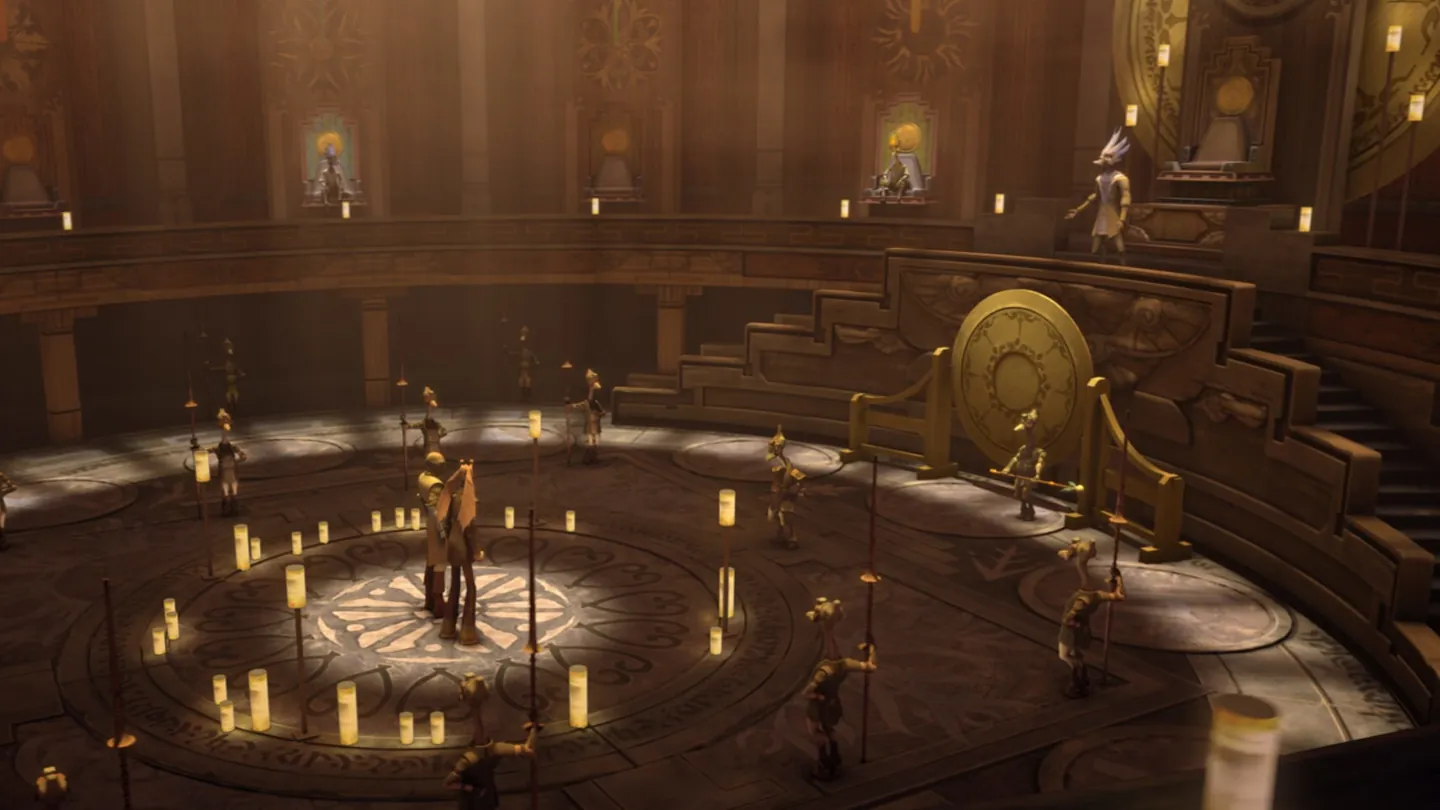
A spiritual center, not a Jedi outpost
The Dagoyan Temple on Bardotta was an important center of the planet's own Force-sensitive religious tradition. Its Masters were mystics valued for their connection to the Force and their ability to receive visions. The official episode records describe them as practicing a receptive form of spiritual attention rather than following the Jedi Order's practices of recruiting and training young members. The temple therefore belonged to an independent cultural institution.
The surviving imagery depicts the temple's exterior, dignitaries and council activities, but it does not provide a measured plan of every chamber or mountain path. The scene navigator links to documented leaders and institutions rather than placing artificial pins at unsupported positions around a cinematic temple panorama.
Why the Bardottans distrusted the Jedi
The Bardottan suspicion of the Jedi had roots in the Order's previous efforts to recruit Force-sensitive children from the planet. Some Bardottans regarded those inductions as taking their children away and came to identify the Jedi with loss rather than protection. This historical account shaped how Queen Julia and her government responded when the Masters disappeared. They wanted help but opposed a mission directed by the Jedi Order.
The dispute cannot be reduced to a single villainous side. The Jedi understood recruitment as a long-established part of their institution, while Bardottan leaders judged the practice in light of their own authority and family relationships. The episode makes the conflict directly relevant when Mace Windu arrives uninvited. An accurate archive preserves the competing institutional perspectives rather than pretending the disagreement never existed.
The Queen's unusual request
Queen Julia contacted Supreme Chancellor Palpatine's government after several Dagoyan Masters vanished. Rather than accept a routine Senate delegation or a Jedi task force, she specifically asked for Jar Jar Binks, a trusted friend with whom she had a personal relationship. Jar Jar was not being selected because he held Jedi rank or commanded a military detachment. His established trust provided a practical route for seeking information in a community distrustful of outsiders.
The Republic agreed to send him but also arranged for Mace Windu to accompany the mission. Julia did not welcome that addition. The difference between requesting help and consent to every form of outside intervention was therefore central from the beginning. The archive treats the diplomatic reception as a documented event, not a generic welcoming ceremony invented for the image.
A council struggling with a prophecy
After the Queen was also abducted, members of Bardotta's Bahk-tov Council met to discuss a Frangawl prophecy that warned of darkness if the missing monarch was not returned. High Seneschal Peteen provided information about the threat but remained wary of the Jedi visitor. The council's concern reflected both the disappearance of recognized religious leaders and the danger to the planet's political legitimacy.
Jar Jar helped Mace communicate when a direct speech from the Jedi was rejected. This unusual process showed that a community's preferred representative could matter even in an emergency. The official gallery documents the meeting and its participants but does not supply a permanent membership roll or a full civic constitution. The interactive topics open the specific records rather than inventing additional ministries or offices.
The temple holds a hidden history
The investigation revealed that a Frangawl shrine existed deep beneath the Dagoyan Temple. According to the Bardottan authorities, the site was taboo and associated with an ancient cult that worshipped a dark figure called Malmourral. The existence of this concealed space did not mean the entire Dagoyan tradition was a Frangawl institution. The public temple and the secret cult represented different communities and uses of the same broader site.
This distinction is a central design choice. A visitor selecting the temple scene sees links to recognized Dagoyan practice and the Queen's government. Selecting the secret shrine opens a separate investigation of abductions and illicit ritual activity rather than making every worshipper or council member an accomplice.
What the documentary record establishes
Bardotta's official Databank, Queen Julia and Peteen profiles, and the two Disappeared episode guides establish the temple, council meeting, political dispute and disappearance of the Masters. They do not establish exact interior geometry, total numbers of clergy or precise routes through the mountainous city. The location's scenes therefore use contextual labels directly on the picture at iPhone sizes without presenting an illustrated shot as an authoritative survey.
The connected Frangawl Shrine page investigates the cult and the Queen's abduction. The offworld sacrificial ceremony on Zardossa Stix remains explicitly separate from Bardotta. This avoids a particularly misleading reconstruction that would place every event from both episodes beneath the same physical temple.