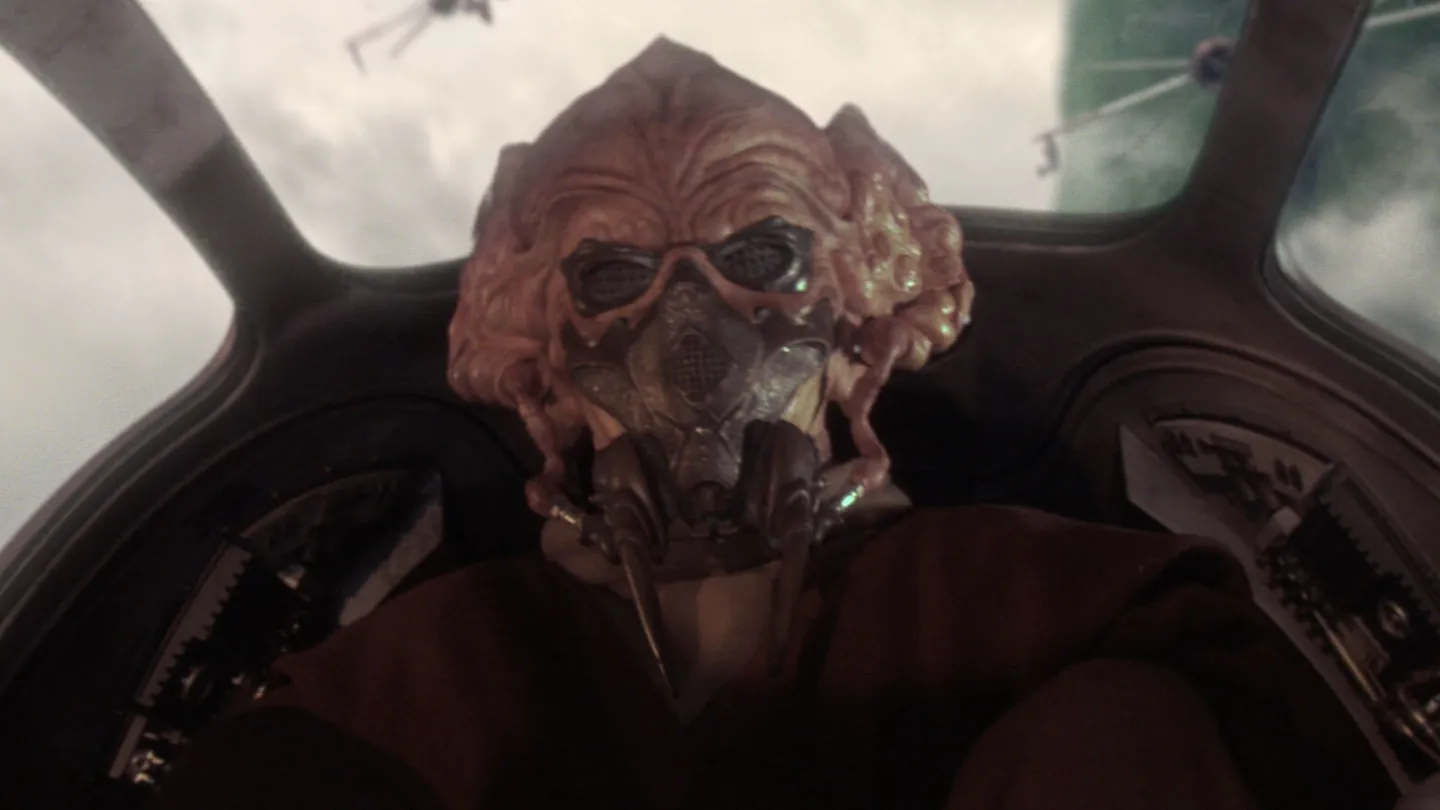
An air battle above a colony world
The final flight of Plo Koon took place over Cato Neimoidia during the Clone Wars' last military campaigns. The official biography identifies him as a Jedi Council member and a skilled pilot who led a starfighter squadron against Separatist forces. The setting was a world whose wealthy Neimoidian bridge-cities rose above canyons. The film presents a brief airborne sequence rather than a long geographical tour, and no source names a particular flight corridor as an official destination. This page investigates a documented event in the planet's airspace without inventing a military base, numbered approach route or crash-site coordinate.
Plo Koon's participation in the war also matters to the meaning of what happened next. He was deeply concerned about the lives of his clone troops, and official biographies describe the close relationships formed with soldiers who served under him elsewhere. The events over Cato Neimoidia brought that relationship into direct conflict with an order from the Republic executive. An investigation anchored in the pilot's experience can explain the betrayal while leaving the exact layout of bridges and nearby streets unspecified.
The Jedi starfighter
The Delta-7 is a compact Jedi starfighter designed for pilots whose reflexes were aided by the Force. Its Databank entry identifies Plo Koon as flying this kind of ship above Cato Neimoidia when Order 66 was issued. This gives the aircraft a direct connection to the incident instead of treating it as generic visual decoration. The gallery allows a visitor to inspect the design of the craft and to connect it with the wider history of Republic-era Jedi aviation. It does not imply that every Delta-7 image was recorded during this particular sortie.
A fighter's purpose is not the same as the society beneath it. The elevated cities and luxurious palaces below were parts of a settled world with Neimoidian commercial institutions. The official record does not describe how people inside those places experienced the attack, or identify the exact structure struck by the wreckage. The airspace investigation avoids claims about a named civilian district that cannot be checked against the film or Databank.
Order 66 in flight
Supreme Chancellor Palpatine sent Order 66 to Republic clone forces operating in different regions of the galaxy. On Cato Neimoidia, Plo Koon's clone wingmen responded by attacking their own Jedi leader. According to the official Databank, they shot his starfighter out of the sky, killing him. This is a specific documented act, not merely a generalized statement that many Jedi died. The scene controls preserve the order of events: an ongoing military flight, transmission of the command, and immediate betrayal by wingmen who had been part of the Republic squadron.
The location should not be confused with Mygeeto, where Bacara's troops killed Ki-Adi-Mundi on the ground, or with Saleucami, where clone troopers attacked Stass Allie while riding speeders. These are parallel results of the same command, not a single shared battle. The connection between planet files is political and chronological. The distinction lets a reader compare institutional obedience across different vehicles, landscapes and command structures without making up a continuous route between the incidents.
Obedience and the command network
Plo Koon belonged to a Jedi institution whose commanders had become integrated into the Republic's war effort. His support for clone soldiers and his active command role were part of the established history. Order 66 exploited that arrangement by turning the chain of command against the Jedi. The rapid reversal offers a way to investigate the consequences of centralized authority: the soldiers kept their aircraft and uniforms, but their instructions changed who counted as an enemy. The analysis follows the official event and avoids speculative details about individual pilots' private motivations.
This distinction is particularly important when describing soldiers. Official accounts clearly identify the attacking wingmen as clones following the order. The archive does not invent conversations among them, assign unverified unit numbers or imply that every participant spoke the same words. The absence of that detail is a limitation of the available scene, not an invitation to supply fictional eyewitness testimony. The page therefore explains what the film and character record establish, and leaves unnamed characters unnamed.
What happened over the bridge-cities
The planet's famous bridge-cities are essential to the visual identity of the final flight. Their monumental structures illustrate the wealth of Trade Federation elites, but the evidence does not show that Plo Koon was protecting a particular palace or attacking a named building in this moment. The airspace scene uses the built landscape as its context rather than as a collection of invented targets. Readers interested in Neimoidian civic life can follow the separate bridge-city investigation, where documented hospitality, status competition and social hierarchy receive more attention.
The final flight is thus treated as a location-specific episode, not an excuse to add false geography. An image of Plo Koon supports his identity, an image of a Delta-7 supports the craft type, and the official world image supports the presence of bridge-cities. None alone establishes a precise trajectory. Presenting those distinct forms of evidence side by side is more accurate than positioning a clickable dot on an arbitrary tower.
Evidence and visual presentation
The visual archive uses official Databank images and source links for the Jedi, ship and planet. Captions identify a portrait or vehicle as reference evidence rather than promising that it is a frame from the exact instant of Order 66. Visitors can switch between the flight, the ship and the political context without treating them as continuous photographs of a single place. The investigation buttons appear on the image on desktop and phone; they address specific subjects instead of displaying unsupported spatial markers.
A browser visit should make the core fact simple to verify: the Cato Neimoidia Databank names its bridge-cities, and the Plo Koon and Delta-7 entries describe the betrayal above the world. The account retains those links beside the narrative. More detailed flight paths, named bridges and crash coordinates would require new primary evidence. Until then, this page describes what can actually be supported and gives readers paths to the broader canon context.