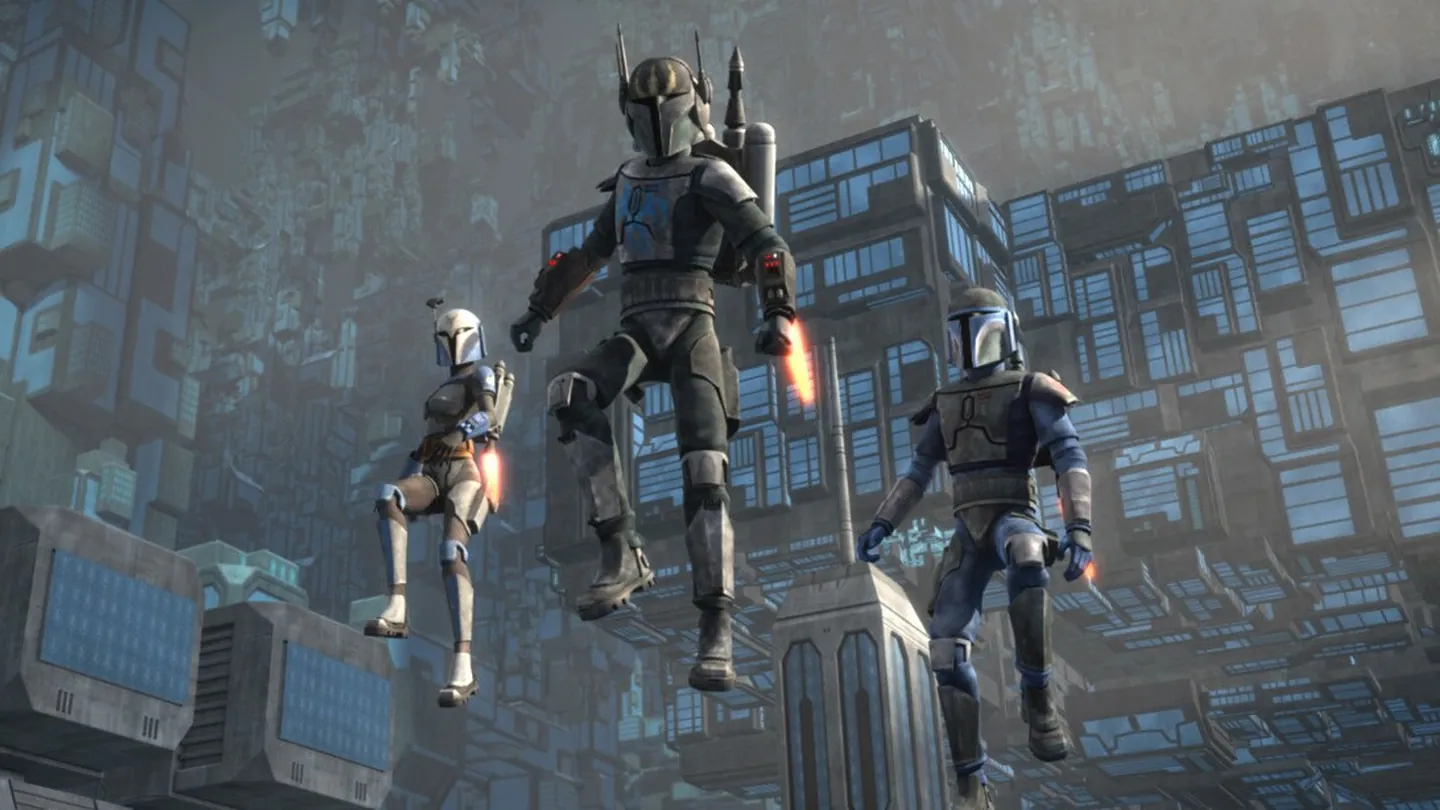
The hidden arsenal beneath a mining moon
During his investigation of violence attributed to Death Watch, Obi-Wan Kenobi traveled to Concordia and uncovered an arsenal in an abandoned mine. Official Death Watch and Pre Vizsla records connect the location to a larger movement seeking to overthrow Duchess Satine's pacifist government. The fact that the facility was a former mine matters because it provided a concealed, usable interior within a recognized industrial landscape. The source establishes the place type and its military use, but not a detailed route through every tunnel or chamber.
This location page treats the arsenal as a documented secret base rather than a newly invented fortress. The imagery includes Death Watch warriors, equipment and related people from official sources. When an image shows a vehicle or armor, it supplies subject evidence rather than proof that the exact object occupied a particular position inside the abandoned mine.
Obi-Wan follows the evidence
Obi-Wan's inquiry began with evidence of Death Watch attacks and a suspected buildup of armed forces. On Concordia, he was ambushed and eventually found the hidden arsenal. Death Watch warriors captured him, confirming that the threat was more substantial than the public reassurances offered by the governor. His visit connected separate acts of violence on Mandalore with a concealed source of organization and military supplies on the moon.
The incident supplies a clear investigative sequence. It does not provide a reliable map of Obi-Wan's entire walking route from a settlement to the mine. A contextual control can connect the investigator to the hidden facility without pretending that a dot on a scenic mountain still marks the doorway he used. Visitors can examine the reported discovery and the identified participants in the archive's source links.
Vizsla's public and covert identities
Pre Vizsla occupied the office of governor while secretly directing the faction uncovered in the mine. He also maintained a relationship with Count Dooku and the Separatists, hoping outside support would help restore militant Mandalorian rule. The official material describes how Death Watch's goals diverged from Satine's politics. The arsenal therefore functioned within a project of political overthrow rather than ordinary law enforcement or conventional mining security.
His public authority should not be treated as evidence that every Concordian official participated in the conspiracy. The record describes the governor and his faction, not a roster of every employee or resident. Likewise, an image of Count Dooku is a record of a broader alliance, not proof that Dooku personally visited each mine. The gallery explicitly distinguishes these contextual relationships.
The Darksaber and the confrontation
When Vizsla confronted Obi-Wan, he wielded the Darksaber, a distinctive black-bladed weapon with deep importance in Mandalorian political history. The official account of the encounter places it in the conflict over Death Watch's secret activity. Obi-Wan survived their duel, and Vizsla also escaped. This event provides a tangible connection between the armory investigation and the political symbolism of ancient weapons, but it does not establish that every Mandalorian recognized Vizsla's authority.
The Darksaber has its own documented history across different eras. The blade can be shown as a reference to the confrontation without claiming that the same photograph records the actual movement of the two fighters through the mine. Scene switching separates the hidden military activity from the duel and its political stakes.
Gauntlet fighters and armed mobility
Death Watch used Gauntlet fighters as both combat ships and transports for armored soldiers. Official specifications describe their movable wings and the seating arrangement that allowed troops to deploy rapidly by jetpack. These vehicles matter because they connect a hidden local base to the organization's capacity to conduct operations elsewhere. Their presence in Death Watch's arsenal provides a plausible institutional connection to Concordia, while the official description does not identify the exact hangar bay or departure point of every ship.
A picture of a Gauntlet therefore functions as a documented vehicle reference, not an exact photograph of the mine entrance. The ship's dimensions and role can be investigated through the Databank without drawing unsupported trajectories between Concordia, Mandalore and other destinations. Such source discipline makes the immersive navigation credible even when a complete tactical map is unavailable.
A military base within a larger political struggle
The secret Concordia facility was part of a movement that outlasted the first confrontation with Obi-Wan. Death Watch later moved through shifting alliances, including a partnership with Darth Maul, and participated in a successful takeover of Mandalore. Those later events do not mean every action occurred at the abandoned mine. The page follows the Concordia episode and links to the later history only as a separate chronological development.
Mobile visitors can use the image topics to examine the investigator, hidden organization, Darksaber and related vehicles. Each target opens a distinct official source or existing character dossier. Image credits identify whether a gallery picture is a character portrait, weapon reference or related spacecraft. The experience does not claim a complete underground map. Its purpose is to explain the political and military significance of the one documented hidden arsenal.