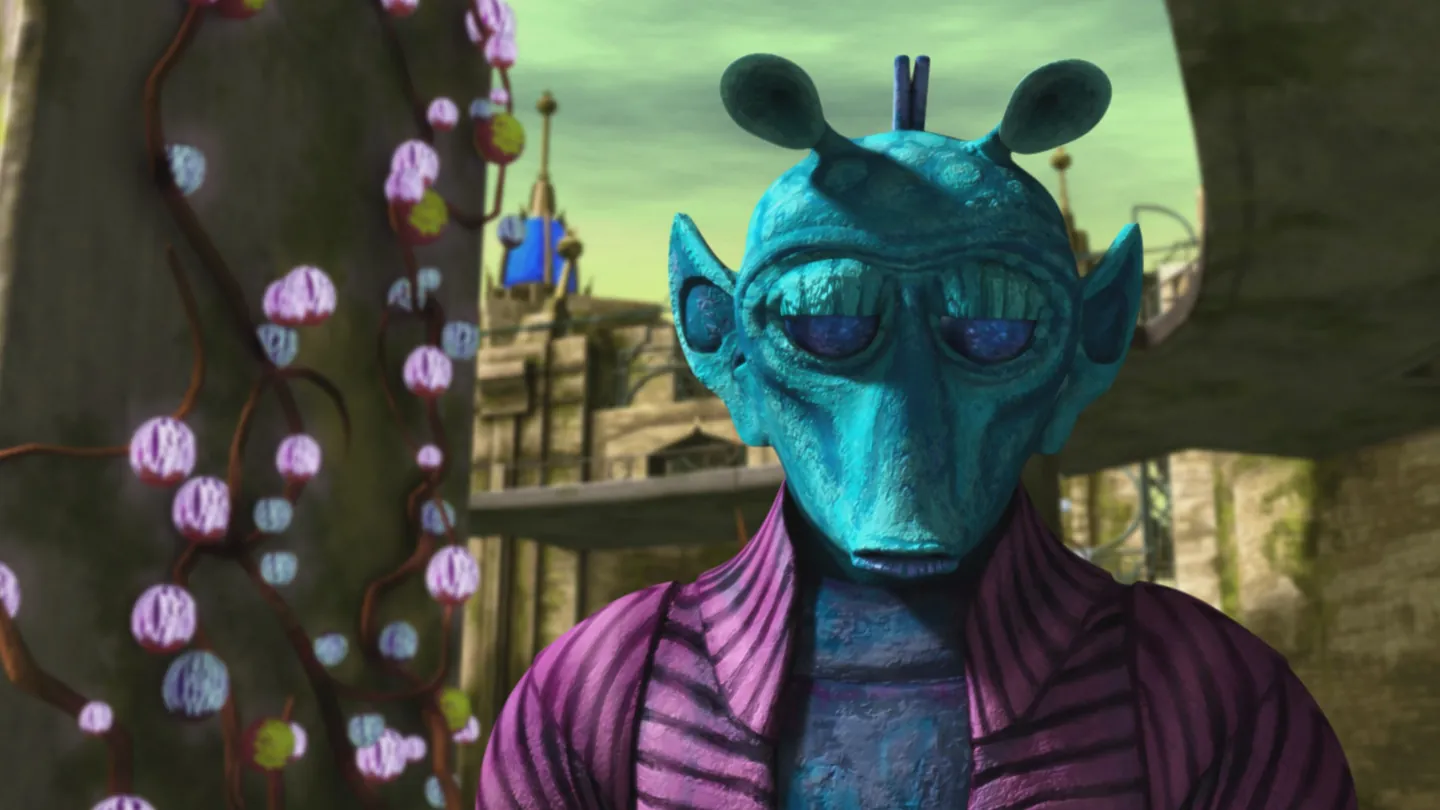
When relief becomes an instrument of power
During the Clone Wars, Rodia's people endured severe shortages. The world Databank records that aid from the Republic was not arriving, and Senator Onaconda Farr sought an alternative source of food and resources. Nute Gunray's Separatist organization offered assistance, but demanded the capture of Padmé Amidala in return. This sequence establishes a political crisis driven by an immediate civilian need, not simply an arbitrary choice by a senator to change allegiances. It also shows why an apparently distant war could alter the options available to a local representative.
The account does not include an itemized aid shipment, a detailed route of convoy travel, or a timetable of deliveries. It is therefore inappropriate to create a fictitious food warehouse or use an on-image point to claim a specific dock where supplies were withheld. The interactive investigation opens with the documented need, bargain and people involved, with the domed city as a separate contextual page.
Onaconda Farr and Padmé Amidala
Farr had known Padmé for many years and considered her a friend. The official profile states that he briefly allied Rodia with the Separatists, then returned to the Republic with her help. Padmé traveled to the planet to dissuade him from placing it under Separatist influence. Their disagreement occurred against a real humanitarian shortage, which made Farr's political decision more complex than a simple personal betrayal. His stated aim was to obtain assistance for his constituents.
The characters' friendship should not be treated as proof that every citizen endorsed Farr's agreement or Padmé's intervention. The Databank records the senator's public role and the particular incident. It says less about internal Rodian debates or local administration. The page thus concentrates on the named participants, their documented decisions and the surrounding crisis, avoiding invented council votes or invented dialogue from unidentified witnesses.
Gunray's changing conditions
Nute Gunray sought revenge against Padmé and attempted to use the supply bargain to capture her. His official character entry describes how he manipulated Farr and then changed the proposed terms: Rodia would only receive the promised food after Padmé was killed. This shift exposed the danger of relying on a hostile political actor to address urgent public needs. The deal was not an impartial trade agreement in which both sides could safely assume compliance.
Gunray's actions also show that the Separatist association was not identical to a voluntary decision by the Rodian population. The Republic's aid failure created vulnerability, while Gunray exploited that vulnerability for a personal and factional goal. The episode records what Gunray attempted; it does not establish that the shipment ever reached all Rodian homes or that every resident knew the terms as they were being negotiated.
Jar Jar and the mistaken Jedi
Jar Jar Binks and C-3PO accompanied Padmé during the mission. After Padmé was imprisoned, Jar Jar disguised himself as a Jedi and became part of an unexpected rescue attempt. The Clone Wars episode guide describes his effort to save his friend from Gunray. This sequence creates a direct connection between Rodia's political emergency and a seemingly improbable rescuer. It is anchored in the episode, not in a newly invented Jedi sanctuary or temple on the planet.
The later confrontation involved a dangerous kwazel maw, a creature from Rodia's local environment. Its presence is a documented feature of the episode, but that does not establish a specific population count for the species or the location of a permanent nesting site in the city's districts. The scene labels focus on the rescue, the creature and the episode's outcome. They do not draw false paths through unidentified buildings.
The political reversal
Padmé escaped, and the efforts of Jar Jar and the other participants contributed to Gunray's capture. Farr recognized the betrayal embedded in the supply agreement and returned Rodia to the Republic's side. Official character material nonetheless notes that some politicians did not forgive his temporary alliance with the Separatists. The crisis therefore had consequences beyond a single rescue: it damaged trust within the Republic and demonstrated how difficult wartime choices could linger in political relationships.
That broader significance should not obscure the ordinary residents who needed food. The episode's specific action focuses on a senator, a diplomat, and a manipulative Separatist leader, not a census of the affected families. The analysis distinguishes what viewers are shown from the wider social implications that can be reasonably discussed. The city page carries the physical environment, while this investigation follows decisions and institutions.
An evidence-led political location
The scene archive combines character portraits, relevant episode imagery and a planet view. Each is labeled according to what it documents. Padmé's portrait identifies her role in the crisis; a photograph of Jar Jar illustrates a named rescuer; a Rodian image shows the homeworld species. None is used as proof of an exact detention-room address. The page does not designate an imaginary senate chamber on Rodia or fabricate a route from a city dome to a creature encounter.
Interactive topics remain directly on the picture on mobile screens, with separate links to the characters, the city context and the official episode guide. The companion domed-city experience presents the material setting and its uncertainty. Together the two pages explain how wartime supply disruption affected the politics of a populated world, while preserving the difference between source-backed events and visual reconstruction.