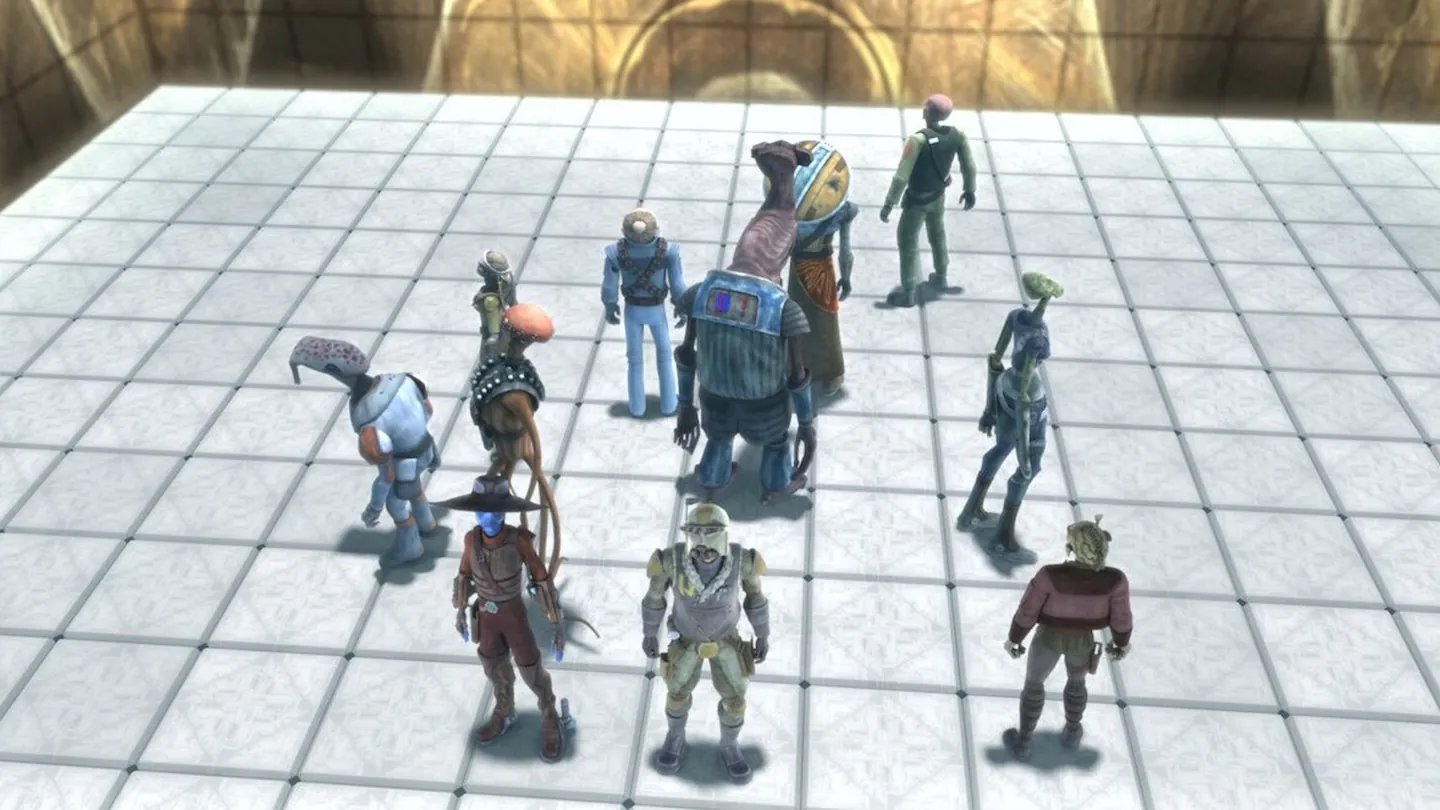
Why the test was constructed
The Box was a purpose-built, lethal simulation facility inside Count Dooku's palace on Serenno. Moralo Eval, a criminal planner entrusted with organizing the venture, designed a sequence of hazards intended to identify bounty hunters suitable for a mission to kidnap Supreme Chancellor Palpatine. The official Databank places the Box deep in the palace. It is not an independently named planet, a stadium in a documented town or a chain of separate facilities across Serenno.
The selection process mattered because the proposed kidnapping required a mixture of physical skill, composure and the ability to act with other highly capable criminals. Dooku hoped to assemble specialists without openly revealing the full plan to the Republic. Testing them under controlled danger was part of that preparation, but the account gives no reason to infer a complete architectural survey of the installation.
Serenno as a controlled operation site
The count's chosen location combined physical isolation with political authority. His cliffside palace was already guarded as an important Separatist base. A hazardous trial staged inside that estate allowed Dooku and Eval to observe participants within their own secure setting rather than handing the exercise to an independent host. This reinforces the distinction between Serenno's aristocratic command center and the Separatist Senate on Raxus.
The Databank does not supply the precise door connecting the Box to the palace. Nor does it tell us which chambers were formerly ordinary residential areas. Visitors can therefore enter the palace investigation for the wider political context and return to this facility to examine the trial without receiving invented architectural directions.
Moralo Eval and the test's rules
Moralo Eval was the driving designer of the Box. The simulation confronted contestants with a succession of dangerous challenges. It was meant to favor the people most likely to remain effective under pressure. The contest had lethal potential, and its hazards cannot be reduced to a standard sporting event. The official material describes it as a brutal selection process for a secret criminal operation rather than a public exhibition approved by the people of Serenno.
Eval's role was not that of an ordinary tournament referee operating in a neutral venue. He was working within Dooku's larger plot. The site's scene topics connect his role, the facility and the operation's political objective, while the gallery uses distinct subject images instead of placing fictional hazards at arbitrary percentages on a palace panorama.
Cad Bane and the surviving hunters
Cad Bane was one of the experienced bounty hunters who emerged from the Box's ordeal. The official record also identifies Embo, Derrown and Twazzi among the survivors. Their professional backgrounds and appearances differed, and passing the trial did not make them agents of a common political cause beyond the paid operation. Dooku and Eval sought useful capabilities, not agreement with a detailed Separatist ideology.
That distinction is important for understanding why the facility was built. The event brought dangerous specialists together through an imposed selection process whose terms were set by its organizers. The Databank identifies the successful contestants but does not publish a complete roster of every defeated entrant with individual biographies and outcomes. The page does not invent those missing records.
Obi-Wan's undercover presence
One contestant was not the bounty hunter he appeared to be. Obi-Wan Kenobi had adopted the identity of Rako Hardeen as part of a Republic undercover mission to investigate the threat against Palpatine. His presence gave the selection a second meaning. Dooku's agents believed they were examining criminals, while the Jedi was attempting to learn enough to frustrate the plan from within.
The undercover operation should not be mistaken for a sign that the Jedi Order ran or endorsed the competition. Its organizers were criminals acting for the Separatist leader, and Obi-Wan was an infiltrator. The Box episode records his participation and the contest's outcome; an image of another hunter is treated as contextual evidence, not a portrait of the disguised Jedi.
From the Box to Naboo
The survivors traveled from Serenno to Naboo, where their mission would involve kidnapping the Supreme Chancellor. That progression marks a change of setting and purpose. The trial's environment was a preparation site on Dooku's homeworld, while the planned abduction concerned a separate Republic political gathering. The archive deliberately avoids drawing a false surface route between those planets or suggesting the Box was a permanent Naboo training installation.
The official Box profile and related episode guide establish the basic sequence. They do not verify every contestant's private motives, detailed payout or the dimensions of each hazard. The three image scenes and their topics examine the design, participants and undercover operation, while source links allow readers to distinguish documented details from interpretation.