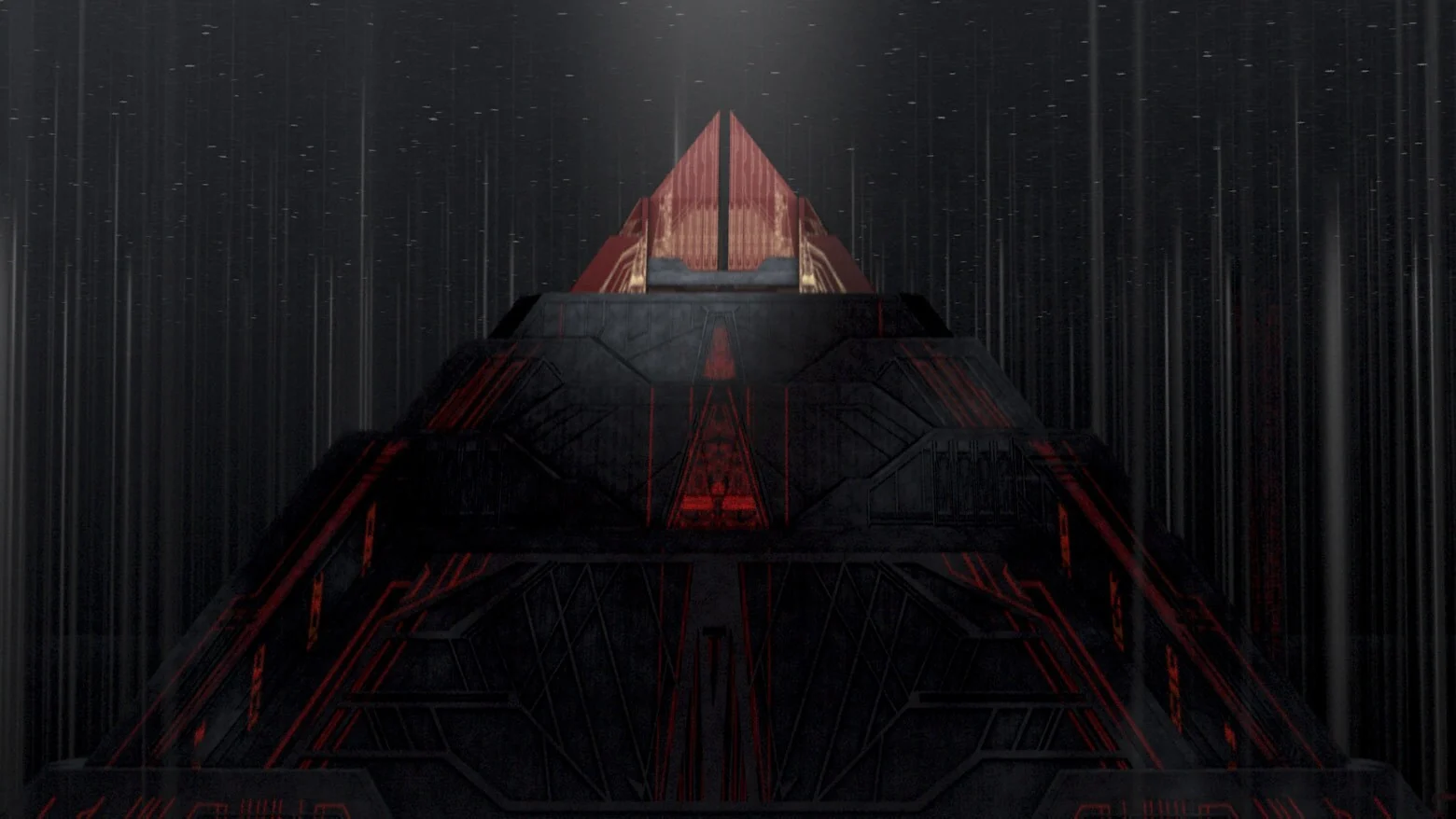
An approach beneath the surface
Ahsoka, Kanan and Ezra arrive on Malachor seeking a way to confront their enemies. Their approach brings them to pillars covered in old writing and then below the surface. The pyramid becomes the central landmark in a vast dark space. The scale creates a contrast between the visitors and the institution whose remains surround them. This is the Malachor depicted in Rebels. The similarly named Malachor V in Knights of the Old Republic II belongs to Legends and carries a different history. The temple investigation does not combine those accounts or borrow the older game’s geography.
Reading the threshold
The writing at the approach signals that the visitors are entering a place with a language and history they cannot immediately master. Ahsoka can recognize only part of the text before Ezra’s actions open the way. The sequence gives the characters a physical threshold and an interpretive problem at once. Seeing an inscription is different from understanding the system it belongs to. The official temple entry establishes the old writing and the entrance event. The trivia gallery discusses the production design’s use of lettering associated with Ralph McQuarrie. Design history adds context without supplying a complete canonical translation of every mark.
Why Maul needs Ezra
The stranger Ezra meets in the ruins presents himself as an old master who can help. Maul has his own reasons to enter the temple and needs another person to proceed. Their cooperation turns the structure into a test of trust as well as ability. Ezra sees a source of knowledge; Maul sees an opportunity to obtain an artifact and influence a potential pupil. The alliance therefore operates under unequal information. The visitor who understands more about the temple can shape how the less experienced visitor interprets its demands. This makes architecture part of the manipulation rather than merely a backdrop to it.
A library object that is also a key
The red, pyramidal holocron is associated with Sith teachings. Its function on Malachor goes beyond storing information. Inserted into the temple’s obelisk, it can activate a destructive weapon. The object therefore connects knowledge, access and force in a single device. A person approaching it only as a source of answers risks participating in a larger mechanism. The official artifact entry identifies the weapon function and the removal of the holocron by Ezra and Kanan. The explorer follows those documented actions rather than inventing an engineering diagram or a complete inventory of the temple’s machinery.
Several conflicts converge
Inquisitors, Maul and the rebels come into conflict within the same complex, and Darth Vader’s arrival raises the stakes further. The episode’s confrontations are not a single duel with a stable set of allies. Maul’s help is conditional and self-serving. Kanan is permanently injured. Ahsoka confronts the former master she knew as Anakin. These personal histories change the meaning of the temple for the people inside it. The setting exposes relationships as well as powers: a teacher trying to protect a pupil, a former apprentice facing her master, and a stranger trying to turn need into dependence.
What leaves the temple
Escaping the immediate danger does not end the artifact’s influence. Ezra later consults the Sith holocron in secret, and Kanan takes it away after discovering his use of it. That later image belongs to events after Malachor; its caption in the gallery identifies it as aftermath rather than a second chamber in the temple. Keeping the scenes separate matters. The journey produces an object that can travel and continue to affect a person’s choices. The temple is therefore both a destination in the episode and the starting point of a continuing struggle over guidance, power and the limits of a pupil’s confidence.