Kanan Jarrus was once Caleb Dume, a Jedi Padawan who survived Order 66 by hiding his abilities and his name. Years of odd jobs and danger made anonymity feel safer than belonging. Meeting Hera Syndulla gave him a partnership, a cause, and a reason to return to the identity he had tried to bury.
Kanan's leadership grows through responsibility rather than certainty. He is an unfinished student who becomes a teacher, a fighter who must learn restraint, and a survivor who eventually allows his past to become a resource for others. His relationship with Ezra makes mentorship a form of family and a form of resistance.
Character in social context
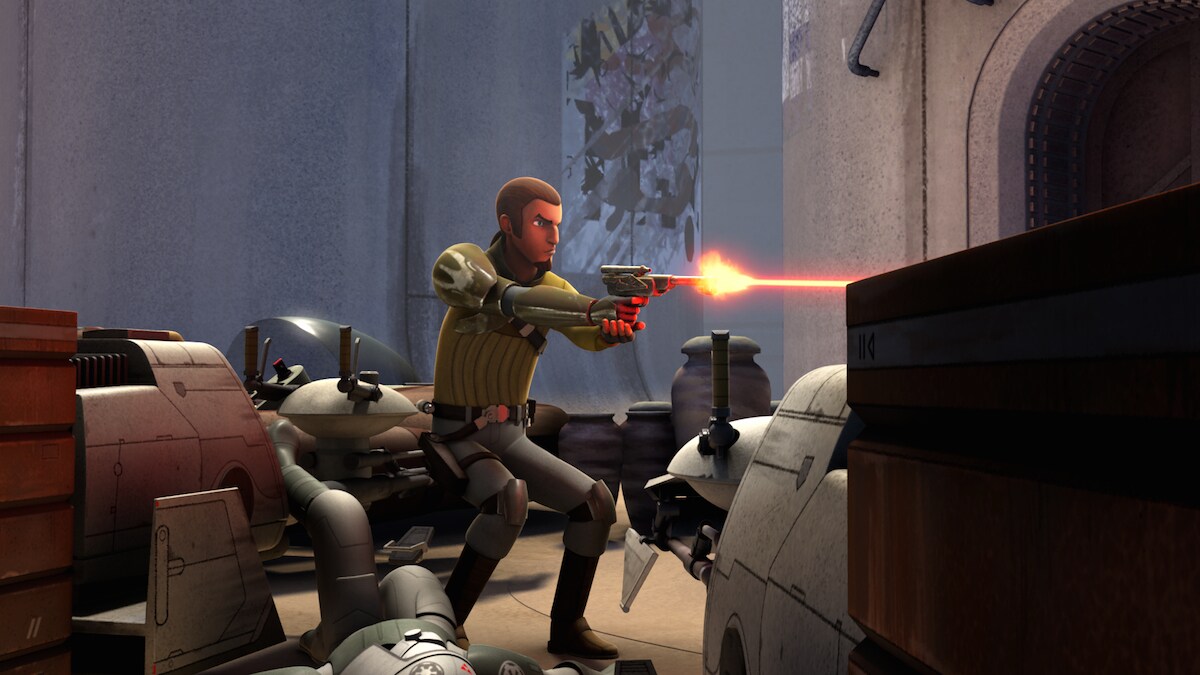
Kanan enters the archive as a survivor of the Jedi purge who has chosen an alias, a blaster, and a life at the edge of formal institutions. The name Caleb Dume connects him to the destroyed Order, while Kanan Jarrus lets him work without exposing every person around him to Imperial surveillance.
When he joins Hera's rebel cell, Kanan becomes part of a social experiment: a crew of different species, histories, and skills trying to act as a household and a political unit at once. His Jedi identity matters, but it is only useful when translated into protection, teaching, and care.

Formation, training, and social position
Caleb's Jedi training is interrupted by Order 66 before he can complete the expected passage from Padawan to Knight. Hiding does not stop his education; it changes its teachers. Work, grief, street knowledge, Hera's trust, and later Ezra's needs all shape the person Kanan becomes.
Training Ezra brings Kanan back into a formal relationship with the Force. He must teach a young person while confronting his own guilt, fear, and unfinished practice. The Jedi Temple's eventual recognition of Kanan as a Knight is important because it confirms a social position he has already begun to enact through responsibility.
Institutions and the distribution of power
The Jedi Order once gave Kanan a language for duty, discipline, and service. The Empire converts that same history into a target list. Kanan's survival exposes the weakness of a system that trained guardians for peace but was unable to protect its own children from a militarized Republic.
The rebel cell does not reproduce the old Order exactly. Kanan's authority is negotiated with Hera, the crew, and the wider Phoenix network. He learns to lead without claiming absolute certainty, and his most important institutional contribution is making another Jedi rather than preserving prestige for himself.

Kinship, community, and belonging
Hera and Kanan build a partnership that is intimate, political, and practical. They share command, risk, and a long-term project of resistance. Their relationship gives the Ghost crew a center without reducing the crew to a conventional family.
Ezra's apprenticeship creates a bond of teaching and chosen kinship. Sabine, Zeb, Chopper, Rex, and the people of Lothal widen Kanan's obligations beyond the Jedi. When he sacrifices himself to save his family, his death is understood through the community he made possible.
Labor, tools, and material culture
Kanan's work includes piloting, scouting, negotiation, combat, teaching, and the constant maintenance of a crew's trust. None of those tasks is separate from leadership. A commander who cannot repair relationships or explain a risk cannot keep a small rebel cell alive.
His blaster is part of the disguise that helped him survive, while his assembled lightsaber marks a Jedi identity rebuilt from fragments. The Ghost, the speeder bike, the Jedi Temple, and the tools of rebel fieldwork show that Kanan's tradition is not abstract. It is made through objects used under pressure.
Body, environment, and representation
Kanan's body is read differently across environments. A hidden man with a blaster can pass as a roughneck; a lightsaber reveals a forbidden history; a blind Jedi who continues to act becomes evidence that perception is not limited to ordinary sight.
Lothal's streets, the Ghost's cockpit, the Jedi Temple, and the battlefields of the Rebellion each call out a different version of Kanan. These places shape what he can teach, whom he can protect, and how much of Caleb Dume can safely be remembered.
Memory, narrative, and historical change
The name Caleb Dume survives through Kanan's choices, Ezra's memory, and the later history of the Rebellion. His life shows how a suppressed identity can return without simply restoring the past. The Jedi legacy is carried through a new household and a different political world.
Kanan's death becomes a shared memory rather than a private tragedy. The crew, Lothal, and Ezra interpret his sacrifice as an instruction about care and release. Historical change does not erase his absence; it makes the community responsible for what it does with his example.
Anthropological assessment
Kanan's central anthropological importance is that he makes mentorship a technology of survival. He passes on knowledge while questioning the institutions that once authorized him to hold it, showing how traditions can persist through adaptation rather than formal continuity.
Canon establishes Caleb Dume's survival, his return to Jedi practice, his leadership of the Ghost crew, and his sacrifice. The interpretation focuses on exile, apprenticeship, chosen kinship, and the distribution of authority after an institution collapses.
Sources and further reading
- Kanan Jarrus / Caleb Dume | StarWars.com Databank
- The Grand Inquisitor | StarWars.com Databank
- Star Wars Rebels Remembered: 10th Anniversary
Rebuilding a Jedi identity from trauma
Kanan survives Order 66 by hiding the name Caleb Dume and suppressing the public identity of a Jedi. Survival requires social reinvention before it allows spiritual recovery.
Hera’s trust and Ezra’s need for a teacher force him to use knowledge he had treated as dangerous to reveal.
Teaching while still learning
Kanan never receives the complete transition from Padawan to Knight that the old Order expected. His mentorship of Ezra therefore happens while he is still working through his own fear, guilt, and uncertainty.
That makes the relationship reciprocal. Ezra gains a teacher, while Kanan becomes capable of teaching by accepting that incomplete knowledge can still be responsibly passed on.
Connected archive