Bendu lived on Atollon, the remote world where the Rebellion established its secret base. Massive and blended into the planet’s coral-like landscape, he remained asleep until Kanan Jarrus’s fear and imbalance disturbed him. Bendu’s presence made Atollon more than a hiding place. It was a living political and spiritual environment with its own resident power, its own history, and its own rules about intervention.
That position makes Bendu different from a conventional wise teacher. He does not exist to confirm the Rebels’ worldview or to help the Jedi restore an old order. He is an older presence encountered by people who arrive for strategic reasons. The Rebels need a base. Kanan needs instruction. Thrawn needs a target. Bendu’s story asks what happens when those institutional needs meet a being who cannot be fully recruited, classified, or controlled.

From an anthropological perspective, this is a lesson about social identity as much as about the Force. Kanan has inherited the expectations of the Jedi Order, even after the Order’s destruction. He is expected to be a protector, teacher, fighter, and symbol. Bendu creates a temporary setting in which Kanan can examine those expectations instead of performing them.
The encounter also shows how knowledge can be transmitted outside formal institutions. The Jedi possess archives, ranks, rituals, and training systems. Bendu teaches through place, conversation, challenge, and embodied experience. His authority does not replace the Jedi system, but it exposes the limits of a system that has lost much of its institutional world.
The meaning of “the one in the middle”
Bendu’s description of himself as “the one in the middle” sounds simple, but it creates a complex political position. He refuses the binary in which the Jedi represent good and the Sith represent evil. He also refuses to become an auxiliary of the Rebel Alliance, even though the Empire threatens his home.
Neutrality can protect independence. It can prevent a local authority from being absorbed by a larger movement and can preserve a space for knowledge that neither side controls. In Bendu’s case, neutrality also reflects a refusal to accept the galaxy’s demand that every powerful being declare allegiance.
Neutrality can also produce harm. When one side has greater resources, refusing to intervene may allow that side to continue exercising power. Bendu’s position therefore cannot be treated as automatically ethical simply because it stands outside the Jedi and Sith. The middle is not a place beyond politics. It is a position within a conflict that has consequences for other beings.
This tension gives Bendu more depth than a simple symbol of balance. He is principled, but his principles are limited by his unwillingness to share the Rebels’ political commitments. His independence is real. So is the cost of withholding it.
Zero Hour and the failure of control
When Grand Admiral Thrawn discovers the Rebel base, Atollon becomes a battlefield. The Empire arrives with a military system designed to locate, surround, and destroy a political enemy. Thrawn’s plan relies on intelligence, timing, logistics, and overwhelming force.
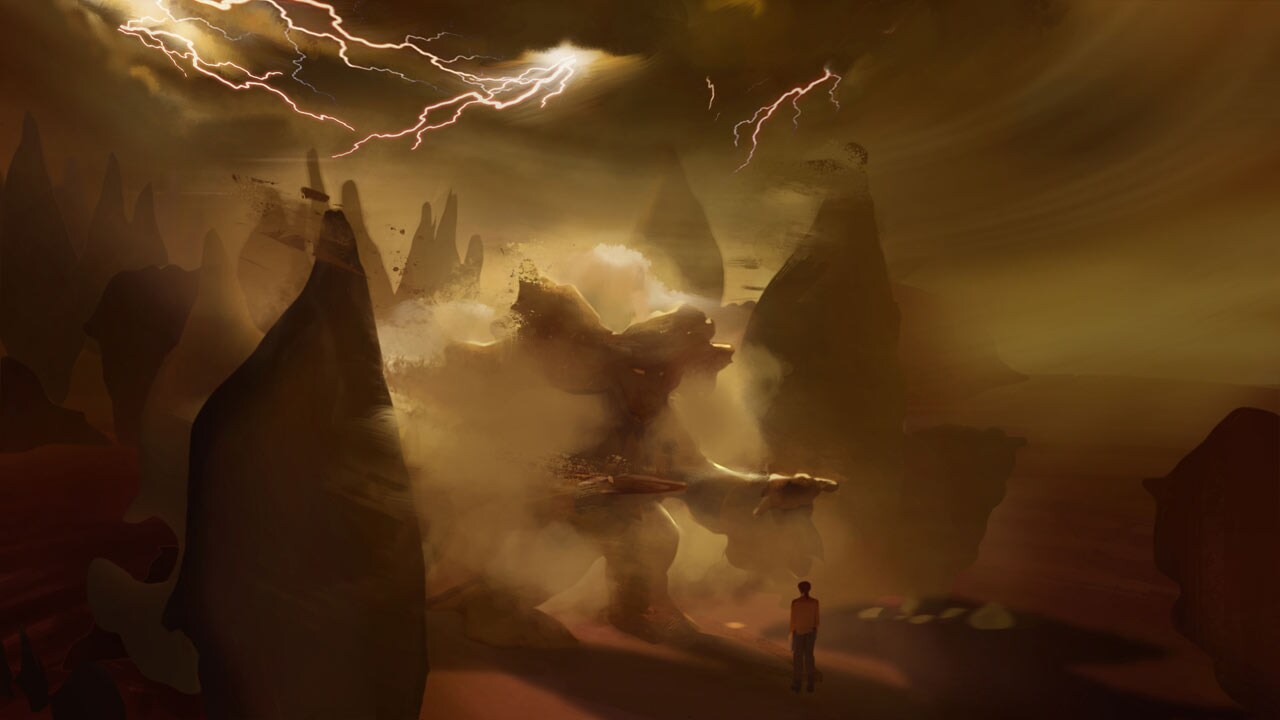
Bendu disrupts that plan because he is not part of the Imperial information system. He cannot be reduced to a troop count, a vehicle, or a known chain of command. His intervention appears as weather, landscape, and Force power at the same time. The Empire has weapons for ships and soldiers, but it has no stable category for a local being who can transform the sky into a weapon.
His lightning damages Imperial and Rebel craft alike. That action helps many Rebels survive, but it also confirms that Bendu is not fighting for the Alliance. He acts according to his own anger and his own interpretation of the intrusion. The result is politically useful to the Rebels without becoming a Rebel victory produced by Rebel command.
The scene also changes how the Empire understands the planet. Atollon is no longer only a remote base location. It becomes evidence that Imperial control has limits. A state can occupy a planet, build weapons, and command armies while still failing to understand the beings and relationships that shape the ground beneath it.
Thrawn and the problem of non-state knowledge
Thrawn responds to Bendu as an Imperial commander. He looks for a weakness, identifies a target, and orders fire. His method is effective against conventional opponents because it converts uncertainty into an intelligence problem. Bendu resists that conversion.
The conflict between them is not simply a contest between good and evil. It is also a contest between two forms of knowledge. Thrawn represents centralized analysis, military information, and the belief that sufficient observation can make an opponent predictable. Bendu represents knowledge rooted in place, long duration, and a relationship to the Force that cannot be separated from Atollon.
Bendu’s warning about Thrawn’s defeat is not merely a supernatural threat. It is a challenge to Imperial confidence. The Empire assumes that the future can be managed through command. Bendu insists that power can remain exposed to forces outside the commander’s system.
Thrawn does not accept that limit. His attempt to destroy Bendu shows the Empire’s preference for elimination when recognition fails. The confrontation ends without Bendu becoming an Imperial subject. He disappears, and his laughter leaves Thrawn without the closure that a destroyed target would provide.

Bendu, the Jedi, and the Sith
Bendu is often discussed through the language of the Force, but he does not fit comfortably into the Jedi or Sith traditions. He does not seek a Jedi council, a Sith master, an apprentice, or a formal order. His identity is not based on a doctrine of institutional succession.
The Jedi and Sith both organize Force knowledge through relationships of training and authority. The Jedi use ranks, teachings, missions, and communal discipline. The Sith use secrecy, hierarchy, rivalry, and the concentration of power in a master and apprentice. Bendu stands outside both systems and therefore offers a different model of Force identity.
That difference does not make him free from culture. Bendu has values, boundaries, memories, and expectations. He recognizes imbalance. He responds to intrusion. He teaches Kanan through a specific relationship. His independence is structured rather than empty.
This is why describing Bendu as a god can be misleading. He is ancient and extremely powerful, but he is also a character with preferences, anger, vulnerability, and a location. Treating him as a god erases the social and political details that make his role meaningful.
Material culture and the body of Bendu
Bendu’s body is one of the clearest expressions of his social position. He is enormous, but his scale is not presented as a military asset. He blends into the coral-like terrain of Atollon, making the landscape itself part of his visual identity.
That design separates him from armored authority. Imperial officers use uniforms, rank plaques, vehicles, and architecture to make power legible. Jedi use robes, lightsabers, temples, and disciplined movement. Bendu’s material presence works differently. His body appears as land before it appears as an individual.
The distinction matters for collectors and for visual anthropology. A picture of Bendu alone emphasizes his form. A picture of Bendu against Atollon emphasizes belonging and scale. A picture of Bendu with Thrawn emphasizes the meeting of local power and Imperial command. The meaning changes with the relationship between figure and setting.
Why Bendu matters to this archive
Bendu is important to Imperial Dark Sector because he makes institutions visible by refusing to join them. The Rebels become more understandable when viewed from the position of a being who does not share their political goals. The Empire becomes more understandable when its methods fail against a power it cannot classify. The Jedi become more understandable when Kanan must learn outside the Order’s formal structure.
His story also supports the archive’s focus on science and education. Bendu’s lessons are not anti-knowledge. They are a different kind of knowledge, one based on attention, place, memory, and the recognition that control has limits. A serious educational approach can study both technical systems and the local knowledge that those systems often ignore.
His relationship with Atollon adds a diversity principle to the archive as well. The galaxy contains many forms of personhood, authority, and community. Not every important being belongs to a familiar species, state, religion, or political faction. Bendu expands the category of who can be a teacher, a landholder, a political actor, or a historical witness.
Bendu is therefore not a simple middle point between the Jedi and Sith. He is an independent actor whose neutrality has consequences. His power protects some lives, threatens others, and exposes the limits of every institution that enters his world believing it understands the whole situation.
Sources and further reading
- Bendu, StarWars.com Databank
- Atollon, StarWars.com Databank
- Krykna, StarWars.com Databank
- Star Wars Rebels, StarWars.com
Neutrality as a political position
Bendu describes himself as the one in the middle, outside the Jedi-Sith opposition. That self-description sounds like withdrawal, but neutrality becomes politically meaningful once the Rebel base on Atollon enters his environment.
Refusing to choose a side does not remove him from the consequences of conflict. His anger during the Imperial assault demonstrates that even withdrawal can collapse when violence reaches the place one is trying to stand apart from.
Atollon has its own authority
The Rebels initially treat Atollon as a strategic location. Bendu’s presence reminds them that the planet is not an empty military resource.
His knowledge of the Force and the landscape gives him authority that does not come from the Alliance, Empire, Jedi, or Sith. The encounter broadens the archive’s idea of political space by showing that institutions are not the only sources of power.
Collector note: Bendu cards and collectibles are best grouped with Atollon, Kanan Jarrus, Krykna, Grand Admiral Thrawn, and Star Wars Rebels references. His visual identity depends on scale, landscape, and his position outside the Jedi and Sith institutions.
Connected archive