
01 · Orientation
Institution in context
The Rebel Alliance connected previously separate resistance cells, dissidents, military defectors, political leaders, and local movements into a coordinated effort to overthrow the Galactic Empire. Rebel Alliance is treated as an institution with a history, membership, leadership structure, and material reach rather than as a simple faction label. Quick Facts places it in Age of Rebellion with a base or reach described as Mobile and dispersed bases across multiple systems. The IDS focus is coalition building, insurgency, legitimacy, revolutionary organization, which directs attention to how organizational power is created, maintained, challenged, and experienced by people inside and outside the institution.
02 · Structure
Structure and membership
The Alliance combined political leadership, military command, intelligence networks, logistics, fleet operations, and semi-autonomous local groups. Its dispersed structure made survival possible but required constant negotiation between strategic goals and local priorities. Membership includes Local rebel cells, defectors, senators, pilots, soldiers, intelligence operatives, allied populations, while the organization's reach is described as Mobile and dispersed bases across multiple systems. IDS separates formal offices from the wider population of personnel, clients, supporters, dependents, or subjects who make institutional action possible.
03 · Leadership
Leadership, authority, and succession
Alliance leadership combines civilian political authority with military command. Mon Mothma provides strategic and political leadership, while generals, admirals, intelligence officials, squadron leaders, and cell commanders coordinate operations. Bail Organa and other founders contribute networks and legitimacy. Because the Alliance is a coalition, leadership depends on persuasion as well as rank. Local cells retain initiative even while High Command tries to align them around common strategy.
04 · Recruitment
Recruitment, incorporation, and training
The Alliance recruits from local resistance movements, defectors, displaced civilians, sympathetic politicians, pilots, soldiers, spies, technicians, and people radicalized by Imperial repression. Recruitment is decentralized because no single state supplies the movement. Personal networks and local crises matter greatly. Joining can mean abandoning a career, family, or homeworld, and members arrive with different political priorities that must be integrated into a shared anti-Imperial project.
05 · Bureaucracy
Administration, records, and institutional routine
Even an insurgency requires administration. The Alliance maintains intelligence networks, logistics, medical systems, procurement, communications, command staffs, mission planning, personnel records, and diplomatic relationships among cells and allied worlds. Secrecy limits how centralized these systems can become. Compartmentalization protects the movement from capture but can also produce duplication and mistrust, forcing the Alliance to balance coordination against operational security.
06 · Ideology
Ideology and legitimacy
Alliance rhetoric emphasized restoration of representative government, opposition to Imperial repression, and defense of local freedom. Members nevertheless entered the movement for different reasons, from ideology to personal loss, occupation, or regional survival. The public or internal ideas attached to Rebel Alliance must be read alongside its institutional practice. The IDS focus on coalition building, insurgency, legitimacy, revolutionary organization helps distinguish stated ideals from the ways authority, resources, coercion, and obligation actually operate.
07 · Financing
Resources, wealth, and institutional support
Alliance resources come from sympathetic senators and elites, allied worlds, covert transfers, donations, captured matériel, local support, smuggling networks, and repurposed civilian technology. Mon Mothma's financial maneuvering in Andor demonstrates the risks of moving funds under Imperial surveillance. The rebellion cannot match Imperial state revenue, so financing depends on concealment and coalition relationships as much as on the amount of money or equipment available.
08 · Military power
Force, security, and coercive capacity
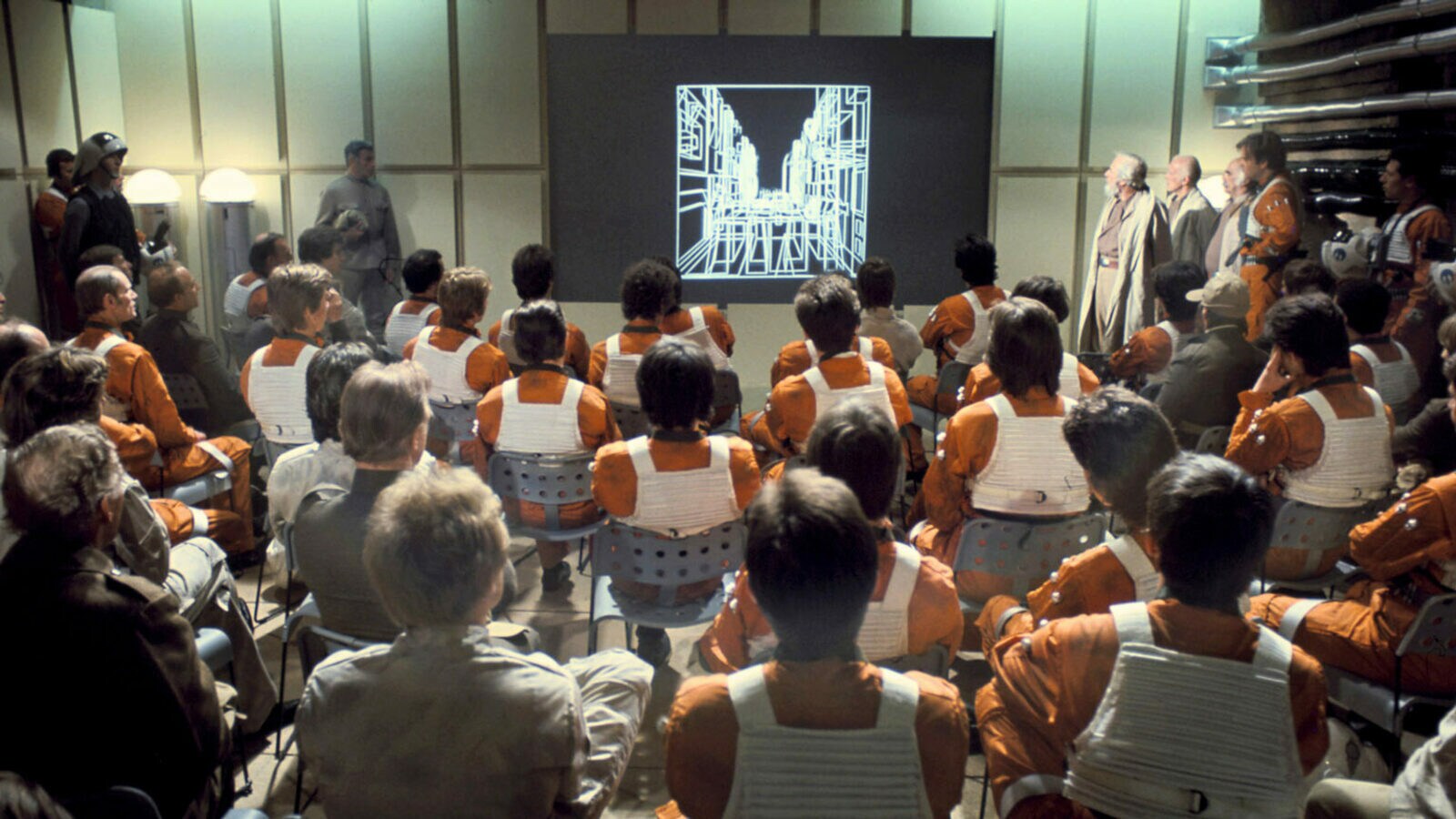
The Alliance fields starfighters, capital ships, ground forces, special operations teams, intelligence agents, and local guerrilla units, but it rarely enjoys numerical superiority. Its military strategy therefore depends on mobility, intelligence, surprise, selective concentration of force, and the political value of symbolic victories. Mon Calamari ships and starfighter corps eventually give the Alliance enough conventional strength to fight major fleet battles such as Endor.
09 · Symbols
Symbols, material identity, and public authority
The starbird emblem, flight suits, squadron markings, improvised base spaces, Mon Calamari vessels, callsigns, and the language of hope and restoration become recognizable symbols of the rebellion. Unlike Imperial standardization, Rebel material identity often displays mixed origins and visible reuse. This diversity itself communicates coalition: ships, uniforms, species, and equipment from different communities are assembled into one political project.
10 · Territory
Territory, bases, and spatial reach
The Alliance controls few permanent territories for long periods and relies instead on hidden or mobile bases such as Yavin 4 and Hoth, friendly worlds, covert safe houses, and sympathetic communities. Territorial insecurity shapes strategy because discovery can force immediate evacuation. The movement's political reach can therefore exceed its direct territorial control, especially where local populations support resistance while formal government remains Imperial.
11 · Internal factions
Rivalries, factions, and competing priorities
The wider rebellion includes moderates, senators, local nationalists, militant partisans, intelligence networks, and cells with different thresholds for violence. Saw Gerrera's Partisans are the clearest example of strategic divergence from Mon Mothma's coalition. These disagreements concern methods, timing, secrecy, and civilian risk. The Alliance's achievement is not the absence of factions but its ability to hold enough of them together to challenge the Empire.
12 · Historical development
Historical development
Early rebel cells operated separately before leaders such as Mon Mothma helped formalize a broader coalition. The Alliance destroyed both Death Stars, survived major defeats, and eventually transitioned from insurgency toward state building after Endor. The principal era listed for Rebel Alliance is Age of Rebellion, but institutional development is rarely static. Leadership changes, wars, alliances, legal reforms, territorial shifts, and resource pressures can alter both goals and structure over time.
13 · Collapse / transformation
Collapse, survival, and transformation
Resistance movements originating before and during the Empire gradually consolidate into the Rebel Alliance. Victory at Endor then creates a new problem: an insurgent coalition must become a government. The Alliance's political leadership and military institutions become foundations for the New Republic, while some wartime practices are deliberately reduced. Transformation therefore involves moving from secrecy and emergency mobilization toward public administration and legal authority.
14 · IDS institutional lens
Why this organization matters analytically
The Alliance is a strong case for studying coalition politics. Successful rebellion required groups with different histories and priorities to cooperate without becoming identical. The IDS lens on Rebel Alliance is coalition building, insurgency, legitimacy, revolutionary organization. The analytical purpose is to show how collective power is produced through people, rules, resources, material systems, and historical memory rather than reducing the organization to its most famous leaders.
Source record
Official sources used for this file
The factual baseline for this Rebel Alliance organization file comes from the linked official Star Wars source, the canon era identified in Quick Facts, and the story contexts reflected throughout the dossier. IDS uses those materials to establish leadership, membership, institutional reach, major events, and documented ideology. The discussion of bureaucracy, legitimacy, labor, coercion, and organizational change is independently written analysis. Public claims made by the organization are not treated as neutral descriptions of how every member understood or experienced it.
Documented case
From scattered cells to a political coalition
Bail Organa and Mon Mothma opposed Palpatine's concentration of power before the Republic fell. Under the Empire, they worked to connect separate resistance groups that had different leaders, methods, and local concerns. Bail aided cells while maintaining a public position in the Senate; Mothma worked secretly toward an Alliance to Restore the Republic. The official accounts describe the coalition's emergence rather than presenting it as an army that existed in a complete form from the beginning. Political coordination required communication, trust, and a shared reason to oppose the Empire.
Coalitions do not have to erase the histories of their members. A former senator, a local insurgent, an Imperial defector, and a military pilot might all oppose Palpatine without having joined for identical reasons. The Alliance therefore faced problems of representation and cooperation in addition to the military challenge of defeating Imperial forces. Its stated project of restoring democracy offered a shared political objective, but organizing people across planets demanded practical relationships and a degree of compromise. That distinction helps explain why becoming an alliance was itself an institutional achievement.
Source: Bail Organa
Documented case
The Scarif decision and disputed authority
The Alliance's leadership did not agree immediately about whether to act on intelligence concerning the Death Star. The Mon Mothma databank recounts the leading council's decision not to authorize a covert mission to seize the plans. Jyn Erso and a small group proceeded to Scarif without that approval. Their actions created an urgent situation in which the wider Rebel fleet could decide whether to intervene. The story makes clear that the Alliance had procedures and leadership, but that initiative could emerge from people who were not acting under an authorized plan.
This episode should not be presented simply as proof that formal organization was ineffective. A council's reluctance reflects the risks faced by groups with limited resources and divided assessments of intelligence. The unauthorized mission also depended on contacts, vehicles, allies, and the possibility of fleet support. Its success therefore involved both dissent from formal decision-making and material assistance from a larger institution. Treating those roles separately provides a more useful description of how a coalition makes decisions under uncertainty than assigning credit entirely to commanders or entirely to independent operatives.
Source: Mon Mothma
Documented case
Military bases and the transition to a New Republic
The Rebel Alliance maintained bases including Yavin 4 and Hoth and operated fleets, pilots, troops, and leadership councils. Those facilities supported planning, equipment maintenance, communications, and the movement of personnel. The Star Wars databank records the Alliance's victory over the Empire at Endor, but victory in a battle was not identical to the administrative work of establishing a government. The same coalition that organized military resistance had also expressed a political commitment to restoring representative rule.
Mon Mothma eventually became Chancellor of the New Republic. That change illustrates the transition from resistance leadership toward public government, a shift that brings different expectations for legitimacy and accountability. Secret cells can act without broad public consultation when secrecy protects their members. A government must address the lives of people beyond those who joined its original movement. The narrative does not establish that the transition was immediate, unanimous, or free of disputes. IDS distinguishes the Alliance's military success from the longer institutional problem of creating a stable post-Imperial political order.
Source: Rebel Alliance
IDS original research focus
How do politically different groups coordinate without becoming identical?
The Rebel Alliance must combine local cells, senators, military officers, intelligence networks, smugglers, defectors, and communities with different political goals. IDS reads the Alliance as coalition infrastructure. Its strength comes partly from coordination across difference, while its recurring challenge is creating shared strategy without erasing the local histories that produced resistance.
This panel is an original Imperial Dark Sector synthesis. It identifies the analytical question guiding this file rather than restating an official Star Wars description. How IDS separates evidence from interpretation →