
01 · Orientation
World overview
The forest moon of Endor is home to Ewok communities whose local knowledge, social organization, and alliance with the Rebels became decisive when the Empire built a shield installation in their territory. IDS treats Endor as a lived world rather than background scenery. Its location in Outer Rim, its classification as Forest moon, and its association with Ewoks and temporary Imperial forces create a social setting shaped by geography, institutions, mobility, and historical change. The purpose of the file is to connect those conditions instead of reducing the planet to a single battle, character, or visual landmark.
02 · Environment
Landscape, climate, and adaptation
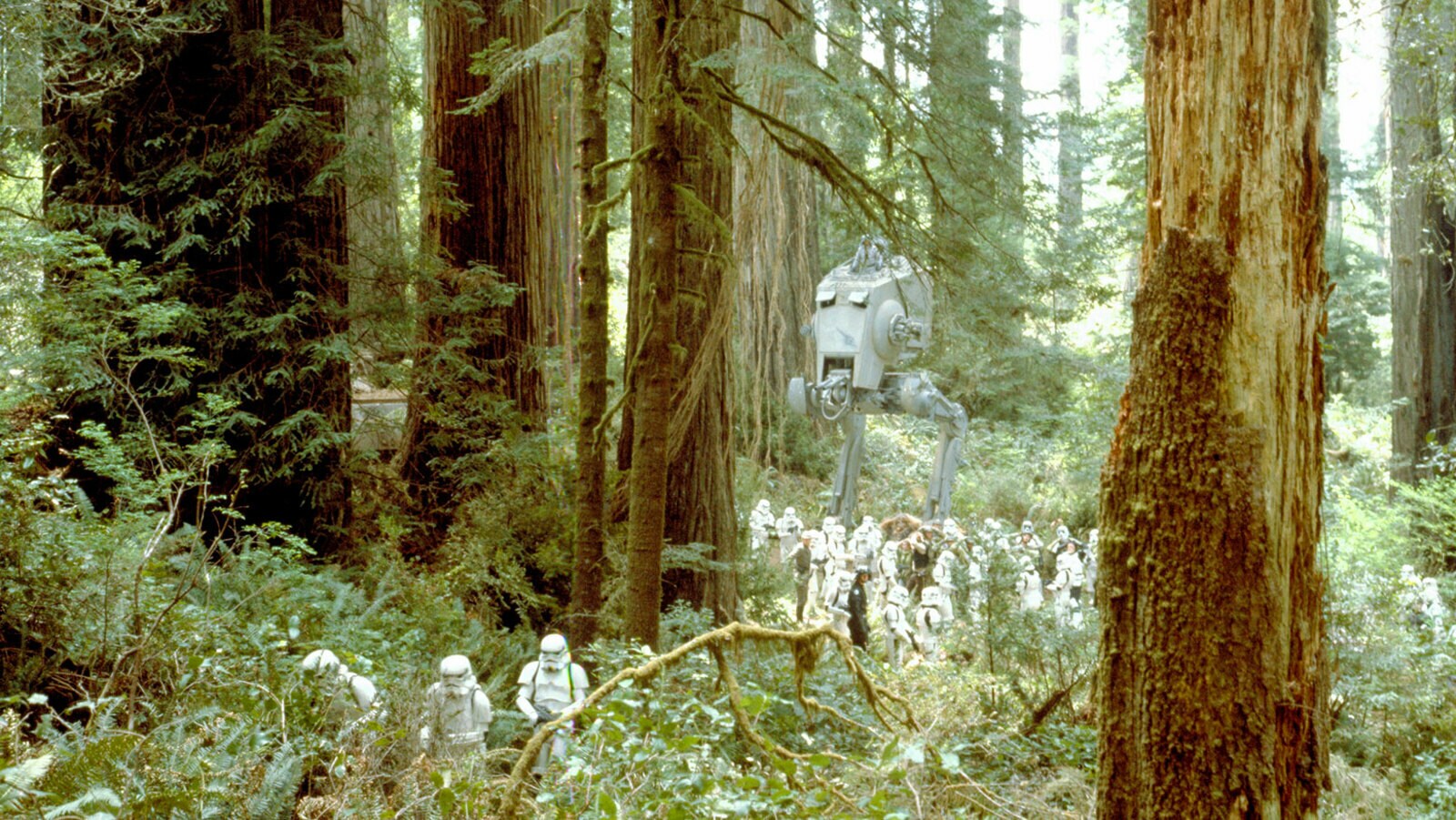
Endor's dense forests create an environment where mobility and visibility depend heavily on local knowledge. Ewok settlements are integrated into enormous trees, while Imperial facilities impose an entirely different technological footprint on the landscape. Quick Facts identifies the climate as Temperate and the terrain as Forests, mountains and rivers. Those environmental conditions affect where settlements can develop, how people travel, what resources become politically important, and which forms of infrastructure are practical. Environment does not mechanically determine culture, but it places real constraints on labor, architecture, transportation, defense, and everyday life.
03 · Built environment
Settlement, architecture, and infrastructure
Ewok settlements use the forest canopy as both home and defense. Platforms, rope bridges, communal spaces, dwellings, and elevated storage integrate architecture with giant trees rather than clearing the environment away. Imperial construction follows a very different logic, inserting bunkers, landing facilities, communications systems, and a shield generator into territory treated primarily as strategic infrastructure. The contrast shows two ways of inhabiting the same landscape: one adaptive and community-centered, the other extractive and military.
04 · Society
People, community, and everyday life
Ewok society includes villages, kin groups, ritual life, hunting, craft traditions, storytelling, and political leadership. Their technology differs from Imperial machinery but is well adapted to the environment and to the forms of conflict that take place there. The communities most closely associated with this file are Ewoks and temporary Imperial forces. The IDS focus is indigenous society, imperial infrastructure, alliance, which means the planet is read through differences in institution, class, occupation, migration, and political experience rather than as a single unified culture. A world can contain neighboring populations with distinct languages, religions, histories, and relationships to state power.
05 · Economy & labor
Resources, work, and political economy
Ewok subsistence is based on local ecology, hunting, gathering, craft, exchange within community networks, and the management of forest resources. Imperial personnel depend on supplies brought through military logistics rather than on local economic integration. That difference matters during conflict because Ewoks know how to use materials already present in the environment, while the Empire relies on standardized technology and centralized supply. The Rebel alliance temporarily connects those two systems through shared military purpose.
06 · Religion & worldview
Sacred landscape, belief, and moral order
Ewok communities treat the forest, ancestors, stories, ritual, and supernatural interpretation as meaningful parts of social life. Canon shows ceremonial behavior and sacred understandings of unfamiliar beings and events, though it does not provide a single systematic Ewok theology. Religion and worldview are treated as parts of social life rather than decorative lore. Sacred places, collective memory, ritual, moral authority, and relationships to land can influence how communities understand belonging and legitimate power. Where canon documents no shared planetary religion, IDS keeps that absence visible instead of inventing a uniform belief system for everyone living on the world.
07 · Institutions
Government, authority, and power
The Empire treated Endor as a strategically useful location for the second Death Star's shield generator. It did not meaningfully incorporate Ewok political authority into that plan. The Rebel Alliance instead formed a local alliance, and that difference in relationships helped shape the battle's outcome. The major eras associated with Endor are Age of Rebellion. Political authority can therefore change as governments, militaries, occupations, local elites, resistance movements, or outside institutions gain and lose control. The archive uses indigenous society, imperial infrastructure, alliance to ask who can make decisions, who bears the costs of those decisions, and how planetary institutions connect local communities to larger galactic systems.
08 · Mobility
Movement, travel, and connection
Ewoks move through forest routes, tree platforms, hidden paths, and terrain difficult for outsiders to interpret. Imperial forces rely more on speeders, cleared approaches, patrol routes, and formal installations. During the battle, local knowledge becomes a mobility advantage because Ewoks can appear, disappear, and redirect forces through familiar terrain. Offworld movement is dominated by the Empire and Rebellion, making the moon suddenly central to galactic travel only because the second Death Star’s defensive system is based there.
09 · Conflict & security
War, policing, occupation, and defense
Endor turns an apparently peripheral community into a decisive participant in galactic war. Imperial planners treat the moon largely as terrain surrounding a shield installation, underestimating its inhabitants. The Rebel strike team instead forms an alliance with Ewoks, converting local social ties and environmental knowledge into military capability. Security failure therefore begins with a political misreading: the Empire sees infrastructure and territory but fails to understand the community whose cooperation the Rebels gain.
10 · Points of interest
Places that make Endor legible
Places inside Endor make large planetary histories concrete. Cities, temples, factories, homes, bases, ruins, and landscapes show where institutions actually operate and where people work, worship, govern, travel, fight, remember, and build community. IDS treats these locations as evidence of social life rather than as a sightseeing checklist. Each point is included because it helps explain how geography, political authority, material culture, religion, or historical change becomes visible on the ground.
Ewok village
The treetop village shows Ewok settlement, foodways, domestic space, ritual, leadership, and collective defense, making it one of the clearest examples of everyday community architecture in the original trilogy.
Imperial shield generator bunker
The bunker tied a forest moon to the second Death Star’s defensive system. Its presence transformed local territory into military infrastructure and brought Imperial occupation into direct conflict with Ewok communities.
Forest battle sites
The Battle of Endor depended on cooperation between Rebel commandos and Ewoks, turning local knowledge, terrain, traps, and social alliance into strategic advantages against technologically superior forces.
11 · Change over time
Historical significance
Imperial construction brought Endor into the Galactic Civil War. Rebel forces disabled the shield generator with Ewok assistance, allowing the fleet to destroy the second Death Star and helping bring about the collapse of Imperial central authority. The principal appearances listed for Endor are Return of the Jedi. Those stories capture particular moments rather than the complete history of the world. IDS reads wars, occupations, migrations, regime changes, reconstruction, and institutional continuity as processes that reshape social life over time. Historical significance therefore comes from what changes for communities, not only from whether a famous event happened there.
12 · IDS lens
What this world reveals
Endor is a reminder that technological asymmetry does not equal social or strategic inferiority. Local knowledge, alliances, terrain, and community organization can matter as much as advanced weapons. The archive emphasis for Endor is indigenous society, imperial infrastructure, alliance. That focus is useful because it connects geography to social organization instead of treating the world as scenery. IDS asks how people experience institutions differently depending on class, community, mobility, political status, access to resources, and historical circumstance, and how those differences become visible in the built and natural environment.
13 · Sources & continuity
Official primary source
The factual baseline for this Endor file comes from official Star Wars reference material and the canon appearances listed in Quick Facts. IDS uses those sources for names, geography, political events, communities, and chronology, while the surrounding discussion of institutions, religion, settlement, labor, and social change is independently written analysis. Some aspects of everyday life on this world remain undocumented in current Canon.