The Galactic Empire began as a political reorganization of the Republic. Palpatine presented the change as a response to disorder and a failed Jedi coup. The Empire also offered a powerful answer to a real political problem: how to coordinate a vast, diverse galaxy after war. Its standardized administration, military science, and infrastructure help explain its appeal, even as the structure concentrated authority in one ruler and gave the military a permanent role in everyday government.
The Empire’s power came from the combination of law, administration, propaganda, and force. Stormtroopers made violence visible. Imperial officers converted orders into policy. Spy technology and surveillance made dissent easier to find. The Death Star made the threat of punishment large enough to stand in for actual control.
The Republic becomes an emergency state
During the Clone Wars, Palpatine accumulated emergency authority while the Senate accepted extraordinary measures as temporary necessities. By the time he declared the first Galactic Empire, the Republic’s institutions had already been trained to treat centralization as a solution to crisis.
Order 66 gave the transformation a target. The Jedi were labeled enemies of the Republic, and the institution that had served as a visible alternative source of authority was dismantled. Palpatine’s message was effective because it presented the purge as protection. The Empire could call a political execution an act of public safety.
Military power as daily government
The Empire did not rule only through battles. It placed officers, security organizations, and military facilities inside local systems. Regional governors replaced older forms of representation. Imperial academies trained people to think of obedience as competence. The system relied on routine because routine made extraordinary power look normal.
That structure created different experiences across the galaxy. Some citizens benefited from the Empire’s order or believed its propaganda. Others experienced occupation, forced labor, surveillance, and collective punishment. The Empire’s claim to stability depended on keeping those experiences separate from the official story told in the Core.
The Death Star and the politics of fear
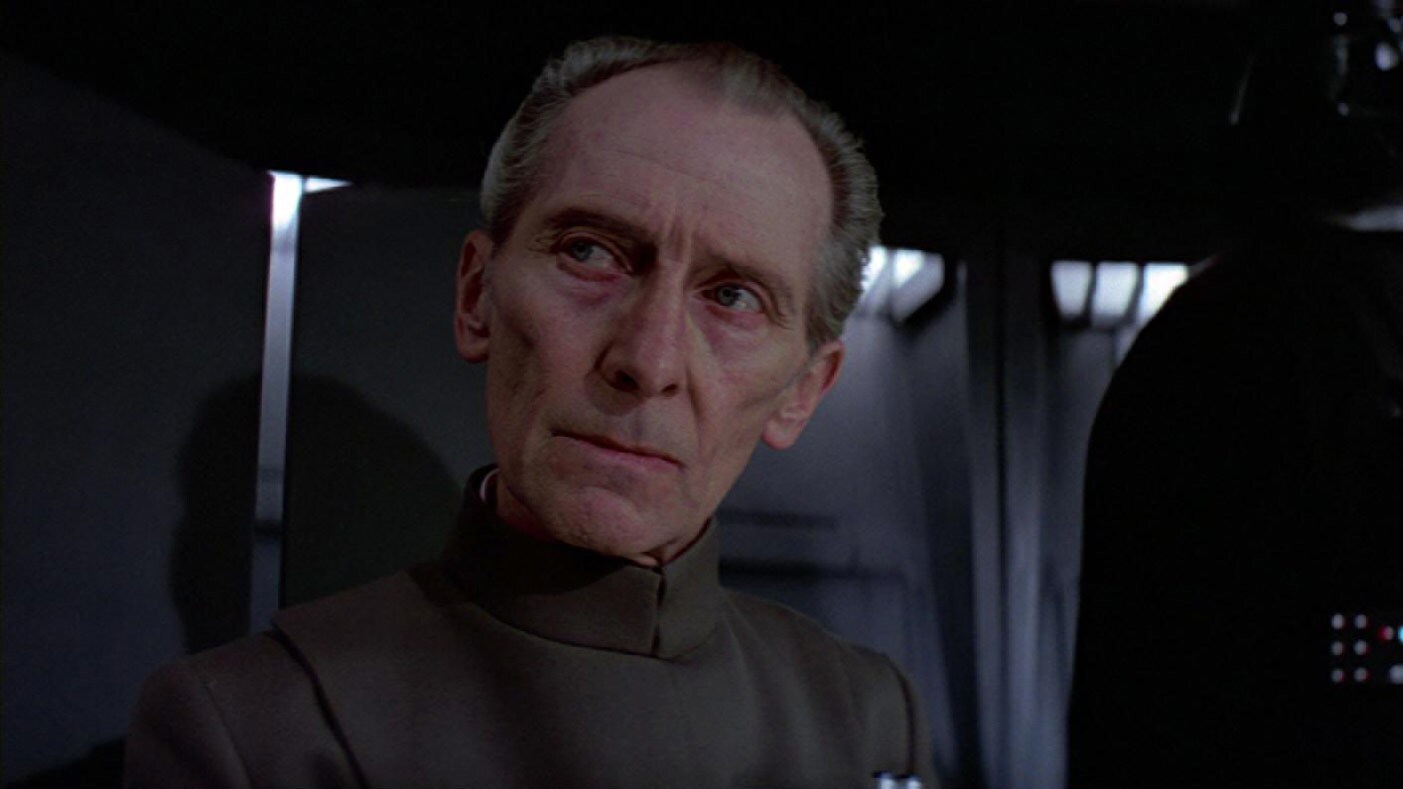
The Death Star was both a weapon and a political argument. Tarkin believed that a single spectacular demonstration could replace the need for constant military campaigns. Destroying Alderaan was meant to make every other system calculate the cost of resistance before it joined the Rebellion.
The strategy failed because fear does not eliminate political imagination. The stolen plans, the attack at Yavin, and the survival of the Rebel Alliance turned the Death Star into evidence that the Empire could be challenged. Its destruction did not end Imperial power, but it made the Empire’s claim to permanence less credible.
Why the Empire kept losing information
Imperial hierarchy rewarded certainty and punished inconvenient reports. Officers competed for favor, local populations were treated as resources, and subordinates learned that telling a superior the truth could be more dangerous than making a bad decision. The result was a system with enormous force but poor knowledge.
Rebel cells exploited that weakness. They worked through relationships, local knowledge, and people who had been ignored by the Imperial chain of command. Cassian Andor’s intelligence work, Leia Organa’s political network, and Luke Skywalker’s symbolic importance all reveal different ways the Rebellion turned information into action.
Endor and the collapse of the model
The Empire’s defeat at Endor exposed the danger of concentrating a political system around the confidence of one ruler. Palpatine expected the trap to be perfect and assumed the Death Star would demonstrate his control. Instead, the battle combined local resistance, a fleet assault, and Vader’s decision to reject the role the Emperor had built for him.
The Empire did not disappear overnight. Imperial remnants continued to fight, govern, and search for ways to restore centralized power. But the myth of inevitability was broken. Once citizens had seen the Empire lose its most protected weapon, every future act of resistance became easier to imagine.
Reading the Empire as a system
The Empire remains compelling because it is not only a collection of villains. It is an argument about how institutions can use fear, bureaucracy, and technology to make domination appear orderly. Star Wars repeatedly returns to the question of whether safety can be separated from freedom once one government claims the right to define both.
For collectors, Imperial cards can be organized by structure: soldiers, officers, intelligence, weapons, worlds, and resistance. A Vader portrait, a stormtrooper image, or a Death Star card can represent a different part of the same system. That framing gives even familiar subjects more room to mean something.
The Empire in films, series, novels, and comics
The Galactic Empire is not one visual style or one moment. Revenge of the Sith shows its birth inside the Republic; The Bad Batch follows the first administrative experiments; Obi-Wan Kenobi and Star Wars Rebels show the reach of Imperial policing; Andor studies prisons, informants, and labor; Rogue One connects insurgency to the Death Star; and the original trilogy records the regime at the height of its confidence. Novels and comics add the institutional detail of intelligence work, regional governors, military procurement, and the lives of people who never stood in the same room as Vader.
Across those formats, the Empire's defining achievement is administrative. It makes domination portable. A garrison, a form, a surveillance report, a tax demand, a labor transfer, and a public execution can carry the same political logic across different planets. The uniform is only the visible surface. The deeper system is a network that turns distance into obedience.
Bureaucracy as a technology of rule
Imperial violence often begins before a blaster is fired. A population is counted, classified, indebted, relocated, or marked as suspicious. Local customs are translated into categories that make them easier to police. A governor's office turns a living community into a report, and the report becomes the justification for a security operation. This is why the Empire can be terrifying even in scenes where no battle occurs.
Andor makes that process unusually clear. The prison on Narkina 5 is frightening not because it is chaotic, but because it is organized. Workers are divided into tables, floors, shifts, outputs, punishments, and routines. Language turns coercion into productivity. The prison can call itself a manufacturing site while treating the people inside as disposable components.
The same logic operates in customs offices, military intelligence, and planetary development programs. Officers compete for metrics, promotions, and access to the Emperor's attention. Their rivalries do not weaken the system as much as they produce more surveillance. Each official wants to prove that another official is insufficiently loyal. Fear travels downward through paperwork.

Extraction, species hierarchy, and occupied life
The Empire presents itself as a universal state, but its economy is uneven. It extracts minerals, food, labor, and strategic access from worlds that have little influence over the decisions made in the Core. Human supremacy gives that extraction a racialized structure, while military classification turns entire species and cultures into security problems. The regime can call a region “pacified” even when its people have lost land, language, or the ability to govern themselves.
Occupation changes everyday time. Curfews divide the day; checkpoints make familiar routes dangerous; searches teach families which objects can be misunderstood; patrols redefine public space. On Ferrix, the funeral march becomes political because the community's ritual creates a temporary social order that Imperial authority cannot fully control. On Lothal, the growth of Imperial industry changes land and labor as well as the skyline. On Jedha, religious life and archaeology become entangled with military extraction.
These pressures create different forms of resistance. Some people sabotage equipment, some hide fugitives, some preserve forbidden songs, and some take positions inside the administration to limit harm. The binary of “rebel” and “civilian” is therefore too narrow. Occupied populations survive through a spectrum of tactics, many of which never enter an official military report.

The Death Star and the performance of omnipotence
The Death Star is a weapon, but it is also a media event. Its purpose is to make the state appear everywhere at once. A planet can be destroyed from a distance, without an occupying army standing in every street, and the news of that destruction can discipline worlds that have never seen the station. Tarkin's doctrine treats terror as a communication system: one spectacular act should replace the slow work of political consent.
That strategy depends on secrecy and hierarchy. Engineers, scientists, pilots, prisoners, and officers know different pieces of the project. The system hides its full scale from the people building it, then hides its vulnerabilities from the people commanding it. Galen Erso's resistance shows that knowledge can become a form of moral responsibility even inside a project designed to eliminate responsibility.
Both Death Stars fail partly because the Empire confuses visibility with control. A superweapon can destroy a city, but it cannot make the destroyed population believe in the legitimacy of the state. The more the Empire relies on spectacular punishment, the more it reveals its fear that ordinary governance has already failed.

Imperial collapse and the afterlife of the regime
The Empire's defeat at Endor is a military turning point, not an instant social transformation. Warlords, loyalist fleets, intelligence officers, corporate suppliers, and local collaborators survive. Some worlds remove statues and uniforms; others keep Imperial systems because they still provide food distribution or security. The later First Order demonstrates how institutions and myths can travel after a government falls.
Memory is contested here too. The Empire's records often present coercion as development and rebellion as criminality. Rebel testimony can correct that record, but it can also simplify the diversity of people who lived under Imperial rule. A serious history asks who benefited, who was displaced, who resisted, and who had to make compromises that later generations might misunderstand.
That complexity is central to the archive's collector lens. Imperial images are striking because the design language is coherent: black uniforms, white armor, red warning lights, monumental corridors. Anthropology asks what that coherence did. It trained people to recognize rank instantly, converted architecture into discipline, and made political violence look like an environment rather than a choice.
Sources and further reading
- Galactic Empire, StarWars.com Databank
- Jedi Order, StarWars.com Databank
- Darth Vader, StarWars.com Databank
- Cassian Andor, StarWars.com Databank
- Andor, StarWars.com
- Rogue One: A Star Wars Story, StarWars.com
- Star Wars Rebels, StarWars.com
- The Bad Batch, StarWars.com
Connected archive