Sheev Palpatine spends decades turning political procedure into a path toward absolute power. As Darth Sidious, he engineers the Clone Wars, weakens the Jedi, and positions himself as the only leader capable of restoring order.
His rise shows how the Republic is not destroyed by one battle. It is dismantled through emergency powers, public fear, military expansion, and institutions that continue to operate while their purpose changes.
As Emperor, Palpatine makes the dark side part of the state. He rules through surveillance, terror, the Imperial military, and the belief that resistance is impossible. His influence extends beyond his apparent death and helps create the First Order and the Sith Eternal.

Character in social context
Emperor Palpatine enters this archive as a politician who turns a republic into an empire and makes power itself the weapon.. The short account describes Sheev Palpatine spends decades turning political procedure into a path toward absolute power. As Darth Sidious, he engineers the Clone Wars, weakens the Jedi, and positions himself as the only leader capable of restoring order.. That account identifies a social position as much as a plot event. Emperor Palpatine is recognized through obligations, institutions, material practices, and the people who can reward, discipline, shelter, or abandon them.
The profile’s anthropology insight is Palpatine’s power rests on institutional camouflage. He moves through the Republic’s offices, emergency laws, Senate rituals, and public language until the political system itself supplies the appearance of lawful succession. Read alongside the story, this suggests that Emperor Palpatine's choices are shaped by Jedi apprenticeship, the Order’s council structures, and the competing traditions that claim authority over the Force. The question is not whether Emperor Palpatine is simply heroic, villainous, loyal, or dangerous. It is how those labels become persuasive and what they hide.
A biography becomes more intelligible when the surrounding community is kept in view. The archive follows the relationships that make Emperor Palpatine possible, the institutions that constrain Emperor Palpatine, and the objects through which Emperor Palpatine becomes visible to others.
Formation, training, and social position
No biography begins at the moment of first appearance. Emperor Palpatine arrives with inherited histories, learned habits, unfinished obligations, and ideas about what a person is allowed to become. Those histories may be private, but institutions make them legible through rank, reputation, family, schooling, service, or exclusion.
Emperor Palpatine learns through apprenticeship, discipline, meditation, and the transmission of embodied knowledge. Training is never only the acquisition of a skill. It teaches posture, vocabulary, timing, acceptable emotion, and the difference between knowledge that may be shared and knowledge that must remain guarded.
Social position changes when Emperor Palpatine crosses a boundary: entering an order, leaving a home, surviving a war, changing allegiance, accepting a title, or being recognized by a new community. Each transition creates possibilities while also producing debts to the people and institutions left behind.

Institutions and the distribution of power
Jedi apprenticeship, the Order’s council structures, and the competing traditions that claim authority over the Force gives Emperor Palpatine a vocabulary for authority. It defines legitimate command, acceptable violence, proper loyalty, and the forms of evidence that count as knowledge. The institution may appear stable, but Emperor Palpatine’s biography reveals the work required to maintain it.
Authority reaches the body. Uniforms, armor, scars, hair, weapons, gestures, and controlled movement let observers identify rank and affiliation before a word is spoken. These signs are material arguments about who may enter a room, give an order, claim protection, or be treated as a threat.
When Emperor Palpatine obeys, questions, or leaves an institution, the conflict is both personal and political. The choice changes relationships, but it also tests whether the institution can tolerate dissent, repair harm, or imagine belonging outside its own rules.
Kinship, community, and belonging
Belonging is not only a feeling. It is a set of rights, duties, stories, names, and practical expectations. masters, students, allies, civilians, and other communities that do not share one definition of responsibility For Emperor Palpatine, these relationships establish what counts as protection and what counts as betrayal.
Kinship can be inherited, chosen, ritualized, or imposed. A mentor may function as a parent, a crew as a household, a clan as a political nation, or a rival as the person who best understands an obligation. The story’s emotional force often comes from these overlapping forms of relatedness.
Moments of separation show how communities define themselves. Exile, adoption, recruitment, imprisonment, marriage, apprenticeship, and reconciliation all reorganize the social map around Emperor Palpatine. The character’s identity changes because other people change the terms under which recognition is offered.
Labor, tools, and material culture
Work reveals the practical structure of Emperor Palpatine’s world. Survival, command, caregiving, intelligence, combat, teaching, trade, and maintenance all require labor that may be celebrated, hidden, or exploited. Studying that work moves attention away from exceptional moments and toward the systems that make them possible.
lightsabers, robes, archives, ships, and the spaces where instruction becomes public. These objects do more than establish a visual style. They carry memory, mark status, distribute risk, and limit the choices available to the people who use them. A tool can be a livelihood, a weapon, an heirloom, or evidence of institutional control.
The collector record preserves these material traces. Palpatine connects the prequels, Original Trilogy, sequel trilogy, Sith imagery, Senate scenes, lightning, and Imperial command.. A card or image can therefore be read as a small archive of social relations rather than only as a portrait.
Body, environment, and representation
The body of Emperor Palpatine is read by other people before the character can explain it. Species, gender, age, clothing, scars, posture, accent, and visible technology become evidence used to assign danger, authority, beauty, weakness, or trust. These readings are social judgments, not neutral observations.
Places also shape identity. Homes, temples, prisons, ships, battlefields, workshops, courts, and frontier settlements offer different forms of shelter and different ways to be seen. Emperor Palpatine becomes a different kind of social person when the surrounding environment changes the risks and relationships available.
This is why the visual record matters. Images show how the story places Emperor Palpatine among other bodies, objects, and landscapes. A full-size scene can reveal hierarchy, distance, care, surveillance, or exclusion that a cropped portrait would conceal.
Memory, narrative, and historical change
Memory is a social resource. Communities use names, rituals, monuments, songs, testimony, archives, and rumors to decide which parts of Emperor Palpatine’s life should endure. Those practices can honor a person, justify a regime, conceal violence, or give survivors a language for repair.
the survival of Jedi memory after the Order’s political collapse. The character’s later meaning is therefore not fixed by the earliest account. New institutions reinterpret old actions, and new generations inherit both the consequences and the arguments surrounding them.
The archive keeps confirmed history, interpretation, canon, and Legends status distinct because each category answers a different question. Historical placement asks what the story establishes. Anthropology asks how people organize meaning around it. Collector context asks how material objects carry that meaning forward.
Anthropological assessment
The strongest anthropological claim in this file is that Palpatine’s power rests on institutional camouflage. He moves through the Republic’s offices, emergency laws, Senate rituals, and public language until the political system itself supplies the appearance of lawful succession. The claim matters because it connects personal identity to institutions, relationships, environments, and material culture.
This assessment is interpretation, not a replacement for canon. The confirmed story establishes the events and relationships. The anthropological reading asks what those events reveal about authority, kinship, labor, training, knowledge, and the boundaries of political belonging.
Emperor Palpatine is therefore not reduced to a moral label or a dramatic role. The profile treats Emperor Palpatine as a person moving through social worlds that distribute recognition, risk, care, and memory unevenly. That is what makes the character historically and anthropologically useful to this archive.
Emergency power made ordinary
Palpatine’s rise works because he rarely asks the Republic to abandon procedure all at once. Crisis after crisis allows exceptional authority to be justified as temporary necessity. Votes, offices, military creation, and emergency measures make concentration of power appear administratively reasonable.
By the time the Empire is declared, much of the institutional transformation has already occurred. The ceremony names a reality created through years of normalized emergency.
The Sith behind the public office
Sidious operates through secrecy because his political and Sith identities serve different audiences. Senators see a chancellor. Separatist leaders see an unseen patron. Anakin sees a trusted mentor. Each relationship gives Palpatine access to information and loyalty that the others do not fully understand.
His power therefore depends on compartmentalization. The same person can direct opposing sides because institutions and individuals are prevented from seeing the whole network.
Collector note: Palpatine connects the prequels, Original Trilogy, sequel trilogy, Sith imagery, Senate scenes, lightning, and Imperial command.
Sources and further reading
- Palpatine visual reference, Space
- Palpatine visual reference, Esquire
- Palpatine visual reference, /Film
- Emperor Palpatine, StarWars.com Databank
LEGO collector picks
Emperor Palpatine in LEGO
Official LEGO Star Wars sets with a direct connection to this character or their signature ship, equipment, or story.
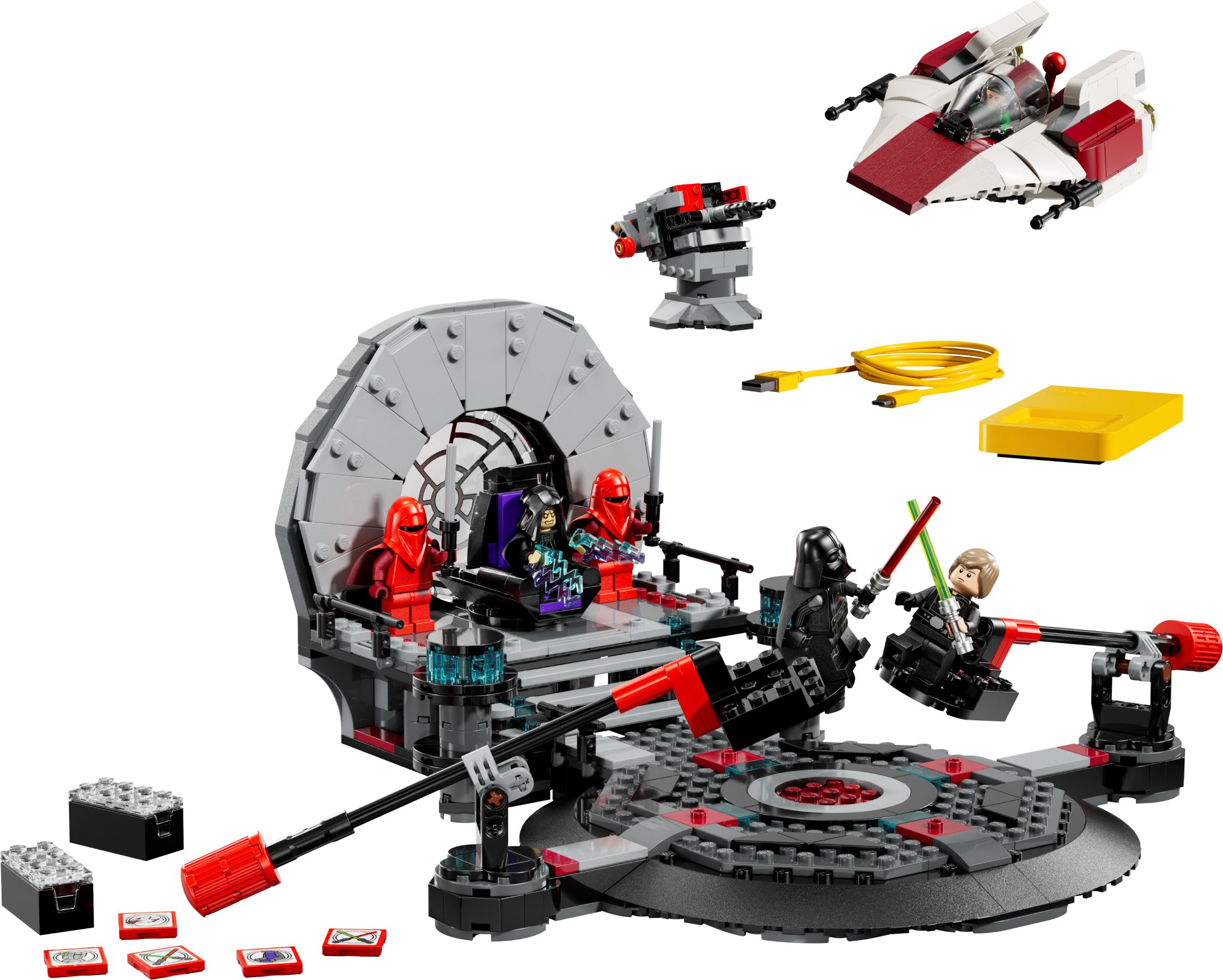
SMART Play Throne Room Duel & A-Wing 75427
The throne room scene centers on Palpatine's attempt to turn Luke and the confrontation that ends his rule over the Empire.
Shop at LEGO.com ↗
Emperor Palpatine Key Chain 854289
An official LEGO Palpatine key chain that expands his collector section beyond building sets into smaller character merchandise.
Shop at LEGO.com ↗Affiliate disclosure: These LEGO Store links use Imperial Dark Sector's Rakuten Advertising affiliate tracking. IDS may earn a commission from qualifying purchases at no added cost to you.
Connected archive