
01 · Orientation
Institution in context
The First Order rebuilt Imperial-style military and ideological power outside effective New Republic control, combining secret rearmament, indoctrination, centralized command, and technological escalation. First Order is treated as an institution with a history, membership, leadership structure, and material reach rather than as a simple faction label. Quick Facts places it in Rise of the First Order with a base or reach described as Unknown Regions and mobile military infrastructure. The IDS focus is imperial revival, militarization, indoctrination, successor politics, which directs attention to how organizational power is created, maintained, challenged, and experienced by people inside and outside the institution.
02 · Structure
Structure and membership
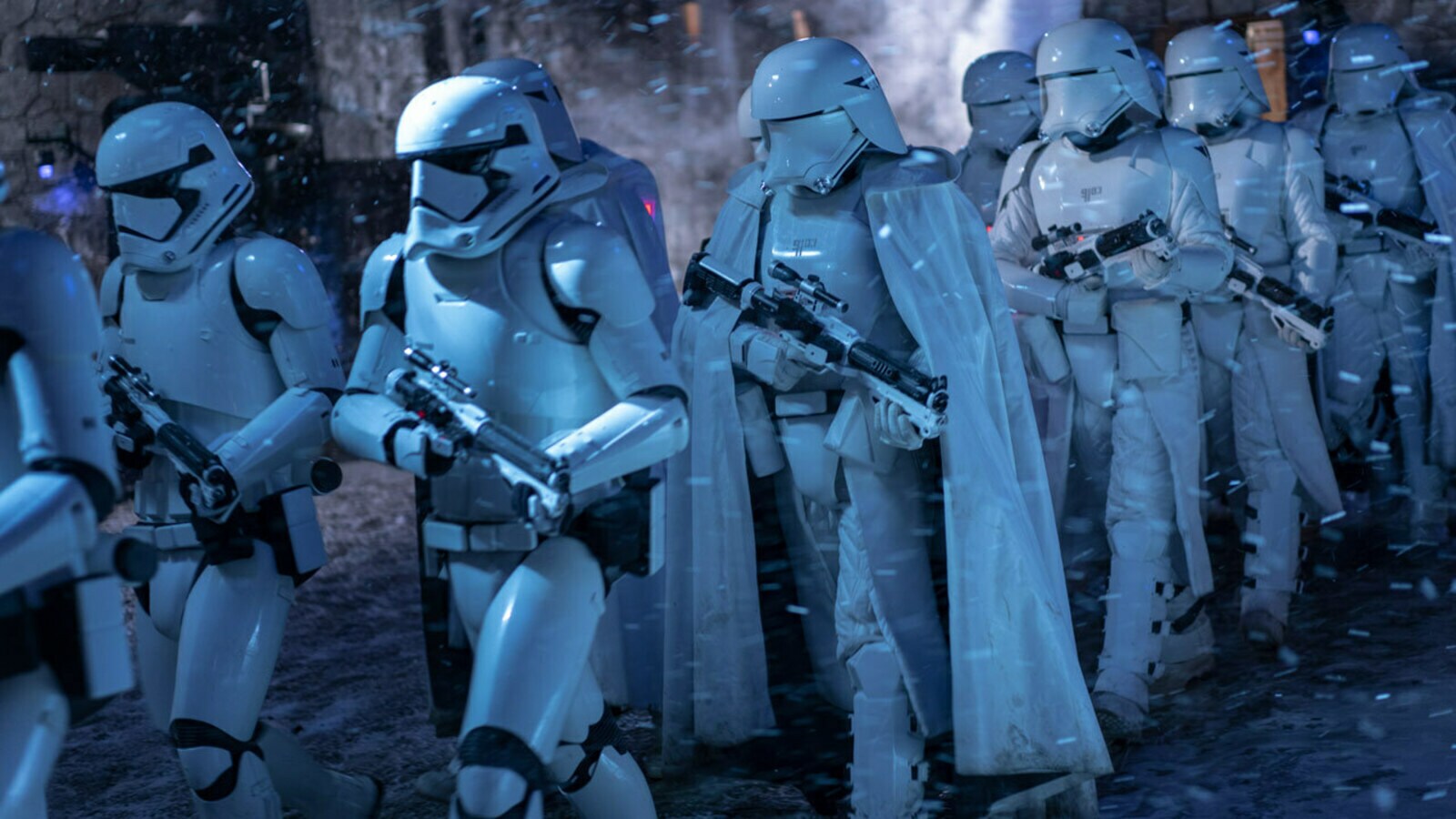
The First Order organized around a Supreme Leader, senior military command, fleets, bases, stormtrooper corps, intelligence functions, and eventually the Knights of Ren under Kylo Ren's rule. Membership includes Military officers, stormtroopers, political leadership, technicians, affiliated dark-side forces, while the organization's reach is described as Unknown Regions and mobile military infrastructure. IDS separates formal offices from the wider population of personnel, clients, supporters, dependents, or subjects who make institutional action possible.
03 · Leadership
Leadership, authority, and succession
The First Order is ruled by Supreme Leader Snoke and later Kylo Ren, with generals, admirals, security chiefs, and specialized officers controlling military branches beneath them. Leadership is intensely centralized, but rivalry among figures such as Hux and Kylo reveals competition inside the hierarchy. Allegiant General Pryde later represents an older Imperial generation whose loyalty connects the First Order to Palpatine's wider plan.
04 · Recruitment
Recruitment, incorporation, and training
The First Order recruits some elites and former Imperial families, but its most distinctive practice is the seizure and conditioning of children for stormtrooper service. Finn's defection reveals the human consequences of that system. Technical personnel and officers follow other pathways, including ideological family networks and military careers. Recruitment therefore combines inherited Imperial loyalty with institutional control over people from childhood.
05 · Bureaucracy
Administration, records, and institutional routine
The First Order operates through military commands, training systems, intelligence, logistics, research, fleet administration, security, and hidden industrial infrastructure in the Unknown Regions. Unlike the old Empire, it initially lacks open galactic state institutions, so much of its bureaucracy is military and clandestine. Once it launches open conquest, those structures are expected to scale rapidly into governance, making the organization a state-in-waiting before it becomes an occupying regime.
06 · Ideology
Ideology and legitimacy
Its political culture glorified order, hierarchy, obedience, militarism, and the legacy of the Empire. It framed New Republic government as weak and disorderly while presenting authoritarian control as restoration. The public or internal ideas attached to First Order must be read alongside its institutional practice. The IDS focus on imperial revival, militarization, indoctrination, successor politics helps distinguish stated ideals from the ways authority, resources, coercion, and obligation actually operate.
07 · Financing
Resources, wealth, and institutional support
Former Imperial wealth, hidden patrons, industrial assets, secret shipbuilding, and resources accumulated in the Unknown Regions support the First Order's rise. Official sources emphasize fleets and armies built covertly despite disarmament settlements. The exact financing mechanisms are not fully documented, so IDS distinguishes confirmed hidden military buildup from speculation. The key point is that decades of concealed investment allow a seemingly marginal successor movement to acquire state-scale force.
08 · Military power
Force, security, and coercive capacity
Military power is the core of First Order organization. Resurgent-class Star Destroyers, stormtroopers, TIE forces, Starkiller Base, dreadnoughts, advanced tracking, and later coordination with Sith Eternal forces give the regime the ability to destroy political centers and occupy systems quickly. The organization expects technological superiority and disciplined troops to compensate for its narrower political base.
09 · Symbols
Symbols, material identity, and public authority
First Order insignia, stark black-white-red design, polished stormtrooper armor, monumental rallies, standardized uniforms, Starkiller Base, and overt reuse of Imperial aesthetic traditions communicate succession. The visual language is intentionally familiar but intensified. Symbols tell supporters that the Empire's defeat was temporary while telling opponents that centralized military order has returned in a more disciplined form.
10 · Territory
Territory, bases, and spatial reach
Before open war, the First Order develops beyond the New Republic's effective reach in the Unknown Regions and through covert networks. After destroying Hosnian Prime, it rapidly projects force into former New Republic space but does not instantly create deep administration everywhere. Its territorial strategy depends on fleet mobility, fear, occupation, and destruction of political centers more than slow integration through representative institutions.
11 · Internal factions
Rivalries, factions, and competing priorities
The regime contains rivalry between military professionals, Snoke's Force-centered leadership, Kylo Ren's personal ambitions, Hux's technocratic military faction, and later Pryde's loyalty to Palpatine. Officers may share authoritarian goals while disagreeing about who should rule and which institutions deserve priority. These tensions intensify after Snoke's death, showing that centralized regimes can become unstable when succession is unclear.
12 · Historical development
Historical development
Imperial successor networks reorganized in the Unknown Regions and gradually built the First Order beyond New Republic oversight. The destruction of Hosnian Prime enabled an open campaign of conquest before internal conflict and the Final Order crisis destabilized its rule. The principal era listed for First Order is Rise of the First Order, but institutional development is rarely static. Leadership changes, wars, alliances, legal reforms, territorial shifts, and resource pressures can alter both goals and structure over time.
13 · Collapse / transformation
Collapse, survival, and transformation
The First Order emerges from Imperial remnants, exiles, technologists, and loyalists who preserve the old regime's institutions in secret. It transforms from hidden successor movement into open galactic aggressor after the destruction of Hosnian Prime. Its eventual integration with Palpatine's Final Order reveals that the organization was never the only surviving Imperial project. Defeat at Exegol breaks the central command structure, though local consequences continue beyond a single battle.
14 · IDS institutional lens
Why this organization matters analytically
The First Order is useful for studying successor regimes. Political institutions can survive defeat by preserving personnel, symbols, training systems, and organizational memory beyond the territory of the fallen state. The IDS lens on First Order is imperial revival, militarization, indoctrination, successor politics. The analytical purpose is to show how collective power is produced through people, rules, resources, material systems, and historical memory rather than reducing the organization to its most famous leaders.
Source record
Official sources used for this file
The factual baseline for this First Order organization file comes from the linked official Star Wars source, the canon era identified in Quick Facts, and the story contexts reflected throughout the dossier. IDS uses those materials to establish leadership, membership, institutional reach, major events, and documented ideology. The discussion of bureaucracy, legitimacy, labor, coercion, and organizational change is independently written analysis. Public claims made by the organization are not treated as neutral descriptions of how every member understood or experienced it.