
01 · Orientation
World overview
Jakku is a desert world whose economy and social landscape were transformed by the wreckage of a massive battle between Imperial and New Republic forces, leaving later communities to survive among the physical remains of galactic war. IDS treats Jakku as a lived world rather than background scenery. Its location in Western Reaches, its classification as Desert frontier world, and its association with Scavengers, refugees, traders and outlaws create a social setting shaped by geography, institutions, mobility, and historical change. The purpose of the file is to connect those conditions instead of reducing the planet to a single battle, character, or visual landmark.
02 · Environment
Landscape, climate, and adaptation
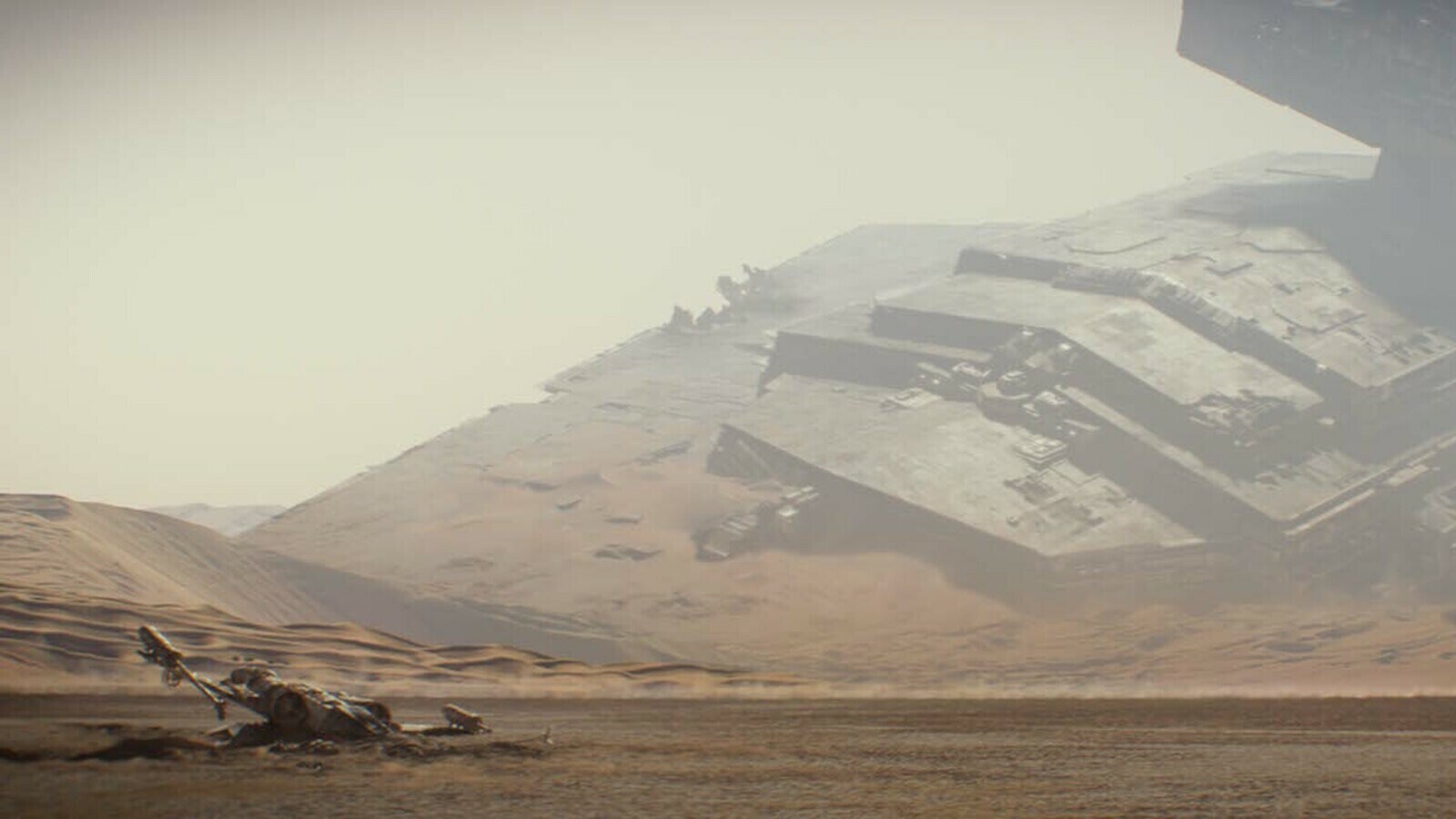
Sand dunes and open desert are broken by crashed Star Destroyers, fighters, machinery, and settlements built around trade. Wreckage functions as a resource field, turning military debris into raw material for everyday survival. Quick Facts identifies the climate as Hot and arid and the terrain as Deserts, wreck fields and settlements. Those environmental conditions affect where settlements can develop, how people travel, what resources become politically important, and which forms of infrastructure are practical. Environment does not mechanically determine culture, but it places real constraints on labor, architecture, transportation, defense, and everyday life.
03 · Built environment
Settlement, architecture, and infrastructure
Jakku’s settlements are built around scarcity and the remains of war. Niima Outpost organizes trade, food distribution, repair work, transport, and salvage exchange, while smaller villages create localized forms of community in the desert. The starship graveyard is effectively a vast industrial ruin whose hulls become shelter, landmarks, workplaces, and resource deposits. Built environment and wreckage blur together because destroyed military technology is continually repurposed into civilian survival.
04 · Society
People, community, and everyday life
Scavengers, traders, refugees, criminal groups, and transport operators create a precarious local economy. Individuals such as Rey survive by extracting value from the remains of institutions that no longer function, making salvage both a livelihood and a relationship to the past. The communities most closely associated with this file are Scavengers, refugees, traders and outlaws. The IDS focus is postwar economy, salvage, refugees, which means the planet is read through differences in institution, class, occupation, migration, and political experience rather than as a single unified culture. A world can contain neighboring populations with distinct languages, religions, histories, and relationships to state power.
05 · Economy & labor
Resources, work, and political economy
Salvage is central to Jakku’s economy. Scavengers recover parts from crashed warships and exchange them through brokers who often control food and other necessities. That system creates severe bargaining inequality because workers bear physical risk while middlemen determine value. Transport, repair, small-scale trade, and informal services grow around salvage. The planet therefore shows how the remains of a galaxy-wide war can become the economic foundation of communities that had little control over the conflict itself.
06 · Religion & worldview
Sacred landscape, belief, and moral order
Jakku includes sacred communities as well as salvage settlements. Tuanul is home to members of the Church of the Force, making the planet an important example of lay Force religion surviving Imperial prohibition and continuing into the New Republic era. Religion and worldview are treated as parts of social life rather than decorative lore. Sacred places, collective memory, ritual, moral authority, and relationships to land can influence how communities understand belonging and legitimate power. Where canon documents no shared planetary religion, IDS keeps that absence visible instead of inventing a uniform belief system for everyone living on the world.
07 · Institutions
Government, authority, and power
Jakku was relatively marginal until Imperial strategy made it important. After the Battle of Endor, Imperial holdouts used the world as a site for a final major confrontation. Later local power was fragmented among traders, bosses, and informal authorities rather than a strong planetary government. The major eras associated with Jakku are Fall of the Empire, New Republic, Rise of the First Order. Political authority can therefore change as governments, militaries, occupations, local elites, resistance movements, or outside institutions gain and lose control. The archive uses postwar economy, salvage, refugees to ask who can make decisions, who bears the costs of those decisions, and how planetary institutions connect local communities to larger galactic systems.
08 · Mobility
Movement, travel, and connection
Desert distances, wreck fields, limited settlements, and scarce resources make local movement difficult without speeders, animals, or reliable routes. Access to a functioning starship radically changes social possibilities, as Rey’s departure demonstrates. Jakku is also connected to galactic history through people arriving in search of information, relics, fugitives, or military secrets. That contrast matters: residents may experience isolation while powerful outsiders can enter and leave quickly when the world becomes strategically relevant.
09 · Conflict & security
War, policing, occupation, and defense
Jakku’s landscape is shaped by the final major battle between the Empire and New Republic, but later violence often centers on information rather than territory. The First Order attacks Tuanul and searches for the map to Luke Skywalker, turning small civilian communities into targets because of what particular individuals know. The planet thus carries two layers of insecurity: inherited military wreckage from an earlier war and renewed coercion when another authoritarian movement begins projecting power into the same remote spaces.
10 · Points of interest
Places that make Jakku legible
Places inside Jakku make large planetary histories concrete. Cities, temples, factories, homes, bases, ruins, and landscapes show where institutions actually operate and where people work, worship, govern, travel, fight, remember, and build community. IDS treats these locations as evidence of social life rather than as a sightseeing checklist. Each point is included because it helps explain how geography, political authority, material culture, religion, or historical change becomes visible on the ground.
Niima Outpost
Niima Outpost turned wreckage into an economy through salvage exchange, food rations, transport, and unequal bargaining relationships, making the settlement central to postwar survival on Jakku.
Starship Graveyard
The remains of the Battle of Jakku became both landscape and resource field. Military debris supported scavenger livelihoods while physically embedding galactic war into everyday economic life.
Tuanul village
The village associated with Lor San Tekka and the Church of the Force shows how small religious communities persisted far from major institutions and became entangled in First Order violence.
Open connected IDS file →11 · Change over time
Historical significance
The Battle of Jakku became one of the decisive engagements ending the Galactic Civil War. Decades later, its wreckage still structured economic life. The world also became part of the chain of events leading Rey, Finn, BB-8, and the Resistance toward Luke Skywalker. The principal appearances listed for Jakku are The Force Awakens and post-Endor stories. Those stories capture particular moments rather than the complete history of the world. IDS reads wars, occupations, migrations, regime changes, reconstruction, and institutional continuity as processes that reshape social life over time. Historical significance therefore comes from what changes for communities, not only from whether a famous event happened there.
12 · IDS lens
What this world reveals
Jakku is a clear example of a post-conflict landscape. War does not end when armies leave; it remains in wreckage, labor markets, migration patterns, trauma, and the opportunities available to later generations. The archive emphasis for Jakku is postwar economy, salvage, refugees. That focus is useful because it connects geography to social organization instead of treating the world as scenery. IDS asks how people experience institutions differently depending on class, community, mobility, political status, access to resources, and historical circumstance, and how those differences become visible in the built and natural environment.
13 · Sources & continuity
Official primary source
The factual baseline for this Jakku file comes from official Star Wars reference material and the canon appearances listed in Quick Facts. IDS uses those sources for names, geography, political events, communities, and chronology, while the surrounding discussion of institutions, religion, settlement, labor, and social change is independently written analysis. Some aspects of everyday life on this world remain undocumented in current Canon.