The battle that exposed an older world
The Battle of Malastare brought Republic forces into combat with a Separatist droid army on a world whose fuel reserves were strategically important. The Republic sought a decisive victory and a working relationship with the Dugs. Chancellor Palpatine ordered the use of an untested electro-proton bomb against the opposing army. According to official episode material, the detonation opened a vast crater and disturbed a creature that had remained hidden beneath the ground. The crater was a consequence of the weapon, not a named urban district or a pre-existing natural monument.
The official record gives the broad sequence, but not the dimensions and coordinates of each bomb crater or the paths of the units around it. The large visual scene should therefore be explored through contextual investigations: the weapon, the battlefield, and the creature's emergence. A dramatic still of the Zillo Beast identifies the creature; it does not create a survey of the entire Malastare front. The nearby settlement network and exact fuel fields remain outside what the episode imagery can prove.
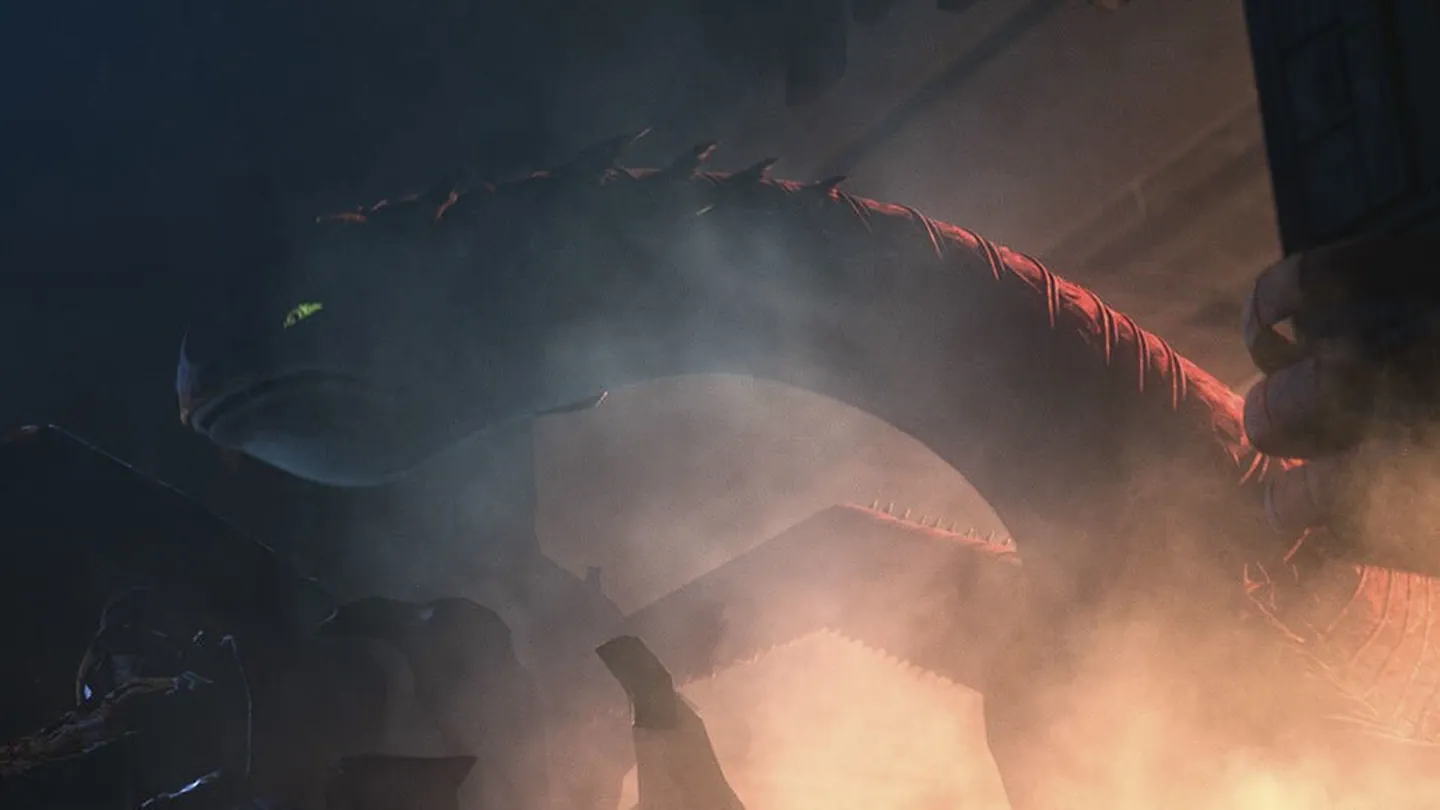
A Zillo Beast emerges
The enormous Zillo Beast had been regarded as a creature of legend. The electro-proton blast brought it to the surface during the campaign and demonstrated that the Republic was dealing with a living animal rather than a new Separatist machine. Its size and armored scales made it an extraordinary presence among much smaller soldiers and battle droids. Official descriptions emphasize that its hide resisted conventional military weapons and even lightsabers. This does not make the animal a supernatural creature; it means the available weaponry performed poorly against its physical defenses.
Anakin Skywalker and Mace Windu were among the Jedi who confronted the animal. The incident changed the objectives of the mission. A fight initially framed around destroying droids and obtaining fuel access became an effort to control an animal whose survival had ethical and scientific implications. Images of the creature can show its general form and scale, but the gallery does not assign exact distances between unidentified troopers and structures in individual frames.
Dug claims and Republic priorities
The native Dugs had their own interests in the creature and in political control of Malastare. The episode guide describes a dangerous dispute surrounding how the Zillo Beast should be treated. Their position cannot be reduced to a universal opinion held by every member of the species. It is presented through leaders involved in the confrontation. The Republic likewise had multiple motives: securing a battlefield victory, managing a strategic fuel supplier, and responding to an unanticipated environmental threat.
The creature's presence complicated those motives because it was not an enemy combatant in the Separatist army. It had been released by a Republic weapon. The choice between killing, containing and studying it was therefore different from an ordinary tactical decision. This page considers the competing institutional positions while reserving the term crater for the documented excavation caused by the blast, not inventing a sacred monument or a traditional Dug settlement on its edge.
Palpatine and the turn toward research
Chancellor Palpatine became interested in the Zillo Beast because of its seemingly impenetrable armor. The official animal history says he ordered it incapacitated and moved to a secured facility on Coruscant. Scientist Sionver Boll also investigated whether its protective scales could be exploited for military applications. This was a transition from local battlefield crisis to a centrally directed experiment. The relocation meant the animal's fate was controlled by officials far removed from the planet where it had emerged.
The decision should not be confused with a rescue intended to restore the creature to Malastare. Its transfer to Coruscant led to another dangerous episode when it escaped the facility and threatened the capital. The page links to the relevant official sources for this continuation, without depicting the Coruscant containment site as though it belonged on Malastare. The different planets and stages remain visible in the investigation.
A battlefield and an ecological intervention
The unexpected emergence is an example of a military operation producing a consequence that its commanders had not anticipated. The weapon was intended to destroy droids. Its ground-level impact exposed a living creature and transformed the problem facing soldiers, scientists and the Dug government. The episode does not provide a complete biological survey of Malastare, however. It cannot establish that other Zillo Beasts lived beneath every forest or that the crater was the species' sole habitat over thousands of years.
Nor does the scene establish how ordinary fuel workers or nearby civilian communities experienced the event. Those people are largely missing from the available imagery. The page can identify the absence and explain the strategic importance of fuel, but should not invent evacuation orders, eyewitness accounts or casualties. A grounded interactive account follows the documented weapon strike, encounter and transfer while distinguishing what remains unknown about local environmental effects.
Reading the visual sources
The gallery contains official images of the Zillo Beast and other documented participants, together with the original Malastare world image. A portrait of Sionver Boll provides the scientific link; a picture of a Dug supplies a reference to the species. Neither proves that the person or individual creature appeared at a particular meter of the crater rim. Scene labels open linked investigations, not imaginary map coordinates. A source gallery is especially important because illustrations from different episodes cannot be treated as consecutive frames of one continuous camera movement.
Visitors can follow the episode guide, the Zillo Beast Databank and the planet entry to check the major claims. Each scene switch presents a distinct subject with a sourced picture and an updated investigation panel. On mobile, those controls remain inside the art area, rather than being silently converted into navigation cards below it. The page is complete as an evidence-led encounter, while its precise spatial reconstruction remains deliberately limited by the record.