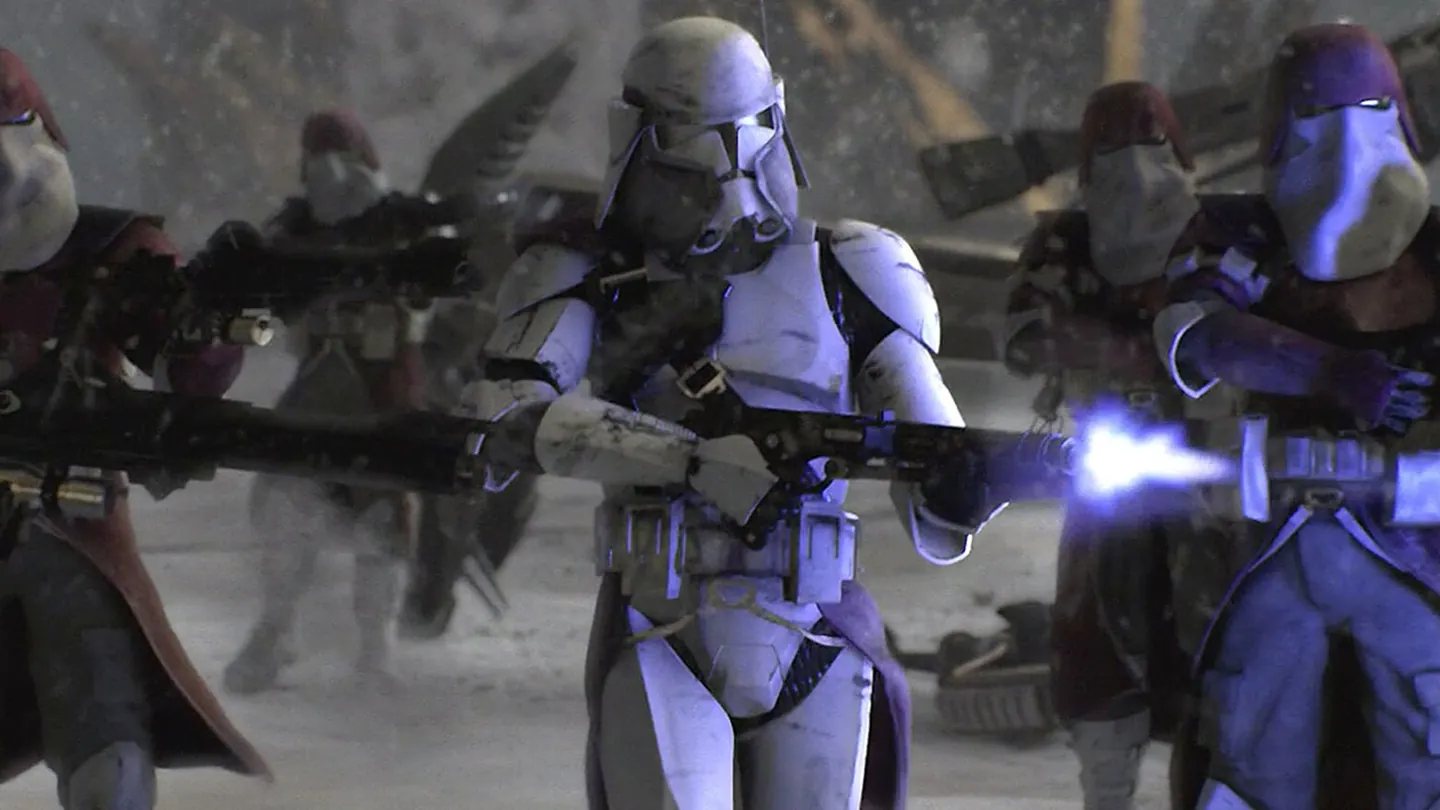
Front under siege
The campaign on Mygeeto belonged to the Outer Rim Sieges, the Republic's final military effort to break the Confederacy of Independent Systems. Official descriptions place Ki-Adi-Mundi and Commander Bacara against Separatist droids on this frozen crystalline world. The film offers a short, intense view of a city-scale battlefield, but not a complete geographical survey. This experience therefore follows the documented people, military structures, equipment, and sequence of events without assigning a fabricated name or coordinate to a particular bridge. The pictured front is evidence of a larger battle rather than a surveyed map of the planet.
The landscape matters to the story. Mygeeto's cold environment and sharp crystalline formations distinguish it from other siege locations. The filmed approach shows a built settlement and bridge-like structures. Yet the source record does not establish the dimensions of every street or the positions of all formations. Moving through this scene means examining what can be seen and documented, not promising a complete tactical route. The Republic and Separatist forces operated amid infrastructure belonging to a world whose political and commercial significance long predated the moment shown on screen.
The armies and their equipment
Commander Bacara led the Galactic Marines, a specialized clone unit recognizable by its distinctive protective armor. The Star Wars Databank describes its aggressive battlefield record and its role in the assault on Mygeeto. The armored marines belong in the scene because the film explicitly shows Bacara's troops with Ki-Adi-Mundi. Their equipment conveys more than a visual uniform. It identifies an organized military force whose command hierarchy could transmit orders instantly across planets. Here, visitors can investigate the army's structure and the specific moment when that organization turned against its general.
The Separatist side included battle droids. Official records identify the Octuptarra droid as a towering, three-legged combat machine, and note that smaller variants fought on Mygeeto. The machines illustrate the industrial scale of the conflict, but the presence of one model does not prove it occupied a particular street in the film's brief sequence. The explorer therefore presents machinery as a documented part of the campaign, not as an excuse to invent a street plan. The conflict joined local infrastructure to galaxy-wide logistics, tactics, and military production.
A Jedi general in a constitutional crisis
Ki-Adi-Mundi had served as both a Jedi Council member and a Republic general. In the final phase of the Clone Wars, he continued to communicate with Coruscant and questioned Chancellor Palpatine's accumulation of emergency power. This political context is important: the soldiers who followed him on Mygeeto belonged to the same Republic institution whose elected executive was transforming the war into an instrument of control. His final campaign was not a separate accident or a routine victory interrupted by a misunderstanding. The attack on him formed part of the coordinated execution of Order 66 across multiple fronts.
The official biography states that the marines opened fire on their Jedi general after Palpatine transmitted his order. In the film, Ki-Adi-Mundi turns, attempts to resist, and falls under clone blaster fire. It is a clearly established event; the exact ground route, casualty count, and civilian experience are not established by that footage. A truthful interactive reconstruction should keep those boundaries visible. A visitor may compare the military command chain and the Jedi's response, but should not treat visual approximations of positions and distances as measurements taken from canon.
What changed when Order 66 arrived
The collapse of the Jedi command relationship is the central event of this battlefield. Bacara and his troops had fought as part of the Republic force led by Ki-Adi-Mundi; within moments of the command, they became his killers. That abrupt reversal explains why images of ordinary troop formations can be misleading when viewed without chronology. The same uniform and chain of command existed on either side of the change, while the institution's definition of who was an enemy shifted. The scene explorer separates the pre-order campaign from the execution of the command rather than treating them as simultaneous combat events.
Order 66 affected numerous worlds at nearly the same time, with parallel deaths at Cato Neimoidia, Felucia and Saleucami. These are separate events and must not be merged into a single imagined battlefield. They can, however, be read together as evidence of a command network acting over enormous distances. The Mygeeto account thus connects to those other planet files while remaining rooted in its own visual and written record. Visitors who follow the linked worlds see a shared turning point without being told that they shared a local geography.
Civilians and histories outside the frame
Mygeeto was not simply an empty stage for a Jedi's death. The Databank identifies the world as the Lurmen homeworld and describes control by the InterGalactic Banking Clan. This means that the final battle occurred in a society and an economic landscape that the film barely explores. It is appropriate to ask how such a conflict affected local people, commerce and ordinary institutions, but the available source does not specify their experience in the depicted streets. A disciplined archive can explain the importance of those questions without inventing witness accounts or civilian structures.
The Lurmen are known through the group who settled on Maridun to escape the war. Their history is relevant to Mygeeto as a history of displacement, not proof that the Maridun settlement's buildings, farming practices or political choices also existed in the Mygeeto cityscape. The distinction is retained in the connected investigation. The world offers a concrete intersection between displacement, military occupation, and the power of a galaxy-wide financial institution, but each belongs to a separate documented part of the record.
A documented sequence, not a tactical map
The surviving footage provides a sequence, not a full map. It identifies Ki-Adi-Mundi, clone marines, an attack, and the frozen setting. The Databank supplies broader context on the Banking Clan, the Lurmen, the Outer Rim Sieges and Bacara's command. Neither source provides a reliable coordinate list for the locations a viewer might wish to click. For this reason, the image labels here identify investigative subjects and route to dedicated dossiers or official sources. They do not create false dots on buildings whose identity cannot be proven.
This distinction also shapes the archive's timeline. A battlefield view made before Order 66 cannot be labeled as though the marines were already attacking their Jedi commander. A view of the betrayal should not be used as evidence of every preceding clash. The two documented conditions belong to the same campaign, but carry different meanings. Image titles and citations should therefore reveal what a picture can actually support. When a source is silent, the page states the uncertainty instead of filling the gap with a precise-sounding reconstruction.