What the landscape reveals
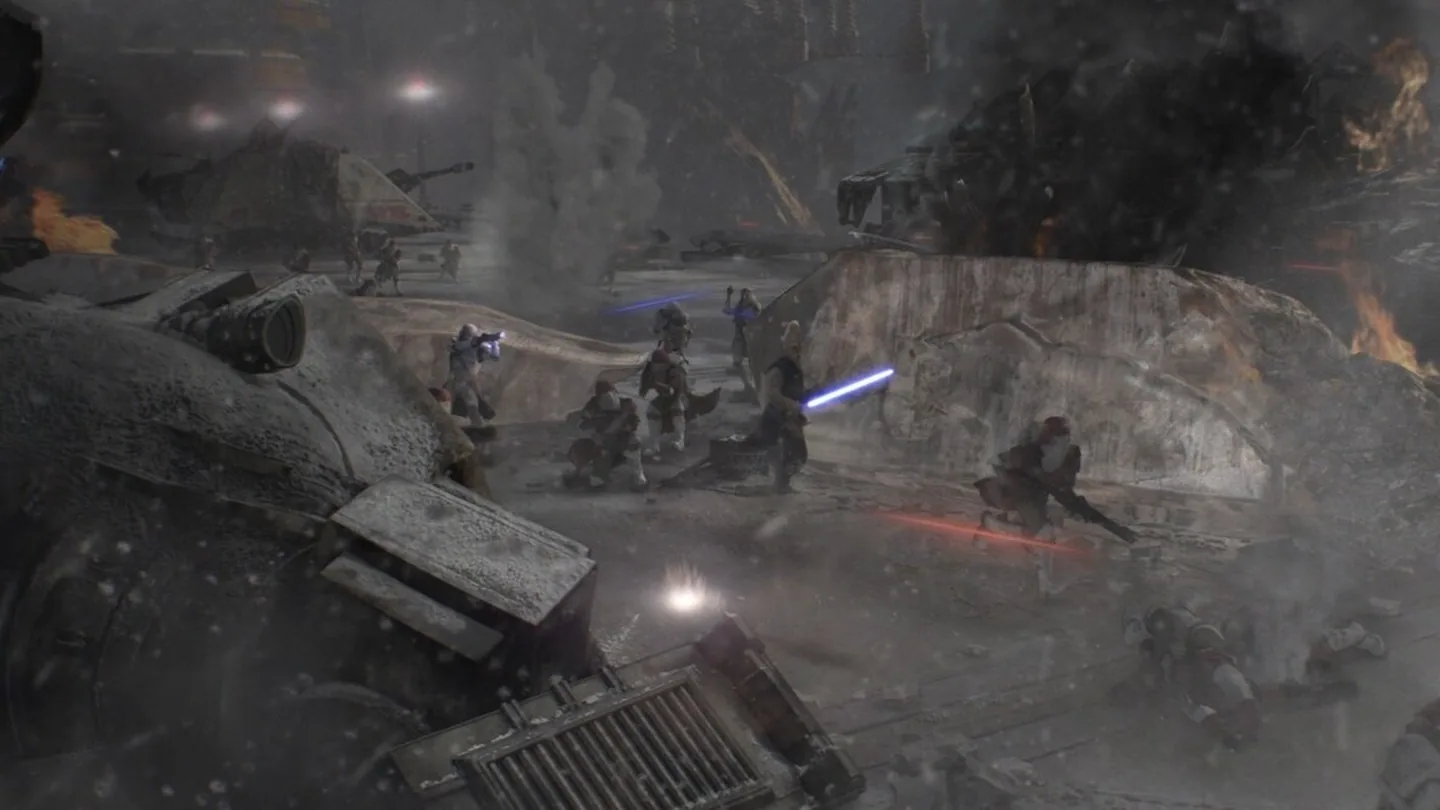
The Star Wars Databank describes Mygeeto as a frigid Outer Rim world with jagged crystalline terrain. Those words establish a strong visual identity, but they do not amount to a complete natural history. The broad ice-covered environment, imposing crystals, and built installations visible in official imagery justify a landscape investigation. They do not justify assigning precise elevations, regional climate statistics or named districts to unseen areas. Visitors can examine the distinction between natural features, settlement imagery, and the political history attached to the world without assuming that every illustration identifies a surveyed place.
The existence of substantial urban structures matters because the planet was not merely a remote wilderness. The visible built setting implies infrastructure capable of supporting work, settlement, and transport, yet the specific uses of individual buildings are not identified in canon. This page therefore uses the term crystalline landscape as a descriptive scene, not as a new official location name. Its visual labels are contextual topics located within the picture rather than claims that a particular unidentified tower is a bank, a home, or a government complex.
Corporate control and its limits in the record
Mygeeto came under the control of the InterGalactic Banking Clan. That explicit statement places a financial power at the center of the planet's modern history. It does not establish every legal mechanism of control, every resident's role, or the layout of any Banking Clan headquarters. The institution's significance is especially evident during the Clone Wars, when corporate organizations and the Separatist political project were intertwined. The relevant question for this archive is how a world associated with financial power also became a major battlefield, not how to invent a fictional palace or vault absent from the sources.
By comparing the world description with Republic battlefield accounts, readers can see two different scales of documentation. The military record concentrates on identifiable commanders and the short period of the Outer Rim Sieges. The economic record supplies an institution and a relationship to the world but few details of everyday commercial administration. Keeping the evidence separate helps avoid mistaking a dramatic cinematic image for a comprehensive account of society. It also makes the associated source links useful for independent inspection rather than decorative endnotes.
Lurmen origins and the Maridun diaspora
The Lurmen are indigenous to Mygeeto according to official Star Wars reference material. Their best-documented story, however, follows a particular group that traveled to Maridun to escape violence. Tee Watt Kaa led that community and advocated avoiding armed conflict. When war reached Maridun, the settlers faced a difficult question about whether defending their home could be consistent with their values. These events do not occur on Mygeeto and should not be illustrated as though they did. They reveal something about Mygeeto's people through a documented movement away from their homeworld.
A history of migration creates a different type of geographic connection from a military route. Mygeeto and Maridun are linked by the origin and later residence of a community, not by the claim that the same village exists on both planets. This experience treats the Lurmen story as a carefully labeled comparison. It connects the Mygeeto file with its people and a known off-world episode, while avoiding invented neighborhoods, temples, governing bodies, or religious practices for the undocumented parts of their homeworld.
Questions about ordinary life
Official material provides very little direct account of ordinary labor or kinship on Mygeeto during the final sieges. It would be reasonable to ask how cold terrain shapes construction, what civilian work sustains settlement, or what an occupying financial institution demands from local residents. It would not be reasonable to answer these questions as established fact without a source. The interactive investigation uses documented images to establish what is visible and offers separate explanations for what those images leave out. It makes uncertainty part of the world record rather than hiding it beneath generic lore.
The same caution applies to military interpretations of public space. A bridge or elevated road visible in film imagery may carry a battle, but its prewar everyday purpose is not specified in the Databank. Visitors can see that transport infrastructure would have mattered to wartime movement without being told an invented name or exact civilian usage. This separation between observed material features and inferred social consequences allows the archive to discuss culture and institutions with more care than a speculative city guide.
Why the siege is a separate investigation
The last part of the Clone Wars placed Mygeeto within a much wider political collapse. Republic forces battled Separatist droids, the Chancellor issued Order 66, and the Galactic Marines killed Ki-Adi-Mundi. These events are independently documented and provide a chronological boundary for the page. A visitor exploring the environmental and economic scene should not receive a map that simultaneously displays the planet as peaceful before the battle, controlled by a military garrison, and devastated afterward. The sources do not establish sufficient images of those different states to make a trustworthy historical slider.
Instead, this page links to the Mygeeto battlefield for the documented military sequence. It keeps the general landscape separate from the actions of particular commanders. That division matters because warfare gives an incomplete view of a world: a few seconds of a battle cannot show the full history of a people or the operation of an economic institution. The content is therefore organized by evidence type, with landscape, inhabitants, and military events accessible as distinct investigations.
Images, sources and uncertainty
The reference images are official stills, illustrations or character records credited in their gallery views. A portrait of a Lurmen or a Separatist unit is not presented as an eyewitness photograph of a named place on Mygeeto. It provides a documented connection to the world, and its caption should say which connection is being shown. This is particularly important on a small screen, where an image-led page can imply much more certainty than the text below it. The browser's on-image controls identify subjects without drawing misleading circles over unidentified structures.
A reader who wants to check the account can follow the Mygeeto Databank, the Lurmen Databank and the Clone Wars episode guides concerning the Maridun community. Those sources establish the broad terrain, the homeworld connection, the community's relocation and the final campaign. They do not establish a full atlas of settlements. The investigation remains open to future documented additions, while its present labels and links avoid converting artistic interpretation into a fact about canon geography.