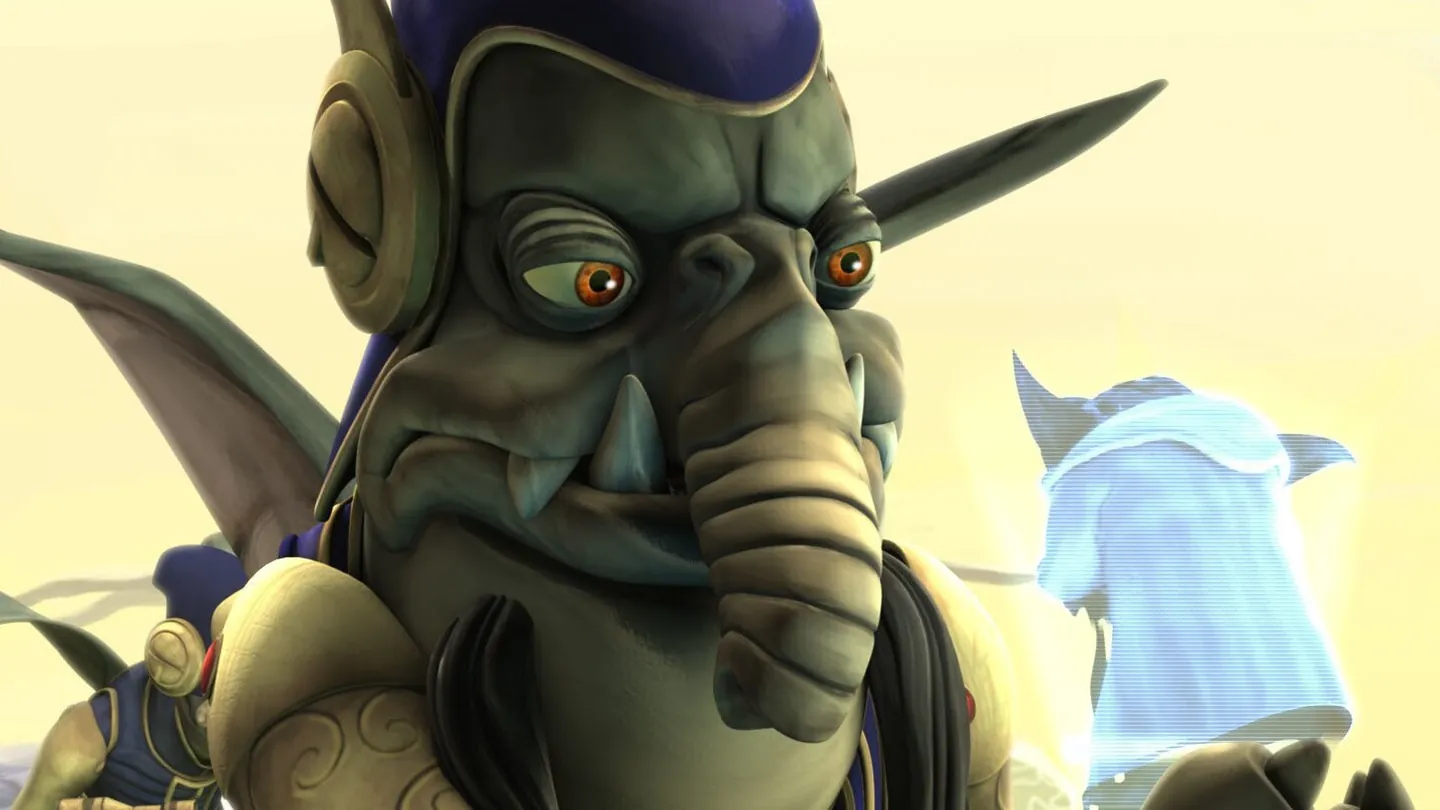
A monarch under wartime pressure
Toydaria's position during the Clone Wars cannot be reduced to the preferences of one outside faction. King Katuunko was sovereign of a people living among foggy forests and wetlands, and the official account emphasizes his concern for their safety. He initially sought neutrality rather than a binding commitment to either the Galactic Republic or the Separatist movement. That decision had practical consequences because both sides wanted access to a world situated near important routes and other contested locations. Neutrality was therefore an active policy, not a claim that the war had no consequences for Toydarians.
The surviving episode material gives a clear account of the king's choices, but not a complete description of his court buildings, council procedures or constitutional powers. A portrait of Katuunko identifies the ruler; it does not prove which room hosted every negotiation. The image controls on this page refer to political decisions and documented participants rather than placing false markers on a palace interior that has not been surveyed.
Yoda and the encounter on Rugosa
An early test of Toydarian diplomacy occurred on the neutral moon of Rugosa. Yoda traveled there to meet King Katuunko, while Asajj Ventress arranged a Separatist challenge intended to influence the king's decision. The Jedi reached the moon despite an ambush, demonstrating discipline and concern for his troops during the encounter. Katuunko's response helped establish an understanding with the Republic. This is a documented off-world meeting associated with Toydarian sovereignty, not a battle fought in the swamps of the Toydaria homeworld.
Rugosa's separate identity matters. A picture of its terrain cannot correctly appear as a named Toydarian city street. The archive treats the event as a political connection and links the moon's own official Databank. It also distinguishes the king's changing position from the behavior of any individual Toydarian who appears elsewhere in Star Wars. A conversation with one sovereign does not define the private beliefs of every resident.
Relief supplies and the Ryloth emergency
Later, as the Separatist blockade and invasion endangered Ryloth, the Republic sought Toydaria's cooperation. Bail Organa and Jar Jar Binks traveled to the world to ask for assistance in delivering urgently needed supplies. King Katuunko faced a difficult choice because overtly aiding the Republic risked drawing his people into the war. The official Supply Lines episode guide establishes that he ultimately agreed to help despite pressure from a Trade Federation envoy. His decision was consequential for civilians and clone troops far from Toydaria.
The documentary record does not establish an exact loading dock or sequence of airport gates for the relief mission. A relief corridor is a description of the supply arrangement, not an officially named road through a local town. Images of Bail, Katuunko and the mission illustrate actors and decisions, and the separate route investigation explains the material stakes without inventing transport coordinates.
The Trade Federation's challenge
Lott Dod represented a commercial power whose institutions were deeply entangled with the Clone Wars. In the Supply Lines episode, he tried to block Katuunko from allowing the Republic to use Toydaria for aid. The presence of a Trade Federation envoy made the Toydarian decision more than a private appeal by friendly senators. It became a contest over who could influence a neutral government and whether urgent humanitarian assistance should be treated as a breach of political nonalignment.
The episode specifies Dod's intervention but gives no exhaustive transcript of closed-door deliberations or financial agreements. This page therefore follows the named public encounter. It avoids inventing votes, separate ministries or secret meetings among unnamed Toydarians. A gallery portrait of Dod offers a documented institutional connection. It is not used to identify an unverified building or to suggest every Trade Federation vessel shown elsewhere landed on Toydaria.
Diplomacy, identity and off-world Toydarians
Toydarians are winged humanoids with a distinctive body form and an ability to resist certain forms of Force influence. The Databank names the species as inhabitants of Toydaria. Watto is another well-known Toydarian, but his life as a junk dealer on Tatooine is a separate story. His appearance does not establish that the king employed him or that the political debate on Toydaria included him. He is useful as a comparison showing that people from the same homeworld can have very different occupations and relationships to institutions.
That difference matters to the court investigation. The king's stance was a policy for the planet. It was not an anatomical or psychological characteristic shared by every Toydarian. The gallery keeps portraits of off-world individuals distinct from photographs or illustrations of the foggy homeworld, so a reader can explore political authority without collapsing a species into a single representative.
What the official record can verify
The strongest sources for this page are Toydaria's world profile, King Katuunko's biography, the Rugosa Databank and the Supply Lines episode guide. Together they establish a progression from neutrality through specific diplomatic tests to participation in Republic relief. They do not establish a measured map of the royal complex, individual home addresses or a full history of Toydarian law. Historical scene switching here follows documented decisions rather than imaginary construction and destruction of buildings.
Mobile visitors can use contextual topics directly inside each image to move between the king, the negotiations and relief policy. The images do not show the same physical room from different camera angles. They present distinct official reference evidence, each with its own caption and source. The destination's title identifies a political investigation, not a newly invented palace or an exact place on the planet.