The palace as a center of political power
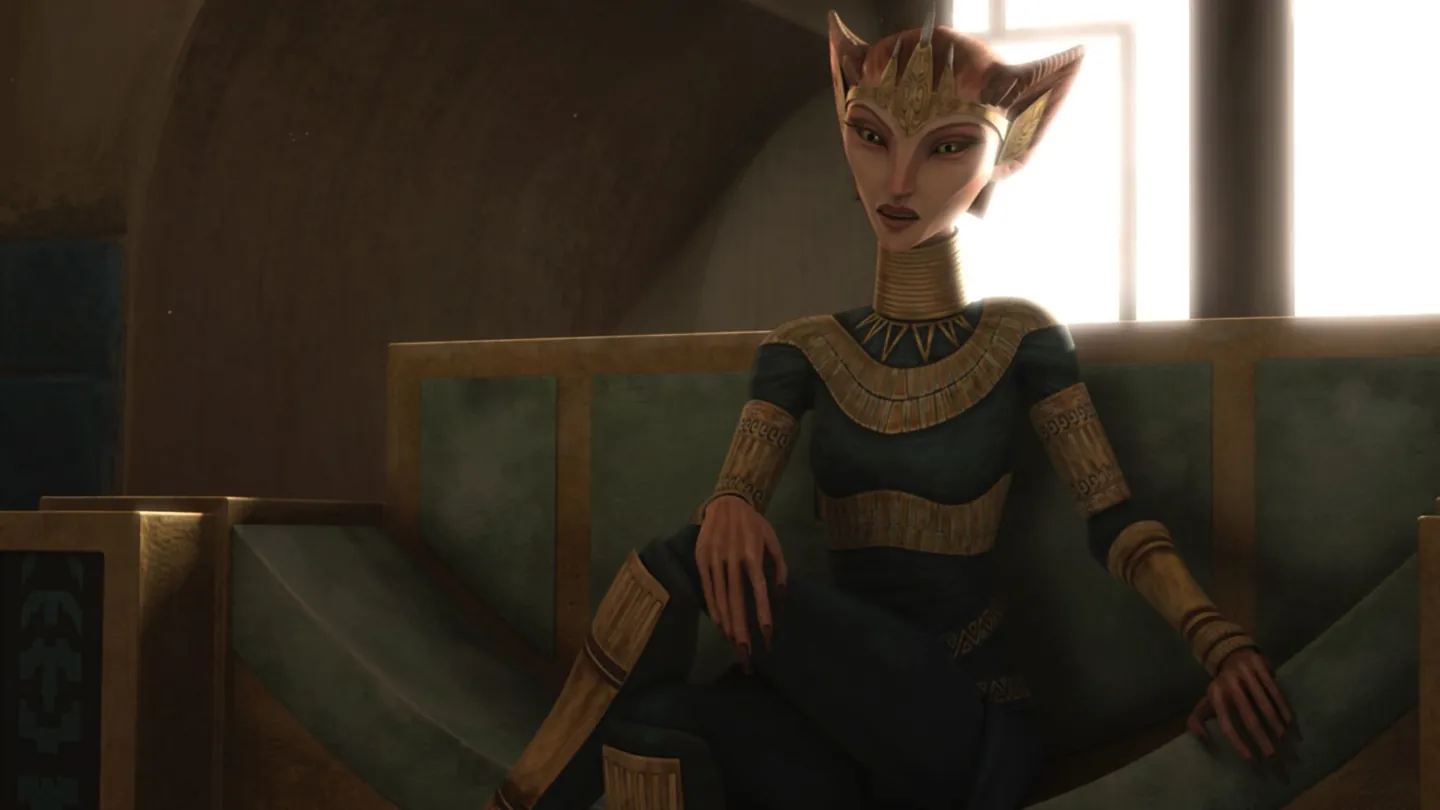
Queen Miraj Scintel ruled Zygerria during a renewed attempt to restore the empire of slavery. The royal palace was more than a residence. It was an institutional center where the queen received powerful guests, oversaw her court and attempted to shape the political future of the Zygerrian trade. The official series depicts a recognizable royal chamber and guards, but does not provide a complete floor plan. This page therefore connects images to documented decisions instead of attaching false coordinates to imagined doors, prisons or balconies.
The palace also expressed an older social order in which rank and possession of others were central to legitimacy. Its refined appearance did not lessen the violence on which the regime depended. Viewing the court and city market together is necessary to understand how elite power relied upon labor extracted from people who had not consented to participate.
Miraj's vision of restoration
The official Queen Miraj profile describes a ruler who wanted to bring Zygerrian slave-trading power back to its former scale. Centuries of suppression by Jedi and Republic authorities had weakened the empire and driven much of the trade into the underworld. The Clone Wars gave Miraj an opportunity: she could ally with the Separatists while the Republic was engaged in a sprawling military struggle. Her ambition was a political and economic project, not an effort to restore freedom to people already under Zygerrian control.
The palace was where that vision appeared in the queen's dealings with visitors and subjects. Miraj's willingness to use Anakin as a captive reveals how she linked personal domination to political power. The account does not imply that she enjoyed unlimited independence from Dooku or that her court represented every Zygerrian resident.
Atai Molec and the court's enforcement
Atai Molec held two major offices: prime minister and captain of the royal guard. His authority extended from palace security into direct enforcement of slavery in the markets. The Databank describes him searching for signs of rebellion and personally using an electro-whip to punish people he controlled. This combination made government, policing and economic coercion difficult to separate. People confronted not only private traders but agents acting in the name of the royal administration.
Images of Molec and the palace guard are therefore explanatory subjects, rather than decoration or evidence of a named gate at a particular coordinate. The archive describes his recorded functions without inventing subordinate commanders, the exact number of guards or a detailed blueprint of their headquarters.
Anakin enters the court in disguise
Anakin Skywalker entered Zygerrian society while searching for the missing Togruta of Kiros. His mission required deception and restraint because revealing his identity could endanger the captives whose location remained unknown. The queen became interested in him as someone she could possess and control. Her attitude sharpened the conflict between the Jedi's immediate need for information and Anakin's emotional reaction to the practice of enslavement.
Anakin's own childhood experience of slavery gave the situation special weight. Yet the story is not only about his memories. Ahsoka, Obi-Wan and the abducted Togruta were also at risk, and the political machinery of the Zygerrian court was the cause of their suffering. The scene controls connect the character record, the episode and the offworld destination without inventing private conversations not in the source.
The court and its Separatist sponsor
Count Dooku's involvement shows that Miraj's court was not an entirely isolated local enterprise. The Zygerrian slave trade expanded with Separatist assistance at a time when the Republic's attention was divided. Dooku and the queen did not necessarily share identical goals: Miraj wanted Zygerrian prestige and commercial domination, while Dooku treated the alliance as part of a wider war. The episode makes the limits of their arrangement consequential for the queen.
An accurate chronology also distinguishes the seizure of the Kiros colony, the infiltration of Zygerria and the later rescue at Kadavo. The latter was a separate volcanic planet with a massive slave-processing facility. It is not a basement in Miraj's palace or a district across the city, and the interactive page avoids treating those locations as interchangeable.
Evidence and visual interpretation
The Zygerria world record, Miraj's official biography, the Atai Molec entry and the Slaves of the Republic episode guide support the palace's political significance, its coercive practices and Anakin's encounter. The concept gallery offers a visual study of the queen's chambers, but its production designs must not be confused with an authoritative architectural survey of an entire estate.
Visitors can shift between court leadership, the prime minister's enforcement and the undercover mission. Each scene uses a different documented image subject, with clickable labels available inside the scene on phone and desktop. Gallery subjects are distinct from the first scene hero, and every local event is separated from the offworld labor site to preserve both the story and basic planetary geography.