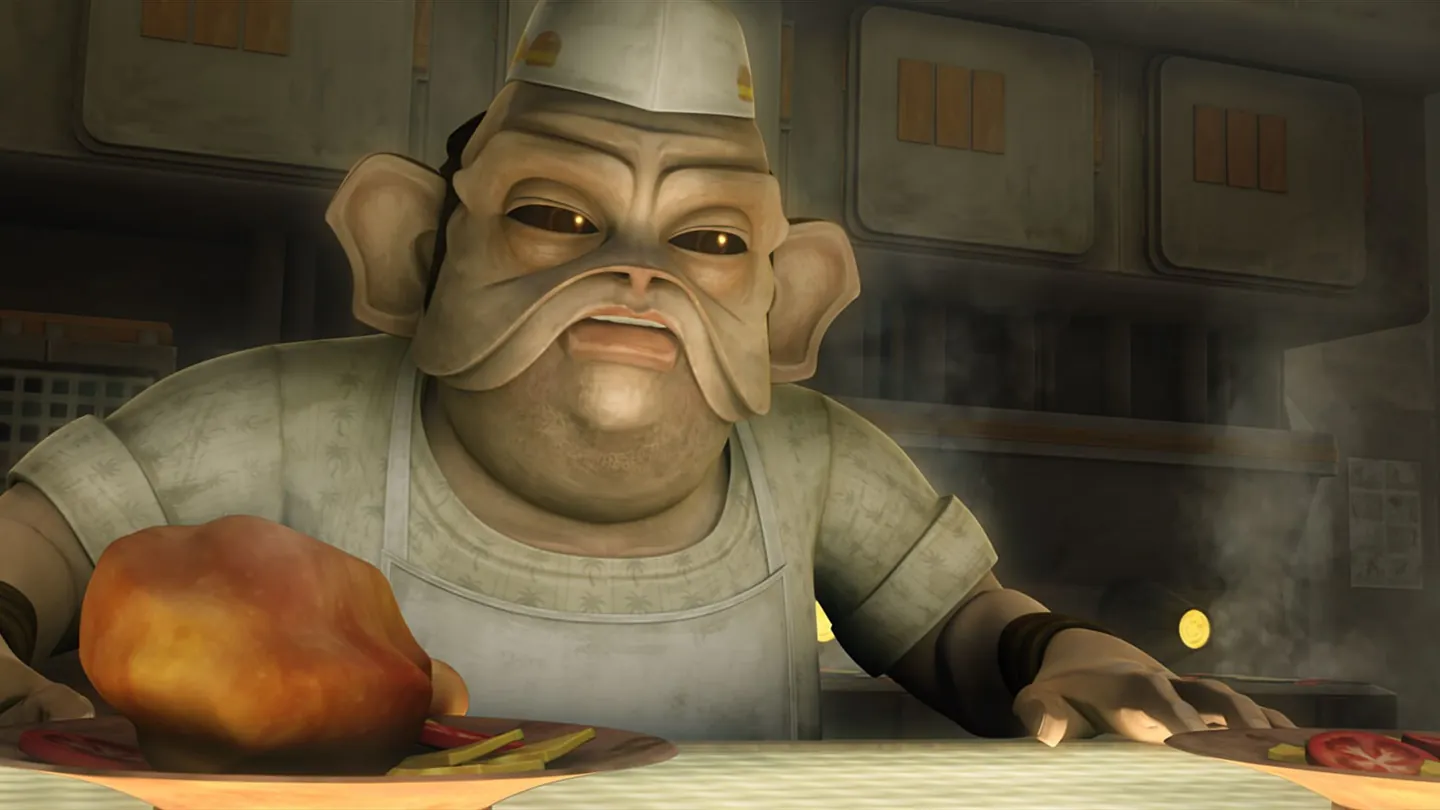
A settlement amid the empty world
Pons Ora was one of the few inhabited settlements on Abafar, a world otherwise dominated by the optical emptiness of the Void. The official Databank names the town and its nearby rhydonium installation, which was operated for the Separatists during the Clone Wars. The settlement was neither a planetary capital with a documented urban plan nor an uninhabited outpost. Its diner, residents and industrial operation gave the stranded D-Squad a place to seek help.
Those facts support an investigation of the town, but not invented streets or building numbers. The source portrays a small community where an opportunistic proprietor could exploit a vulnerable worker. Scene topics connect the diner, Gregor's identity and the nearby fuel operation without drawing a false schematic of their precise separation.
Mister Borkus's treatment of Gregor
Mister Borkus was a Sullustan diner proprietor who found a clone commando suffering from amnesia after a crash. He offered Gregor room, board and work washing dishes, but withheld information about his origins and took advantage of the soldier's confusion. The terms left Gregor almost entirely dependent on his employer because small wages could not cover the costs charged for his necessities. The Databank describes the practical relationship as a kind of enslavement.
The diner was not a neutral safe house staffed by sympathetic helpers. Borkus's behavior limited Gregor's freedom and prevented him from discovering the military identity that others might have recognized. The image of a diner owner therefore illustrates a specific documented power relationship rather than a generic picturesque local occupation.
How D-Squad identified the dishwasher
Colonel Gascon and the five droids encountered Gregor after crossing the Void. Gascon suspected the man might be a Republic clone despite his beard, disheveled clothing and lack of clear memories. R2-D2 used technical analysis to identify a wrist implant and confirm that Gregor was CC-5576-39, the captain of an elite commando squad lost at the Battle of Sarrish. The revelation gave Gregor a concrete identity and a path toward recovering his former purpose.
He had not simply chosen to desert the Republic or join the Separatists. His memory loss followed a crash, and his subsequent dependence on Borkus was exploited. The archive preserves that distinction, which is central to understanding why his eventual willingness to aid D-Squad represented recovery of a lost commitment rather than an unexplained change of allegiance.
Recovering equipment and military training
Once the truth emerged, Gregor confronted Borkus, reclaimed his armor and began to remember how to act as a soldier. Official accounts emphasize that even while his memories remained imperfect, his training could guide him. He helped the small unit plan an escape through a Separatist-controlled transport operation. The episode does not establish every item in the diner's inventory or a hidden military barracks next door, and this page does not fill those gaps with fictional objects.
The commando's response also contrasted with the exploitative relationship at the diner. He accepted significant personal risk to help a group of Republic agents who had given him information rather than demanding permanent obedience. His decision shifted attention from the town's coercive local employment arrangement to the industrial and military threats around it.
The rhydonium plant and Separatist cargo
Rhydonium was a highly combustible fuel extracted on Abafar and used in large quantities by Separatist forces. The mining or processing operation near Pons Ora gave the Confederacy a resource it could transport for military use. A shuttle loaded with the volatile material also created an opportunity for D-Squad to escape the planet, provided the droids could seize the craft and depart before the Separatists stopped them.
The transport's hazardous cargo made the operation especially dangerous. Gregor held off attackers so the Republic agents could leave, and a powerful explosion followed. The Star Wars record later confirms his survival; the squad's immediate assumption that he had died must not be presented as an eternal fact. The page uses fuel, ship and character images as documented subjects rather than exact marked positions on a refinery map.
A town that the wider war reached
Abafar's remoteness did not mean its inhabitants were insulated from the Clone Wars. Separatist fuel extraction, a stranded Republic clone and D-Squad's theft of a transport linked Pons Ora to larger military institutions. Local power also existed in smaller relationships, as Borkus's treatment of Gregor demonstrated. These different scales matter because neither the industrial operation nor the diner alone explains the situation of the vulnerable commando.
The companion Void page documents the extraordinary environmental journey that brought D-Squad to town. This destination concentrates on specific people and material institutions. Its three changing scene images and source links allow the investigation to remain interactive on desktop and iPhone without inventing exact streets, refinery entrance coordinates or unsupported named districts.