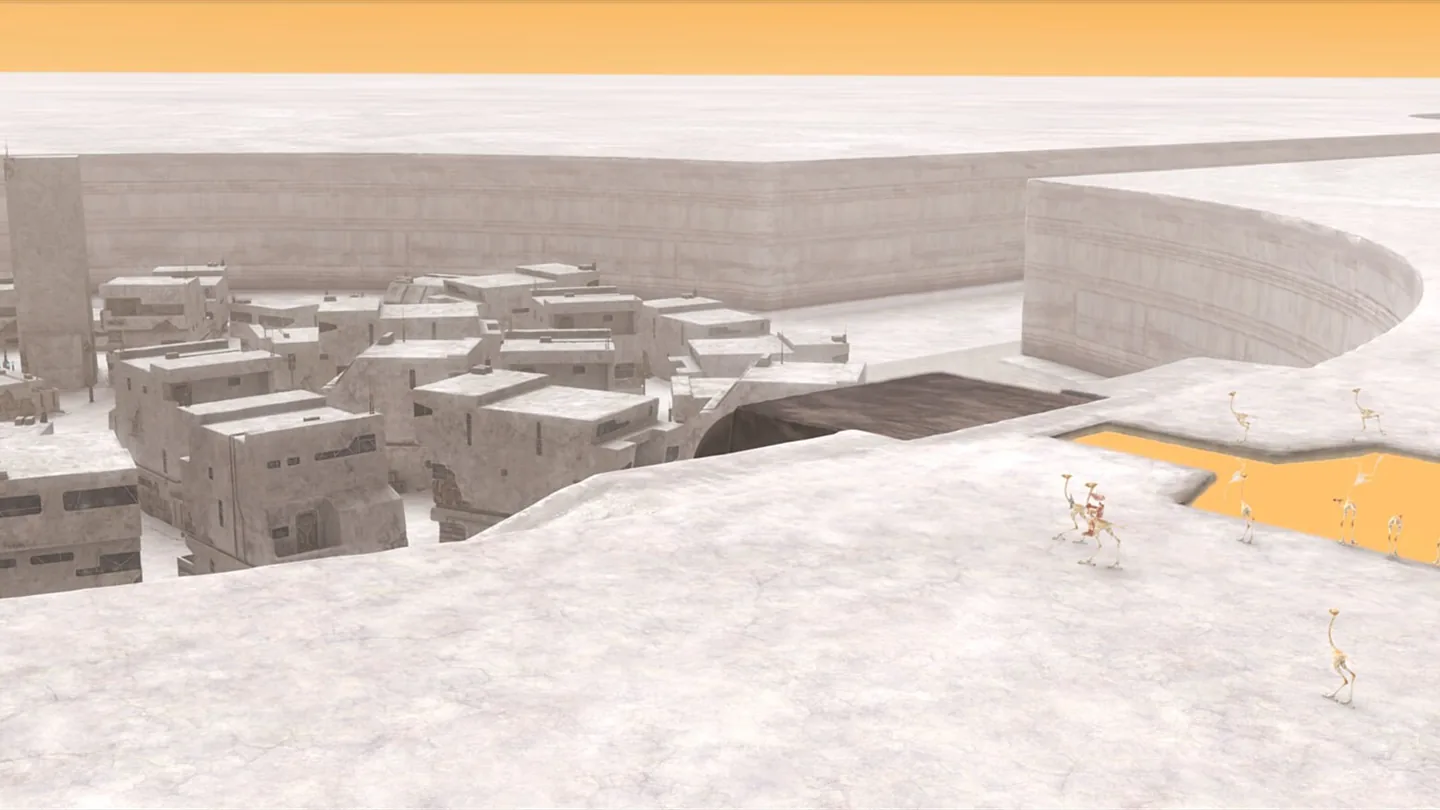
An environment that removes visual direction
Abafar's Void is one of the most unusual deserts documented in Star Wars. The official Databank describes fine regolith that refracts light so effectively that shadows and footprints become difficult or impossible to detect. Suspended atmospheric particles scatter sunlight into a persistent orange glow. A traveler cannot reliably infer the time or direction from familiar cues. The emptiness is therefore a documented physical condition, not merely a poetic label for a large barren valley.
No source supplies a geographic route of the stranded team's movements with accurate distances or named intersections. This page treats the featureless surface as the story's defining environment and refuses to invent clickable rocks as coordinate markers. Readers can instead open documented scenes about navigation, survival and the people who eventually reached a settlement.
How D-Squad reached Abafar
Colonel Meebur Gascon led a specialized five-droid Republic team assigned to acquire a Separatist encryption module. After completing the initial mission, their shuttle was damaged by a comet and crashed on Abafar. The team found itself far from assistance with limited supplies and no obvious route across the desert. The crash belonged to the journey home from another operation, not a planned expedition to survey Abafar's geology.
R2-D2, WAC-47 and the other droids were trained or modified for particular tasks. In the Void, those abilities were less straightforwardly useful than in their original mission. Their experience challenged the assumption that military authority alone could produce an immediate answer. The episode shows a leader depending on subordinates with different forms of practical knowledge.
The colonel's crisis
Gascon was an experienced Republic officer with a strong commitment to rank and procedure. The seemingly infinite desert left him discouraged when plans failed to yield results. His small physical size was not the reason the team struggled; the problem was an environment that denied ordinary direction and a sequence of unlucky events that removed the squad's transportation. His loss of hope was personal and situational.
WAC-47's behavior repeatedly irritated the colonel, but the droids also demonstrated resourcefulness. Gascon's willingness to continue changed as he listened and considered what the team could still accomplish. The episode does not require the audience to imagine an undisclosed rescue settlement in the desert; its essential conflict concerns whether the team can persist until it finds a real destination.
A desert that defeats the usual map
Stories set in deserts often allow travelers to follow landmarks, tracks or the shadows of distant formations. The Void was explicitly designed to deny those methods. Its uniform illumination and light-twisting surface created a perceptual challenge rather than an obstacle solved by memorizing a series of monuments. The visual navigator therefore presents three contextual scenes without converting incidental image details into false locations.
Abafar was sparsely inhabited, yet it was not entirely empty. Pons Ora existed as a real settlement, and a Separatist mining operation extracted rhydonium. The team eventually emerged from its ordeal near that activity. The archive links to the documented town, avoiding an invented promise that every visible desert feature on the panorama corresponds to a named geographic site.
Droids as participants in the mission
The five droids of D-Squad were not simply interchangeable cargo. Each performed distinct duties and demonstrated different reactions to Gascon's leadership. The Databank names R2-D2, QT-KT, U9-C4, M5-BZ and WAC-47 as members. This limited roster matters because it anchors the actual team instead of adding fictional assistants or claiming unrelated robots appear in the episode.
WAC-47 challenged the way the colonel demanded obedience, while R2-D2 offered technical experience accumulated through earlier Republic service. The droids' participation helped sustain the team through the crossing. Their choices make the episode an examination of command and cooperation within a military institution, not simply an inventory of machines moving through sand.
What the scene evidence can demonstrate
The Abafar Databank establishes the optical behavior of the Void and the existence of Pons Ora. A Sunny Day in the Void documents the crash and the stranded team. The D-Squad, Gascon and WAC-47 records identify the participants and their roles. These sources do not authorize claims about exact travel distance, total time spent on the surface, permanent routes, coordinates or every object visible in a scene.
Three documentary images allow visitors to change between the vast landscape, the colonel and the team. The topic links remain tappable directly inside the art on iPhones without implying the location of the original crash through a guessed dot. The connected Pons Ora investigation explains the town and rhydonium operation that made the team's eventual escape possible.