Disaster in Aleena communities
Aleen is a Mid Rim world whose small, blue-skinned Aleena population welcomed a Republic relief mission after destructive groundquakes. The official Databank describes the Aleena as friendly and energetic, while the episode establishes the immediate need for assistance after the seismic emergency. Food, supplies and personnel were sent to support communities affected by damaged ground and disrupted routines. The site does not turn the event into an invented census or assign casualties unsupported by the series.
The surface settlements were only part of the planet's inhabited environment. Underground populations existed beyond the Republic's awareness, and the disaster had affected their ability to maintain the separation between habitats. The scene navigator therefore links the relief area with the Kindalo investigation, but does not treat them as one surveyed neighborhood or invent a precise road to the entrance.
What the Republic aid mission could and could not see
Republic personnel, including clone soldiers and the droids R2-D2 and C-3PO, arrived to provide practical help. That work was valuable, but its initial focus on obvious surface damage left an important problem unexplored. The Aleena tried to communicate an urgent message that their visitors did not fully understand. The humanitarian response thus faced an information problem as well as a shortage of resources.
The episode's contrast between visible relief work and an unseen underground crisis is important. People who live in the affected place may understand its risks differently from outside helpers. The official narrative does not mean the relief workers were deliberately malicious; it shows how an assumption that the disaster was only a surface emergency could delay recognition of what actually caused the continuing danger.
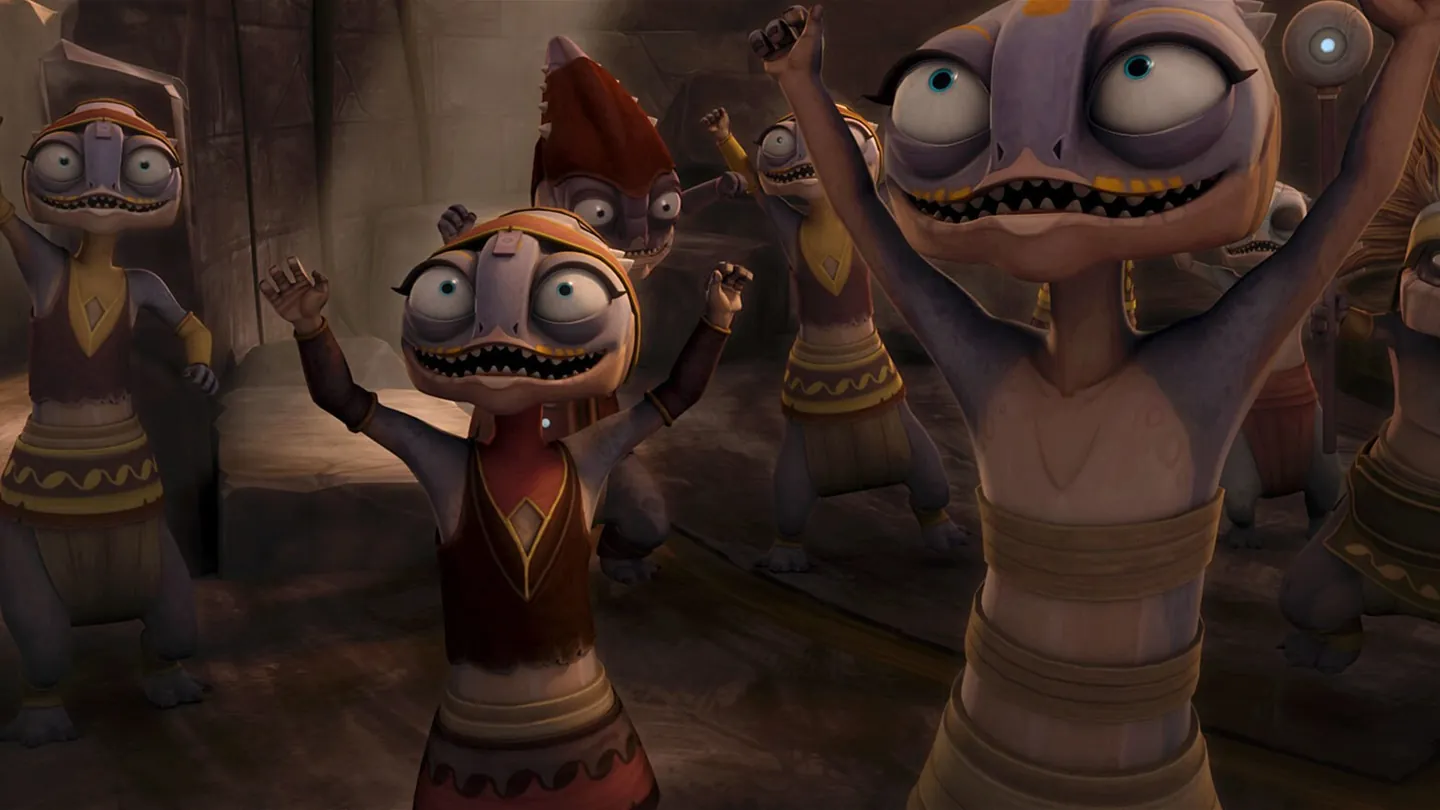
Aleena inhabitants are not the subterranean Kindalo
The Aleena were the most visible residents to outside visitors. They had recognizable settlements and belonged to a species that had also traveled elsewhere in the galaxy. The Kindalo, by contrast, lived in bioluminescent caverns far beneath Aleen's surface and were unknown to the Republic relief team. Their isolation was not a proof that Aleen lacked indigenous culture or that the surface population alone constituted the entire world.
Keeping these identities separate is necessary for a useful planet archive. The surface panorama can link to the Aleena species record while the subsurface scene identifies Kindalo inhabitants, their grove and the barrier that protected them. The distinction is especially important on a phone, where one image and its labels must not suggest that people living in different environments occupy an identical village.
R2-D2 and C-3PO follow the problem
The two droids became central investigators when the Aleena's warnings did not lead to a clear human response. C-3PO's language skills and R2-D2's practical ingenuity allowed them to move beyond the routine relief operation. They discovered an opening into an environment and society that Republic personnel had not anticipated. Their journey is documented in Mercy Mission and in later character biographies.
The discovery did not establish that the droids had mapped every underground passage or discovered all of Aleen's species. The narrative follows a particular route, a conversation with inhabitants below and an intervention that solved the immediate crisis. This page links to the source material instead of supplying imagined tunnels, village names or measurements.
A breached passage with consequences on both sides
The groundquakes had exposed a connection between the exterior and interior worlds. Through that opening, conditions from the surface threatened the sensitive ecology of the Kindalo's home. The episode ultimately treated this interconnection as an environmental hazard that could be addressed through action, rather than a conflict necessarily solved by military occupation. The underground residents' protective behavior was grounded in the vulnerability of their habitat.
Once the droids understood that problem, restoring the separation between the two environments became the relevant response. The work benefited the surface communities by stopping the upheaval and also protected underground inhabitants from conditions they could not tolerate. The story thus links disaster relief to a form of cooperation in which two communities had different information and different needs.
Boundaries of the available image record
The Aleen Databank and Mercy Mission episode guide support the existence of a surface relief effort, groundquake damage and an underground civilization. The official Aleena and Kindalo entries identify the distinct species. These accounts do not establish a complete plan of the camps, every structure rebuilt or a map of all caverns. The page therefore avoids invented dots, positions and travel metrics.
Three changing scene images investigate the surface population, the droids' involvement and the breached passage. Each contains contextual links that remain directly tappable within the image on iPhones. The connected Kindalo Caverns destination offers a deeper account of the ecological and diplomatic resolution without repeating the same lead image immediately beneath the hero.