Translation as infrastructure
C-3PO's primary function is communication across languages and social settings. His role makes visible a basic fact of the Star Wars galaxy: political alliances, trade, military coordination, and diplomacy depend on translation between very different communities.
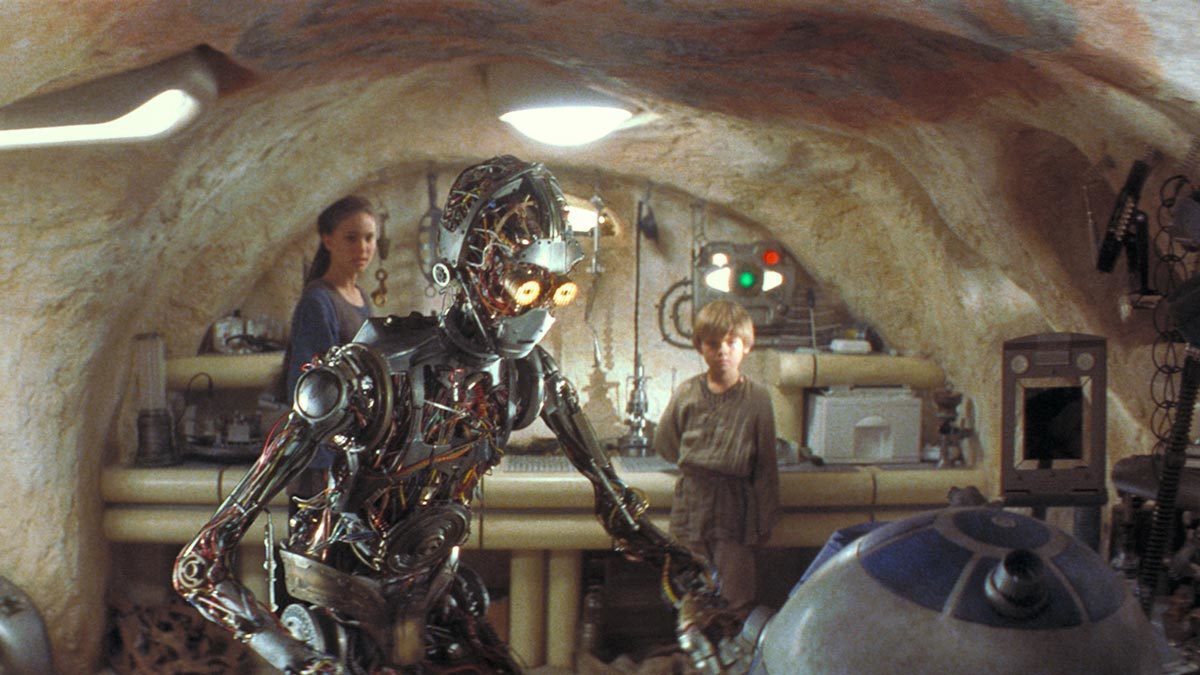
Built by Anakin Skywalker
Anakin constructs C-3PO on Tatooine before becoming a Jedi. The droid later lives with the Lars family, accompanies Padmé Amidala, and becomes paired with R2-D2. Those transfers place him inside several households and institutions before the Galactic Civil War.
Memory and identity
C-3PO's memory is wiped after the fall of the Republic. The event separates continuity of body from continuity of remembered experience. Later stories repeatedly use memory access, loss, and restoration to raise questions about what persists when a droid's stored experience is altered.
Rebellion and Resistance
During the Galactic Civil War, C-3PO supports Leia Organa and the Rebel Alliance. Decades later he serves the Resistance. His cautious personality often contrasts with the dangerous environments around him, but his linguistic abilities repeatedly become operationally important.
R2-D2 and companionship
His long partnership with R2-D2 is one of the franchise's clearest examples of droids forming durable social relationships. Their arguing, cooperation, dependence, and concern for one another are written as a relationship rather than a pairing of interchangeable machines.
Official StarWars.com databank ↗
Protocol as social infrastructure
C-3PO’s usefulness comes from language, etiquette, translation, and knowledge of social rules. Those skills are easy to treat as comic because they are less spectacular than combat, but they allow people and institutions to communicate across cultural boundaries.
The droid makes visible a kind of labor that diplomacy, trade, and coalition warfare require before any agreement can function.
Memory, ownership, and personhood
C-3PO repeatedly has his memory altered, erased, or accessed by others. That history raises a basic question about droid personhood: what does ownership mean when the owned object has relationships, preferences, fear, and autobiographical memory?
His continuity across generations depends partly on friends who recognize him as more than equipment, even while legal and technical systems continue to treat his mind as something others may edit.
Connected archive