
01 · Orientation
World overview
Tatooine is a harsh twin-sun desert world where moisture farmers, Tusken communities, Jawas, criminal syndicates, merchants, migrants, and offworld settlers compete and cooperate far from strong central government. IDS treats Tatooine as a lived world rather than background scenery. Its location in Outer Rim, its classification as Desert frontier world, and its association with Tusken Raiders, Jawas, settlers and migrants create a social setting shaped by geography, institutions, mobility, and historical change. The purpose of the file is to connect those conditions instead of reducing the planet to a single battle, character, or visual landmark.
02 · Environment
Landscape, climate, and adaptation
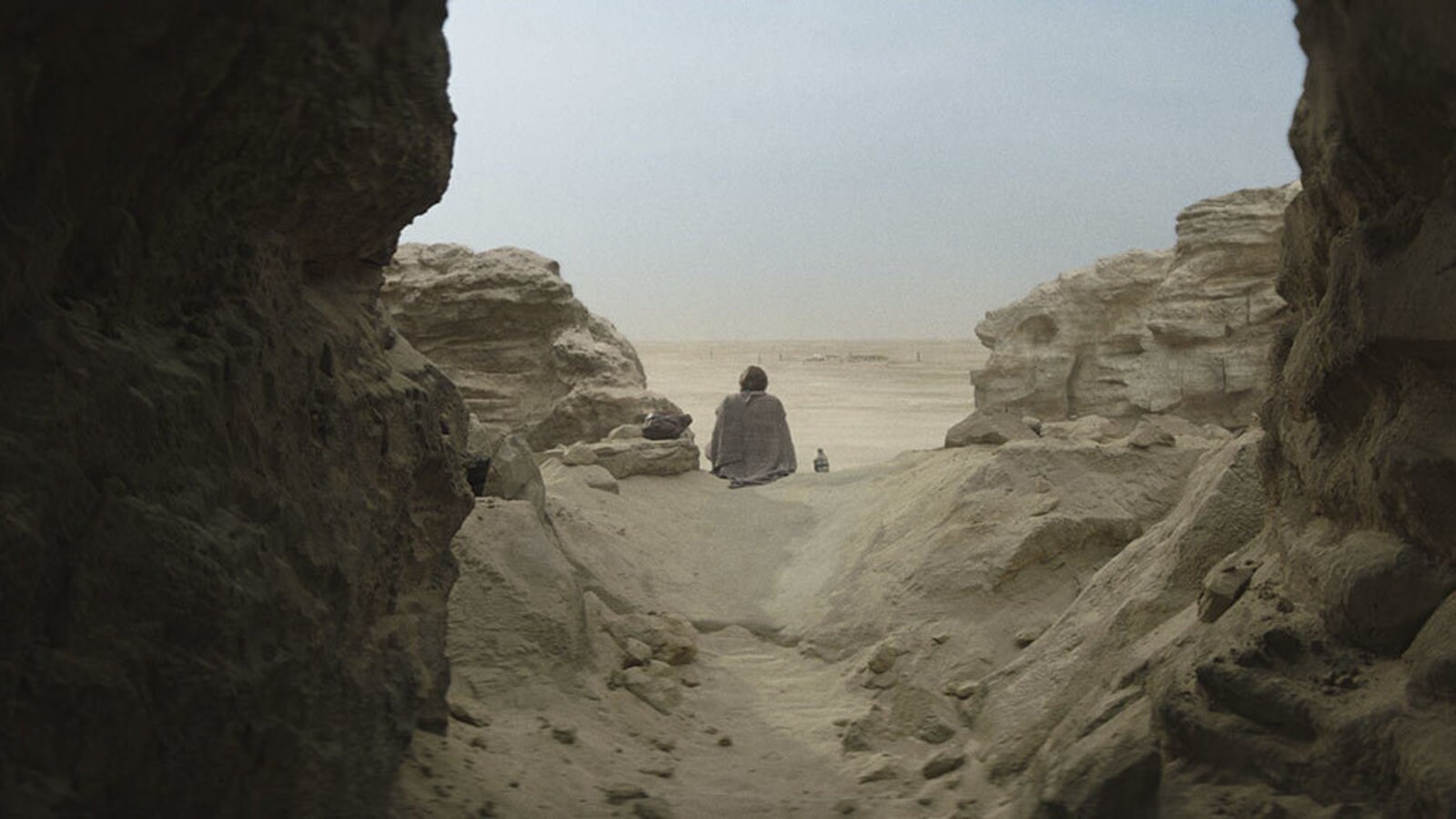
Water scarcity shapes almost every aspect of life. Settlements cluster around ports, farms, trade routes, and reliable resources, while large stretches of desert remain difficult for outsiders to navigate. Moisture farming, scavenging, transport, and animal husbandry are adaptations to the environment rather than background details. Quick Facts identifies the climate as Hot and arid and the terrain as Deserts, canyons and dune seas. Those environmental conditions affect where settlements can develop, how people travel, what resources become politically important, and which forms of infrastructure are practical. Environment does not mechanically determine culture, but it places real constraints on labor, architecture, transportation, defense, and everyday life.
03 · Built environment
Settlement, architecture, and infrastructure
Tatooine’s settlements are adaptations to heat, scarcity, and weak centralized authority. Moisture farms spread households far apart, while Mos Eisley and Mos Espa concentrate trade, repair, lodging, entertainment, and transport around offworld traffic. Jawa sandcrawlers function as mobile commercial settlements, while Tusken camps follow different territorial and social logics. Underground or thick-walled architecture helps manage heat, making everyday buildings evidence of environmental adaptation rather than merely visual style.
04 · Society
People, community, and everyday life
Tatooine contains multiple societies with very different relationships to the land. Tusken communities maintain their own histories, territories, rituals, and kinship structures. Jawas travel in sandcrawlers and support a scavenging and repair economy. Settlers build farms and towns, while ports such as Mos Eisley and Mos Espa connect local life to galactic commerce.
05 · Economy & labor
Resources, work, and political economy
Water, transport, salvage, livestock, repair work, smuggling, hospitality, gambling, slavery in earlier periods, and criminal protection all shape Tatooine’s economy. Moisture farmers convert atmospheric water into survival and modest trade, Jawas turn discarded technology into marketable goods, and spaceports connect local work to galactic movement. Hutt power grows from controlling exchange and violence rather than from a productive state bureaucracy, leaving households and small businesses exposed to unequal bargaining relationships.
06 · Religion & worldview
Sacred landscape, belief, and moral order
Current canon does not establish one planet-wide Tatooine religion. The world contains many migrant, Indigenous, criminal, commercial, and settler communities with distinct traditions. Tusken ritual, ancestral connection to land, funerary customs, and oral memory are especially important examples of sacred worldview on the planet. Religion and worldview are treated as parts of social life rather than decorative lore. Sacred places, collective memory, ritual, moral authority, and relationships to land can influence how communities understand belonging and legitimate power. Where canon documents no shared planetary religion, IDS keeps that absence visible instead of inventing a uniform belief system for everyone living on the world.
07 · Institutions
Government, authority, and power
Formal state authority is weak compared with local power brokers. Hutt influence, criminal syndicates, bounty hunters, merchants, militias, and family networks often matter more than distant governments. That political fragmentation helps explain why slavery and exploitation persisted despite changes elsewhere in the galaxy. The major eras associated with Tatooine are Republic, Empire, New Republic. Political authority can therefore change as governments, militaries, occupations, local elites, resistance movements, or outside institutions gain and lose control. The archive uses frontier power, migration, subsistence to ask who can make decisions, who bears the costs of those decisions, and how planetary institutions connect local communities to larger galactic systems.
08 · Mobility
Movement, travel, and connection
Tatooine is remote but not disconnected. Spaceports, caravan routes, sandcrawlers, speeders, animal transport, and local guides link settlements across terrain that can be deadly to outsiders. Mobility also divides communities. Offworlders often treat the planet as a temporary stop, while Tusken groups understand routes and territory through much longer histories. Access to a starship can transform a person’s possibilities immediately, which is why leaving Tatooine carries such social importance for Anakin, Luke, and many migrants.
09 · Conflict & security
War, policing, occupation, and defense
Violence on Tatooine is decentralized. Hutts, syndicates, bounty hunters, settlers, raiders, Tusken communities, local militias, and occasional Imperial forces all exercise coercive power in different places. Conflict over water, territory, debt, slavery, and criminal control can matter more locally than distant galactic wars. Because no state fully monopolizes force, security depends heavily on family, reputation, hired protection, alliances, and knowledge of who controls a particular road, settlement, or stretch of desert.
10 · Points of interest
Places that make Tatooine legible
Places inside Tatooine make large planetary histories concrete. Cities, temples, factories, homes, bases, ruins, and landscapes show where institutions actually operate and where people work, worship, govern, travel, fight, remember, and build community. IDS treats these locations as evidence of social life rather than as a sightseeing checklist. Each point is included because it helps explain how geography, political authority, material culture, religion, or historical change becomes visible on the ground.
Mos Eisley Spaceport
Mos Eisley links Tatooine to galactic transport, smuggling, wage labor, criminal brokerage, and migration. Its cantinas and hangars function as informal markets for pilots, information, and protection.
Open connected IDS file →Mos Espa
Mos Espa combined markets, entertainment, municipal government, slavery in the Republic era, Hutt influence, and later competing crime syndicates, making it one of Tatooine’s clearest urban political centers.
Open connected IDS file →Lars homestead
The Lars moisture farm shows ordinary settlement life through family labor, water extraction, isolation, and dependence on local infrastructure rather than through the criminal and military institutions that dominate many Tatooine stories.
11 · Change over time
Historical significance
Anakin Skywalker and Luke Skywalker both grew up on Tatooine, but the world has a much larger history than the Skywalker family. Control shifted among Hutts and other criminal powers, Imperial patrols came and went, and local communities continued adapting regardless of who claimed to govern the wider galaxy. The principal appearances listed for Tatooine are Skywalker saga, The Mandalorian, The Book of Boba Fett, Obi-Wan Kenobi. Those stories capture particular moments rather than the complete history of the world. IDS reads wars, occupations, migrations, regime changes, reconstruction, and institutional continuity as processes that reshape social life over time. Historical significance therefore comes from what changes for communities, not only from whether a famous event happened there.
12 · IDS lens
What this world reveals
Tatooine works as a frontier study because sovereignty is uneven. Different groups exercise authority over territory, trade, water, violence, and mobility without a single institution fully controlling the planet. The archive emphasis for Tatooine is frontier power, migration, subsistence. That focus is useful because it connects geography to social organization instead of treating the world as scenery. IDS asks how people experience institutions differently depending on class, community, mobility, political status, access to resources, and historical circumstance, and how those differences become visible in the built and natural environment.
13 · Sources & continuity
Official primary source
The factual baseline for this Tatooine file comes from official Star Wars reference material and the canon appearances listed in Quick Facts. IDS uses those sources for names, geography, political events, communities, and chronology, while the surrounding discussion of institutions, religion, settlement, labor, and social change is independently written analysis. Some aspects of everyday life on this world remain undocumented in current Canon.