A route is a political decision
Concord Dawn was strategically significant because controlling approaches to the system could protect or impede rebel movements. The official world record explains that the Mandalorian Protectors, under Fenn Rau, held authority over passage. For a time Rau's organization had a mutually beneficial relationship with the Empire. The Protectors' craft and local base gave that understanding a concrete military presence.
The Star Wars record does not supply a measured navigational corridor across a grid, named checkpoints or a complete star chart for this episode. System Passage is therefore an investigation of documented transit rights, not a claim that a road or permanent hyperspace line with that proper name appears on a planet's surface.
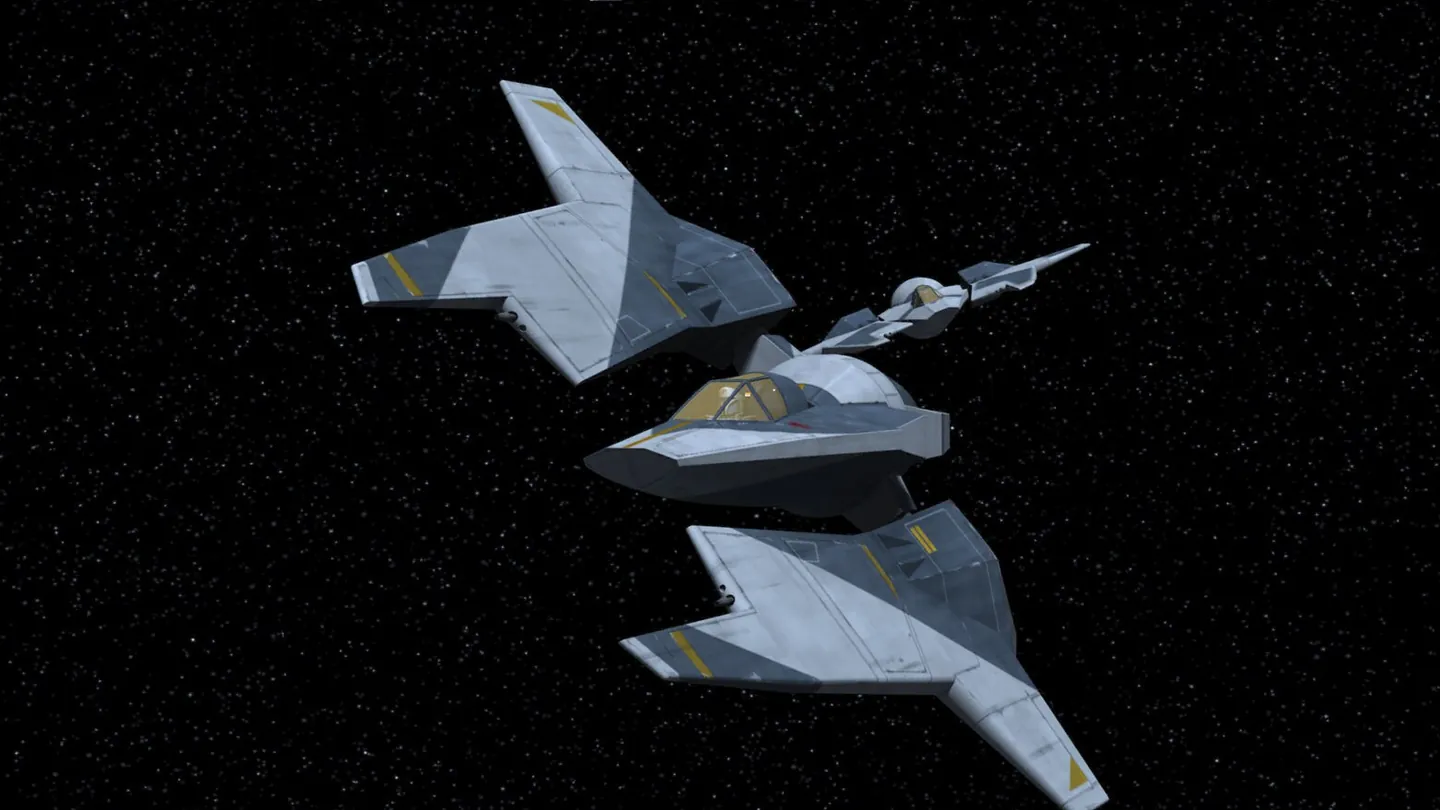
Why the Fang fighter mattered
The Protectors used Fang fighters, compact craft designed around the maneuvering needs of Mandalorian pilots. The Databank identifies specialized wing systems, heavy weapons and a torpedo port. Rau's instruction was part of the force's capabilities, and the presence of experienced pilots gave his organization a practical means of stopping less prepared travelers.
The aircraft gallery shows the vehicles and pilots as distinct documentary subjects rather than simply repeating the moon's portrait from the parent world. A starfighter image can explain the system's defensive capacity without suggesting that every craft was photographed above the camp or flown by Rau personally. The point of interest is the connection between equipment and controlled mobility.
The attack on Phoenix Squadron
The Protectors' arrangement with the Empire became a direct threat to rebel operations when their pilots attacked Phoenix Squadron. In The Protector of Concord Dawn, the Ghost crew pursued a response that would end the immediate danger and help establish access to the system. Sabine Wren and Kanan Jarrus went to the Protectors' camp, destroyed fighters and captured Rau.
This was not a routine negotiation with an Imperial officer. The Protectors were Mandalorians, and Sabine's own history placed her in a difficult encounter with a community that shared parts of her identity but followed an opposing political course. The archive's scene controls let visitors move between Sabine, the camp and the military technology rather than presenting them as unrelated trivia.
Captivity and an incomplete realignment
Rau's capture created an opportunity for safer rebel travel through the system. It did not instantly erase his commitments. The official biography states that Rau initially refused to join the struggle against the Empire even while held by the rebels. His history as a Clone Wars veteran and a respected pilot helps explain why his authority mattered, but the sources do not justify inventing private conversations or a detailed treaty schedule.
The important change was political, not geographic. The same Mandalorian group that had helped the Empire obstruct passage could, through a revised arrangement, cease to be a threat to rebel movement. The Concord Dawn Databank records that Rau eventually granted safe passage.
A massacre changes the calculation
When communication with the Protectors ceased, Rau returned with rebels to investigate. Gar Saxon's Imperial super commandos had destroyed his followers. The attack made the Empire's willingness to eliminate a former partner apparent. The surviving commander then acted to defend Sabine, Ezra and Chopper and ultimately joined the rebellion. This was a distinct later event from the earlier capture at the moon camp.
The two episodes show why territorial control in the system cannot be assigned a single permanent allegiance across all periods. A map pin with one fixed 'Imperial' or 'Rebel' identity would flatten the chronology. The interactive views instead distinguish the earlier patrol agreement, rebel intervention and the aftermath of the Imperial attack.
Boundaries of the evidence
The primary sources are the Concord Dawn and Fang fighter records, the Protectors' history, Rau's biography and the episode guide. They establish military actors and major decisions, not exact starship vectors or the time and position of every patrol. The interactive system does not plot invented trajectory lines or pretend to display an operational navigation map.
Every destination label points to a named episode, vehicle, participant or location with separate documentary support. The camp on the third moon is distinguished from the inhabited world and the wider system. That separation allows the archive to discuss local power, external occupation and the movement of ships without creating false place labels.