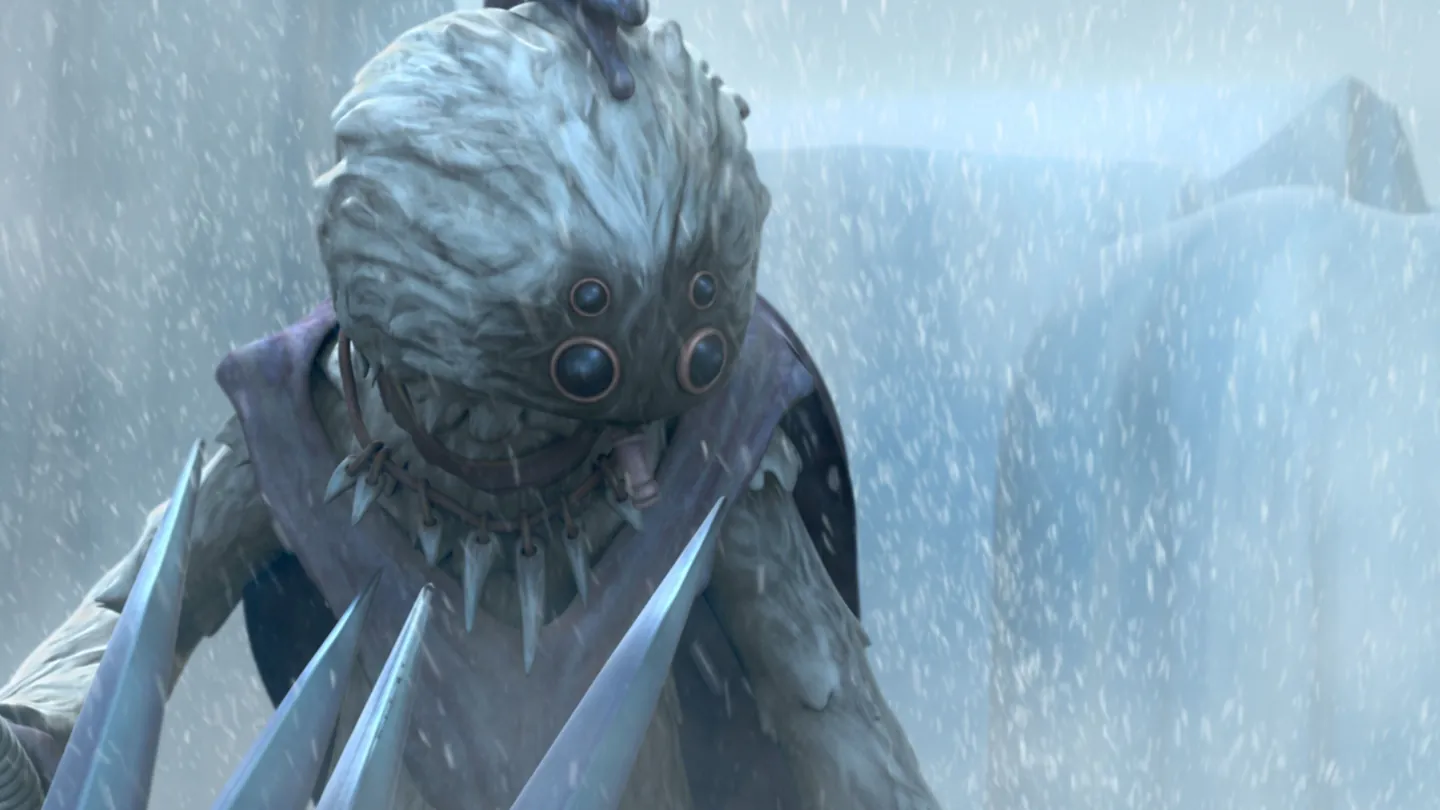
A population hidden from outsiders
Orto Plutonia's frozen surface contains inhabited ice canyons that Pantoran explorers initially overlooked. According to the Talz Databank, the native population lived in villages carved into the ice walls, making their presence difficult for visiting scouts to recognize. Pantora's officials consequently claimed the world as a protectorate under the mistaken assumption that no one lived there. The hidden settlements are therefore not merely remote background features; they are central evidence that the territory was occupied before the Republic and Separatist outposts arrived.
The episode does not publish coordinates for individual villages or the boundaries between each Talz group. This archive identifies the documented kind of settlement and its inhabitants rather than placing inaccurate geographic markers on a generic snowy panorama. The first image is a subject reference, not a survey of a particular canyon's floor plan.
Material culture adapted to the cold
Talz settlements used shelters made from animal hides stretched over bone frameworks. These huts were situated within or alongside ice formations that protected the population from a harsh climate. The combination of constructed shelters and natural canyon walls shows how local people adapted available materials to their environment. The official description establishes the use of hides and bone but not a uniform floor plan, household size, specific ritual practice or the identity of each village's builders.
Those limits matter when creating an explorable location. A realistic illustration can suggest the experience of moving among shelters, but it must not be labeled as an exact depiction of a structure whose position and design have not been documented. The scene topics therefore examine housing methods and evidence rather than inventing an architectural catalog.
Narglatch mounts and local defense
The Talz used narglatches, large predatory creatures adapted to snowy environments, for transport and protection. The Narglatch Databank describes animals often colored blue, capable of operating in icy terrain. Their function as mounts made them especially important when community members needed to move beyond sheltered villages or respond to an outside threat. The Talz were not simply stationary figures inhabiting an otherwise empty environment.
At the same time, the source does not explain whether every household owned a mount, how the animals were bred or whether they held a specific ceremonial status. The site's creature scene can accurately connect the people and the species without turning plausible assumptions into established cultural facts. A separate link leads to the full official animal record.
Thi-Sen and the willingness to negotiate
Thi-Sen led a Talz community encountered by the Jedi and Pantoran delegation during the investigation into missing security forces. The Trespass episode establishes that he sought to protect the Talz from unwanted outsiders and was willing to reach an accommodation. His claim was not simply that his warriors could win a fight; he wanted his people to be able to live without foreign interference. Obi-Wan and Anakin were able to achieve an initial understanding.
Chairman Chi Cho rejected that understanding. The disagreement shows that the conflict did not result from an inevitable inability of different species to communicate. The Talz leader had offered terms, and the confrontation grew because a Pantoran official refused to recognize that the Talz could decide their own position. This distinction keeps the villagers' political agency visible.
From defensive action to a dangerous conflict
The Talz attacked Republic and Separatist positions after armed outsiders entered the ice world. Those attacks killed troops and produced a broader investigation that eventually exposed their settlements. In the context of this history, the villages were home territory threatened by external security deployments, not bases supplied by either of the galaxy's rival military coalitions. The episode shows how attempts to secure a strategically useful region could create conflict with the people already living there.
Chi Cho's attempt to impose Pantoran authority then led to an assault on the Talz, in which he was fatally wounded and clone soldiers died. Treating this as a simple battle between enemies of the Republic would obscure the dispute over sovereignty and the unsuccessful earlier negotiations.
What can be shown responsibly
The Talz, Thi-Sen and Narglatch Databank records establish the community's settlement style, leadership and transport animals. The Trespass episode establishes the clash with outsiders and the negotiated end to hostilities. None provides a measured village plan, a census or an authoritative map of family dwellings. Accordingly, the visual explorer uses three distinct official subjects and contextual controls rather than falsely locating homes on a generic landscape.
Readers can move directly to the adjoining outpost investigation to understand how outsiders reached the planet, or follow a separate link to Pantora's own political account. The separation preserves the fact that Talz villages are on Orto Plutonia, not neighborhoods of the nearby inhabited moon.