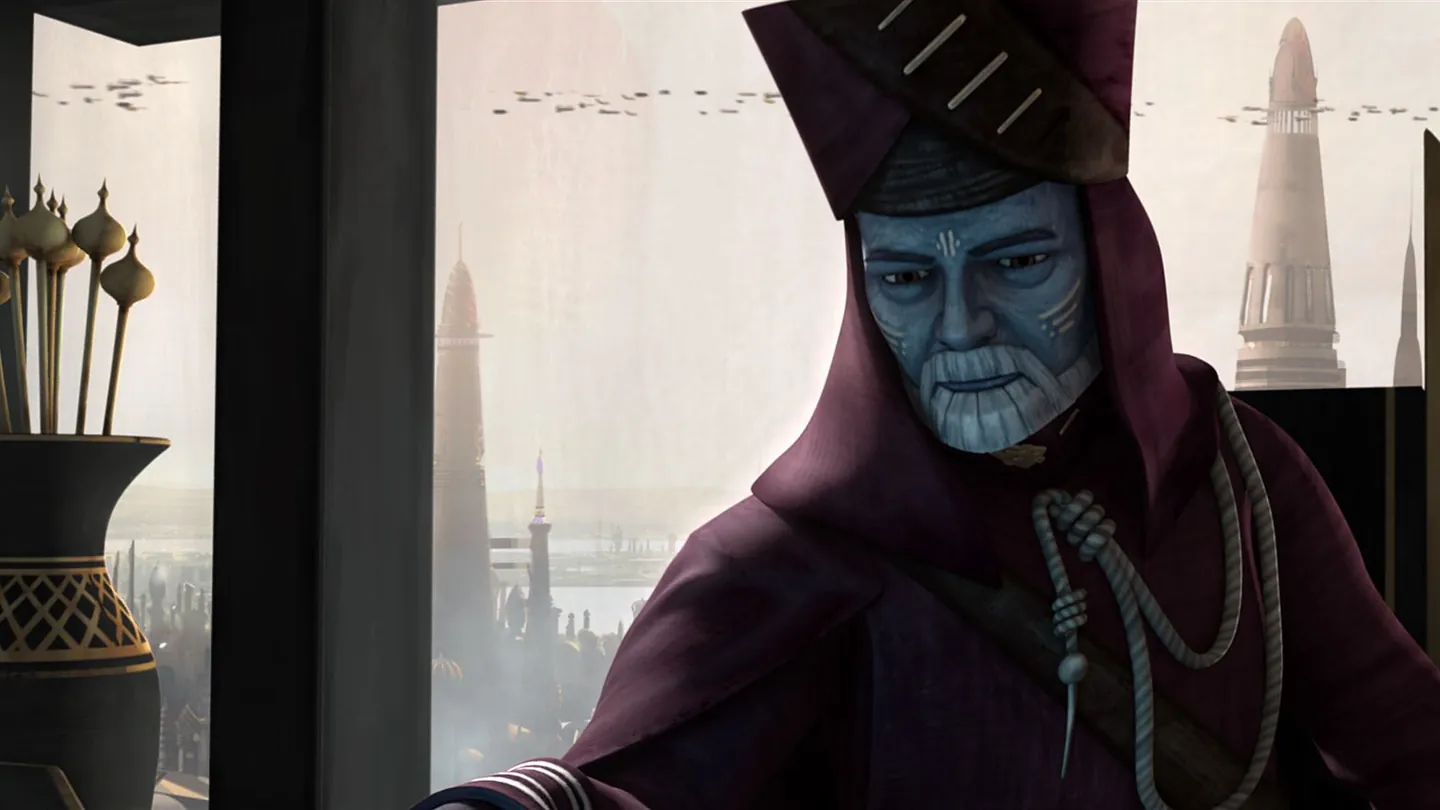
The new chairman and a threat to autonomy
Chairman Papanoida succeeded Chi Cho as Pantora's political leader. He inherited a system already tested by the dispute over Orto Plutonia. During the Clone Wars, the Trade Federation attempted to force Pantora away from the Republic through a blockade and a kidnapping plot. The Federation's representatives claimed the action related to unpaid debts, but the wider Separatist objective was to change the moon's political allegiance.
The blockade had consequences for ordinary residents because commerce and movement were obstructed. The official record establishes that coercive strategy but provides no full inventory of ships, cargoes or individual shortages. This destination therefore concentrates on documented decisions and people rather than presenting an invented harbor or an exact patrol map.
The abduction of Chi Eekway and Che Amanwe
Two daughters of Papanoida, Chi Eekway and Che Amanwe, were kidnapped by criminals working for the Trade Federation. Their confinement was not an unrelated family dispute. The kidnapping was designed to pressure a powerful local official at the same time that the blockade threatened the population. It exposed a family to direct danger as a means of influencing the political future of an entire moon.
The Sphere of Influence episode establishes where the sisters were taken. Chi Eekway remained aboard a Trade Federation vessel over Pantora. Che Amanwe was sent to Tatooine. Treating the abductions as two locations in a single Pantoran building would erase a crucial part of the story. Scene controls instead show the separate actors and source evidence without drawing an unsupported route.
Papanoida and Ion take an independent lead
Papanoida refused to rely entirely on Coruscant law enforcement or wait for Senate action. With his son Ion, he pursued clues pointing to Greedo and the criminals involved in the kidnapping. Their search eventually took them to Tatooine, where they confronted people connected to the abduction and recovered Che Amanwe. The investigation involved a parent taking risks outside ordinary institutional channels while still acting in response to a political crisis.
Greedo was not the chairman's official emissary. He was a bounty hunter acting on behalf of the conspirators. The difference is important because the crime was meant to manipulate the chairman rather than to represent the will of Pantoran society. The record supports the participants and rescue but not a complete itinerary through the Tatooine streets.
Riyo and Ahsoka board the Trade Federation ship
Riyo Chuchi and Ahsoka Tano followed the other rescue path. The senator boarded a Trade Federation battleship under a diplomatic pretext with Ahsoka posing as her servant. Once inside, the two located Chi Eekway in detention. The episode portrays the rescue as a combination of political presence and direct action, not simply a conventional Jedi raid in which the senator had no role.
Chuchi's ability to challenge Sib Canay at the end of the encounter mattered as much as her willingness to enter enemy space. She confronted the conditions of the blockade while Ahsoka helped defeat the plot. Their actions provided a path to recover the captive and force the Federation to release its grip on Pantora.
Economic language conceals a political ultimatum
Sib Canay represented the Trade Federation's use of commerce and blockade enforcement as instruments of political influence. The official narrative states that his goal was to push the Pantorans into the Separatist Alliance. His position as a trade officer did not make the dispute a neutral disagreement about payment. The kidnapping and coordinated blockade show how coercion can operate through multiple institutions and agents.
Chuchi demanded an end to the blockade after exposing the conspiracy. The attempt to reshape Pantora's allegiances failed. That outcome should not be described as the destruction of the entire Trade Federation or the end of all disputes in the Pantora system. The episode establishes the resolution of this immediate crisis and the recovery of the chairman's daughters.
What belongs on Pantora and what does not
The Pantora and Papanoida profiles, Sphere of Influence episode guide and biographies of the daughters identify the moon's leadership, the blockade and the two rescue operations. They do not establish the exact location of every household, government office or spaceport. A still of a ship officer or a captive identifies a documented participant, not a specific intersection or floor in Pantora's civic buildings.
This archive separates the three visual subjects of the investigation: political authority on the moon, coercion aboard the blockading ship and the trail to Tatooine. It also keeps the earlier Orto Plutonia dispute as a separate timeline. Interactive controls lead to sources and existing characters without inventing a navigational route between planets.