An inhabited moon and a political community
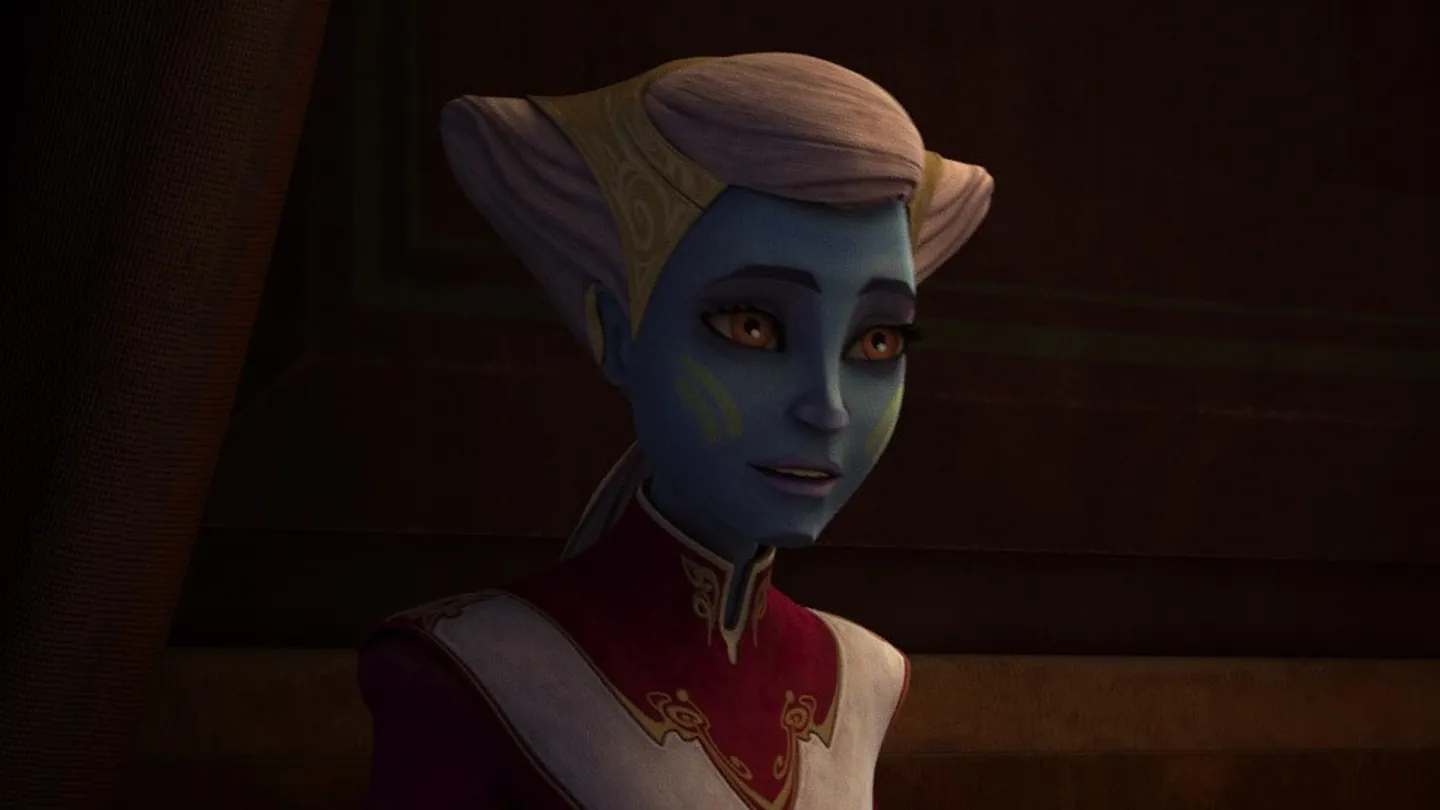
Pantora is the principal inhabited moon of the Pantora system, orbiting the icy planet Orto Plutonia. Its people belong to a distinct community whose blue skin and facial markings make them recognizable in The Clone Wars. The moon also had its own public institutions, including a chairman and a Pantoran Assembly, while representatives served in the Galactic Senate. Those organizations cannot be reduced to the personal wishes of a single chairman or senator. The story of Pantora's dispute with the Talz shows them disagreeing openly about legitimate authority.
The official planetary material describes Pantora and its institutions but does not give a detailed civic floor plan or a measured map of the Assembly's chambers. This page therefore offers documented participants and political episodes as interactive image topics. It does not claim that every photographed meeting happened in the same building.
How a protectorate claim began
Pantoran explorers once searched Orto Plutonia and concluded that it had no inhabitants, leading their government to claim it as a protectorate. The exploration was mistaken. Talz communities had long survived in ice-walled villages that remained unseen by outsiders. The discrepancy meant the legal and political assumption behind Pantora's claim did not match the indigenous population's experience of living there.
When a Republic outpost and a Separatist outpost were destroyed, Jedi investigators and Pantoran leaders traveled to the ice planet to determine what had happened. The Talz were defending their own territory against people they considered intruders. Chairman Chi Cho, however, insisted that the Talz were trespassers. The initial misunderstanding thus became a confrontation between competing claims about who had authority to govern and defend the world.
Chairman Chi Cho refuses negotiation
Obi-Wan Kenobi and Anakin Skywalker were able to contact the Talz chieftain Thi-Sen and reach a provisional understanding. The Talz wanted to be left alone. Chairman Chi Cho rejected that settlement, claiming that Pantora's authority was absolute and that the Talz could not determine their own future. He declared that the dispute was an internal Pantoran affair, limiting the Jedi's ability to intervene despite their interest in preventing further deaths.
The source does not portray the chairman as a representative of a unanimous Pantoran public. His choice was contested by Riyo Chuchi, who recognized both the humanitarian danger and the flaw in the original assertion of ownership. Rather than depicting all Pantorans as invaders, this scene distinguishes a particular official's actions from the policies that the wider Assembly was prepared to endorse.
A legislated challenge to executive power
Riyo Chuchi sought a decision from the Pantoran Assembly instead of allowing Chairman Cho's military escalation to stand unchallenged. The Assembly determined that the chairman had acted improperly and authorized Chuchi to settle the dispute. This was a specific institutional correction with practical consequences. It gave the senator a public mandate to work with the Talz, rather than leaving her to negotiate only as a private individual.
The official biography states the Assembly's intervention but does not publish a complete transcript of its debate, a vote count or the formal wording of its decision. The archive therefore describes what the institution did without inventing a parliamentary process. The important distinction is between Cho's personal refusal and the later authority granted by the Assembly.
The cost of the chairman's final assault
Chi Cho continued his campaign despite the objections. He led forces into a skirmish with the Talz and was mortally wounded. Many accompanying clone soldiers died. When Chuchi and the Jedi arrived, the chairman could no longer enforce his position. The violence showed that the earlier opportunity to reach a peaceful accommodation had not been merely theoretical; an agreement had been possible before the attack escalated the conflict.
Chuchi ultimately negotiated directly with Thi-Sen, whose people sought recognition and safety. C-3PO helped with communication, making the process an encounter between different linguistic and political communities rather than a surrender ceremony. The subsequent peace is treated here as a specific outcome of the episode, not a claim that every interplanetary dispute in the system was permanently resolved.
What the Assembly record supports
Pantora's political story is documented in the Pantora and Riyo Chuchi Databank records and in the Trespass episode. These establish the existence of the local institutions, the chairman's refusal to negotiate, the Assembly's challenge and the senator's successful meeting with Thi-Sen. They do not establish a complete political constitution, all historic territorial claims or the measured positions of every official during the crisis.
The scene explorer separates the initial political dispute, Cho's refusal and the later settlement. It links to the distinct ice-world investigation so visitors do not mistake Talz settlements for neighborhoods on Pantora. The photographs provide identifiable official subjects and events, with image-area controls accessible on phones without placing invented dots on unverified buildings.