Event illustration is original IDS symbolic artwork, not a verified historical scene or licensed source panel. Official StarWars.com military reference →
In 4775 BBY, the Gank Massacres ended after roughly twenty-five years. Supreme Chancellor Vocatara commissioned Juggernaut war droids to assist Republic forces, while Jedi Knights joined the effort to stop the Ganks' continuing campaigns.
Juggernaut war droids
The Republic responded to prolonged mercenary violence by expanding mechanized military capacity.
Jedi intervention
Jedi participation brought the Order into a conflict rooted in trade, mercenary violence, and regional insecurity rather than a classic Sith war.
A twenty-five-year cycle closes
The end of the massacres did not restore the extinct Porporites or erase the reputation the Ganks acquired during the violence.
Anthropological assessment
The Gank Massacres demonstrate that intervention may end active violence without reversing demographic or cultural destruction already produced by it. Institutional memory often begins after the worst losses have become irreversible.
Legends chronology / contextual study
Ending the war without restoring the people destroyed
The Gank Massacres are generally dated as ending in 4775 BBY, after roughly twenty-five years of escalating violence. The conflict began against a background of ryll trafficking and the Porporites, whose addiction to the drug was linked in the historical accounts with attacks on neighboring communities. Neimoidian interests employed Gank mercenaries, who then exterminated the Porporites and expanded their violent actions against other populations. The Republic and Jedi intervened. Supreme Chancellor Vocatara ordered the creation of Juggernaut war droids, one of several measures associated with defeating the Gank forces.
The ending of active warfare does not erase the earlier destruction of the Porporites. That distinction is important because the name Gank Massacres can make a dispersed set of atrocities appear to be one conventional Republic victory. The surviving references establish the date range and general outcome more clearly than the events of one final battle. The story also shaped military practice: Republic rocket-jumpers served during the fighting, and large mechanized platforms became part of the institutional response to mercenary violence. Those same technological changes later had consequences during the Great Droid Revolution.
Commercial protection becomes militarized conflict
A commercial relationship can give armed contractors extraordinary power when clients depend on them for protection. The Gank mercenaries' actions exceeded defense of employers' interests and eventually drew the Republic into a protracted conflict. A conflict's economic origins matter even after it becomes military history.
No victory can reverse extinction
For surviving Republic worlds, the end of the Gank threat was a political achievement. For the Porporites, the reported extermination could not be reversed by the defeat of perpetrators. A chronology should give both outcomes space rather than describing the war only from the victors' viewpoint.
Was the final year a single well-documented decisive battle?
The references establish 4775 BBY and the Jedi/Republic victory, but do not support inventing a specific single last battle with precise tactical details.
Published source basis: Galaxy at War; The New Essential Chronology; StarWars.com, The Essential Guide to Warfare Author's Cut, Part 4. Chronology cross-check →. No unseen statements, exact casualty totals or unsupported battle locations have been inferred.
Legends · Research field note
Historical perspective: The end of the Gank Massacres
An end date does not by itself explain recovery, displacement or the long-term consequences for affected communities.
Reading the evidence: This interpretation draws out the social implications of the recorded event without supplying undocumented conversations, numbers or motivations.
Research question: what would stronger evidence require?
Compare the source cited below with nearby chronology entries. Distinguish what is explicitly recorded from broader conclusions about political institutions, lived experience and historical consequences.
4775 BBY · Legends · Evidence-based overview
Juggernaut war droids and the Republic response
- A state responds to a prolonged threat
By 4775 BBY the conflict conventionally called the Gank Massacres had lasted about a quarter-century in Legends histories. Republic forces and Jedi Knights are credited with bringing the campaigns to an end. The reference tradition presents this as a military and political victory, rather than a single named final battle with documented maneuvers and a precise surrender location.
- Why Juggernauts enter the record
The official Essential Guide to Warfare Author's Cut says that Supreme Chancellor Vocatara, a highly decorated veteran of the rocket-jumpers, commissioned the first Juggernaut war droids to help turn the tide during the Gank Massacres. Their significance lies in the Republic's decision to supplement troops with large mechanized weapons. The source does not establish how many droids fought in the final year or prove that one droid defeated the entire Gank force.
- What Republic victory could not restore
The extermination of the Porporites was already part of the conflict's history. The defeat of the armed groups responsible did not reverse that loss. Star Wars reference histories also preserve the reputation of the Ganks as mercenaries long afterward. Keeping those different outcomes separate prevents a conventional victory narrative from erasing the earlier mass killing of a sentient people.
Were the Juggernaut war droids designed because the final battle's exact terrain demanded them?
That is not established. The official author account identifies Vocatara's decision and the wider war, but not the detailed engineering requirements or battlefield orders for a singular final engagement.
Historical source basis: Galaxy at War (2009); StarWars.com, Essential Guide to Warfare Author's Cut, Part 4. Consult the official StarWars.com publication. Dates are Legends-era dating, and anthropological comparisons are IDS analysis. The original reference pages must be inspected before accepting casualty totals or detailed tactics.
Legends · Historical source review
4775 BBY: victory without cultural restoration
The Gank Massacres ended roughly twenty-five years after their outbreak. Republic armed responses, Jedi participation and military innovation shaped the conflict, but ending an operation could not restore the extinct Porporites or rebuild every lost community. The history of weapons also extends beyond a single war. The author's cut credits Vocatara with commissioning Juggernaut war droids in the Gank period; centuries afterward it describes rogue Juggernauts destroying Republic rocket-jumpers during the 4015 BBY Great Droid Revolt. These are distinct conflicts, not proof that the Gank Massacres still raged in 4015. The distinction shows how institutions inherit tools whose future uses their designers cannot guarantee.
Evidence boundary and primary-source trail
StarWars.com warfare author's cut, rocket-jumpers and Juggernauts. View source or reference information →. Source-supported fiction history is distinguished from IDS interpretation of political institutions and material culture. No undocumented eyewitness testimony, precise casualty figures or invented rituals are claimed.
History quiz · Legends
Test your historical judgment
Get a score and a correction explaining the source for each question.
Ancient records · 4775 BBY · Legends
A long campaign ends
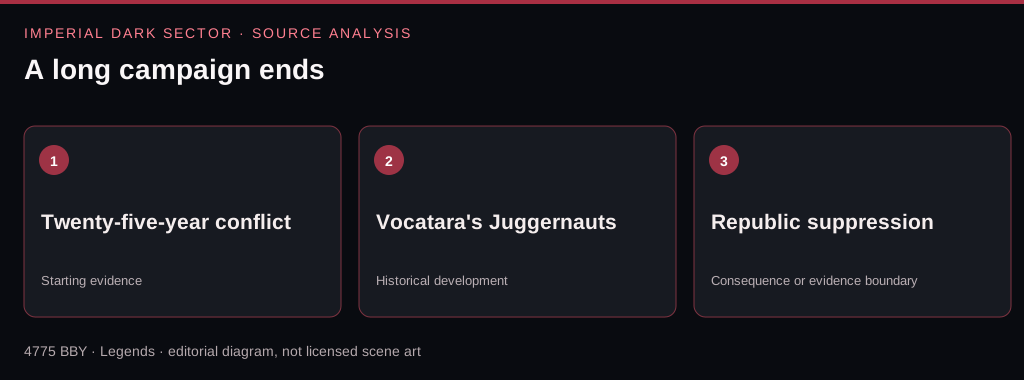
Documented history
StarWars.com identifies Chancellor Vocatara as the official who commissioned the first Juggernaut war droids to turn the tide in the Gank Massacres. The broader conflict is placed between 4800 and 4775 BBY.
Limits of the evidence
Ending the campaign in 4775 BBY does not establish a single final battle or the extinction of a species. The published excerpt is not a day-by-day history of the war.
Historical judgment: Did the Gank species disappear when the massacres ended?
No. The entry dates the suppression of a war, not the extinction of all Ganks.
Sources and further reading
- StarWars.com: The Essential Guide to Warfare author’s-cut, Part 4 (official supporting reference).
- Jason Fry and Erich Schoeneweiss, The Essential Guide to Warfare Author’s Cut, Part 4: The Rise of the Republic, StarWars.com, rocket-jumpers, Vocatara and Gank Massacres context.
- Galaxy at War (Wizards of the Coast, 2009), for Barkin's journal, the unit and campaign chronology. Original pages pending primary-text review.
- Galaxy at War, Wizards of the Coast.
- Timeline of galactic history/Legends, Wookieepedia