The lord who claims to have created everything
Daiman is a Sith ruler in the Grumani sector during the New Sith Wars, centuries before the film eras. His philosophy is unusual even among other Sith. The official Knight Errant gazetteer describes him as believing that he created the universe. Within the Daimanate, monuments and holographic presentations transmit this claim to people who live under his government. Such public displays are not mere expressions of personal vanity. They present a ruler's understanding of reality as a political fact that inhabitants are expected to acknowledge. The gap between his claim of unlimited power and the practical needs of a territorial government becomes one of the defining tensions of his story.
The Daimanate and its subjects
Daiman governs a territory that emerged after the breakup of earlier Sith domination in the Grumani sector. Darkknell is identified as the capital, while other worlds are associated with production, military activity and the resources needed to continue his campaigns. The term Daimanate describes a political domain and should not be confused with a voluntary religious community. Not everyone living within its borders adopts Daiman's beliefs. The gazetteer explicitly separates the followers of Sith lords from people compelled to live under their authority. This distinction becomes especially important when considering miners, laborers and residents of conquered settlements who cannot choose the government that controls their livelihoods.
Baradium and the industrial war
The mines on Chelloa contain baradium, a compound needed for explosives. In the official account, the scale of this resource threatens to alter the stalemate between Daiman and his older brother Odion. Baradium must be extracted, transported and processed before it can strengthen a fleet or ground army. The Sith ruler who claims to have authored existence therefore depends on a very material chain of workers, vehicles, factories and military logistics. Control of that chain offers an advantage, but it also creates targets for opponents. The Jedi mission known as Operation Influx focuses on this vulnerability rather than treating the entire war as a contest in individual Force ability.
The volunteer Jedi raid
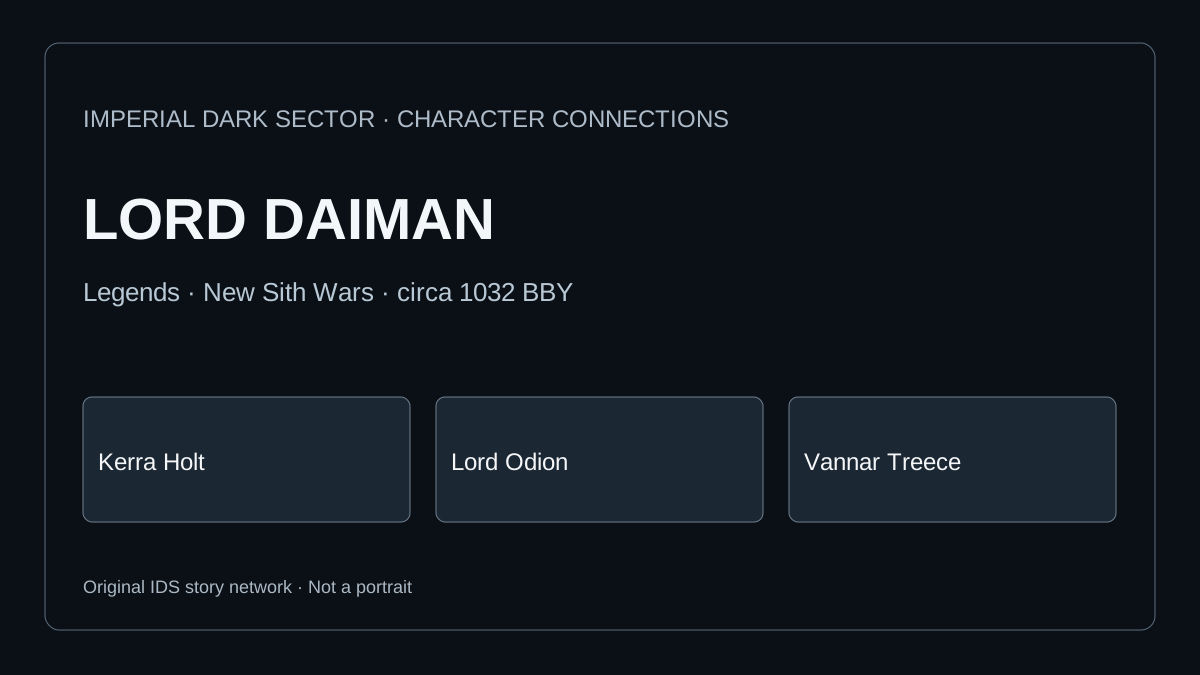
Jedi Master Vannar Treece organizes a volunteer expedition to strike the baradium facilities before Daiman can use them to gain a decisive military edge. Kerra Holt, his former pupil and a Jedi Knight, contributes tactical planning. The operation is not formally endorsed by the Jedi Council or the Republic, a distinction stated in Treece's own gazetteer report. Its objectives are limited, aimed at industrial disruption and eventual withdrawal. This places Daiman in a concrete adversarial relationship to both Jedi, although their target is his military resource network rather than necessarily a direct duel with him. The people who work in the area remain vulnerable to the consequences of all the competing armed forces.
His brother Odion
Odion is Daiman's older brother and the ruler of a separate territory, the Odionate. The two are enemies whose rivalry shapes the region's military geography. One cannot assume that Odion's opposition makes him a benevolent alternative or that Daiman's enemies share common ideals. Both lords impose their authority through Sith power and territorial institutions. Their conflict can create temporary tactical intersections with third parties, including Kerra, without producing an enduring friendship or a shared political purpose. The StarWars.com villains retrospective discusses the unusual nature of Daiman's rivalry and the moments when the conflict with Odion creates an overlap of immediate interests. Such episodes are not evidence that Daiman joined the Jedi Order.
The Correctors and enforced doctrine
The gazetteer describes followers trained in Sith methods who act as Correctors within Daiman's inner systems. They enforce his extravagant conception of reality against people who disagree. Their name suggests that opposition is treated as an error rather than a political choice. This practice connects religious-looking claims to the daily administration of a state. Monuments, public statements, trained enforcers and the threat of punishment all make the same doctrine actionable. For an anthropological reading, the critical distinction is between belief freely professed and conformity compelled by institutions. Daiman's ability to demand public recognition does not prove that the people under his control accept his version of the universe.
A ruler dependent on material resources
Daiman's story is built around the contradiction between claimed cosmic omnipotence and actual military dependency. His state has borders, supply lines, technical personnel, mines and factories. These are not incidental decorations placed around a powerful Sith character. They determine which operations the state can carry out and where its enemies may intervene. Chelloa makes that contradiction visible. A small group of Jedi cannot simply refute an entire ideology by force of argument, but it may constrain the weapons production that enables the ruler to maintain his wars. Conversely, the destruction or seizure of industrial sites brings serious consequences for civilians who work in them, regardless of their views of Daiman's doctrines.
Historical setting and evidence
This dossier is based on the Legends continuity of Knight Errant, not on the Canon timeline of the Galactic Empire or the Skywalker family. StarWars.com's gazetteer supplies territorial and economic detail, while Dark Horse's comics depict incidents involving Daiman and his opponents. The strongest specific character relationships are to Odion, the rival brother, and to Vannar Treece and Kerra Holt, the Jedi whose mission targets his resources. Their presence does not establish that Daiman personally knew later Sith rulers merely because he shares their title. IDS keeps the political geography, the chronology and the difference between followers and subjects visible rather than forcing his story into a generic Sith biography.
Institutions, work, and social relations
The anthropological distinction in Daiman's story is between ideological conformity and actual affiliation. The ruler announces that he created reality, while the people in his mines may work under coercion rather than genuine conviction. Extracted baradium and transport routes sustain military force regardless of what subjects believe. His Sith political doctrine is therefore relevant as an institutional system; the Jedi Order is relevant as the opposing tradition of Treece's volunteer mission, not as Daiman's own membership.
Follow the documented institutional setting through these related files. The links describe an institution's role in the story rather than asserting that every linked organization counts as the character's own allegiance.
- Sith Order and political doctrine — The tradition in which Daiman frames his political claims.
- Jedi Order and Operation Influx — Institutional background for the volunteers opposing his resource economy.
Material fandom · Collector reference
Collecting this Character
Explore related Star Wars media
Browse Star Wars books and collectibles related to this character.
Search Amazon for Lord Daiman ↗As an Amazon Associate I earn from qualifying purchases. Check the product, maker and edition before buying; searches may include unrelated items.
Sources and continuity
This Legends character file is grounded in the linked primary and publisher sources. Historical interpretation is distinguished from documented story events, and unknown personal history is not filled in with unsupported claims.