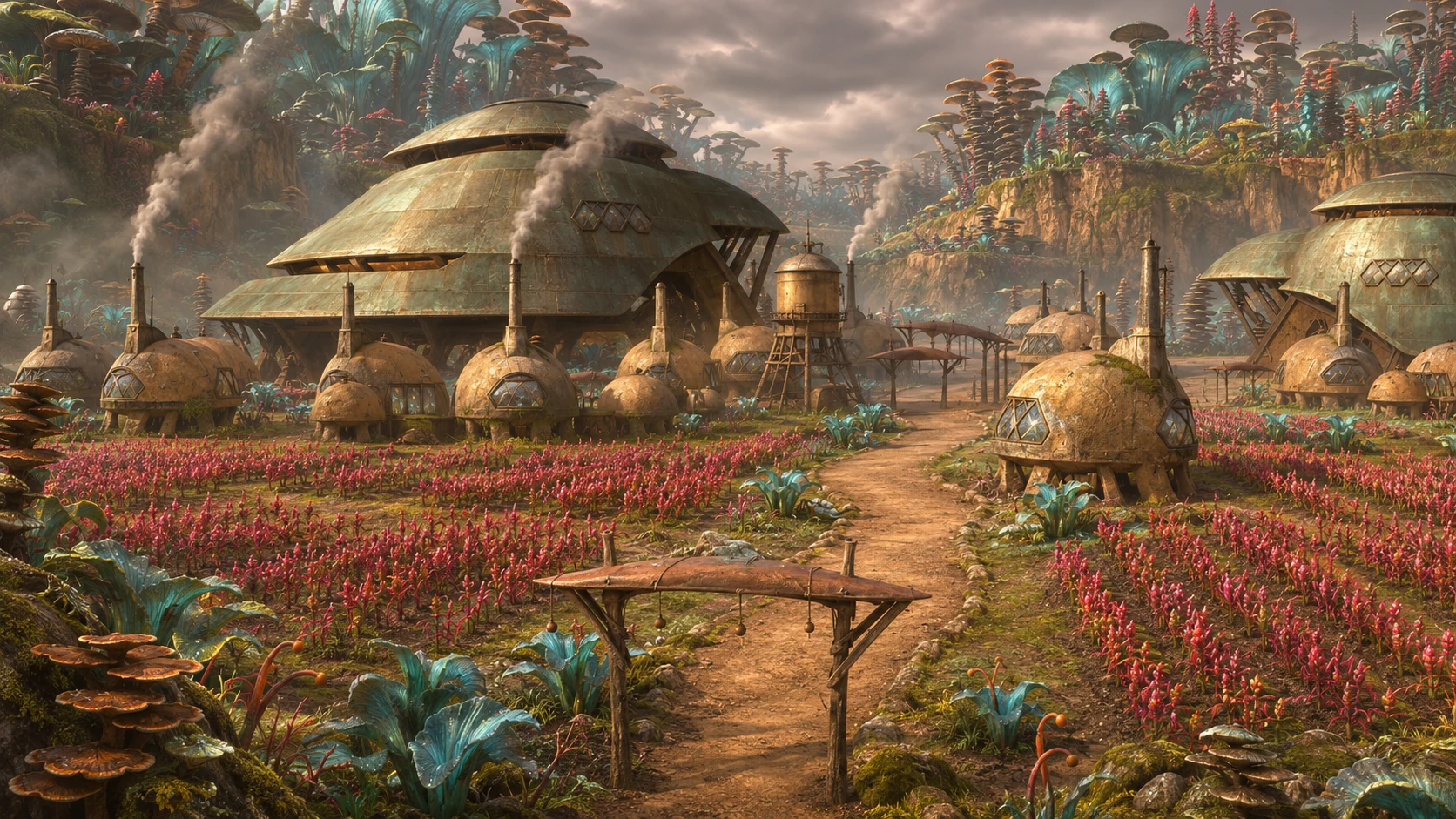
Homes within a working landscape
The village in Bounty Hunters sits among Felucia’s huge growths and cultivated ground. Its buildings and fields belong to people trying to bring in a harvest during a wider war. The Jedi arrive after losing their shuttle, so their initial need is practical: transport and help. Instead, they encounter residents who need protection themselves. The apparently quiet settlement soon reveals farmers in hiding and hired hunters guarding them. The scene asks the visitor to look again at a place that first seems empty. Absence from the open ground is a response to threat, not evidence that no one lives there.
Why the harvest matters
Hondo’s pirates demand the village’s nysillin. The crop is therefore more than background decoration. It represents the time, labor and resources the farmers have committed to their livelihood. Armed outsiders seek to take that production without doing the work that made it possible. The villagers’ decision to hire protectors is an effort to preserve control over the harvest. The official world history identifies the crop and the repeated raids. The concept gallery also explores the appearance of the cultivated environment, although design artwork should be read as production development rather than a literal photograph of an additional canonical field.
A contract under pressure
Sugi leads a band of four hunters who have accepted the job of protecting the village. Hondo tries to persuade them to step aside, but Sugi maintains the agreement with the farmers. That decision distinguishes a paid service from a willingness to accept whichever offer happens to be larger. Rumi Paramita, Embo and Seripas bring different abilities to the group. Their presence also complicates the Jedi’s assumptions about bounty hunters. For this particular task, professional skill and an honored commitment make the hunters allies. Their occupation alone does not determine which side they take in the dispute.
Training changes the defense
The Jedi and hunters cannot rely only on their own ability to defeat attackers. They help the villagers prepare, study the settlement and practice using available weapons. Ahsoka’s slingshot lesson makes the process concrete. Repetition and encouragement turn an unfamiliar tool into a skill that can be used under pressure. The official rewatch emphasizes the farmers’ cooperation and growing confidence. The village is not rescued solely by spectators watching exceptional warriors. Its residents take part in defending the things they have made, with help that increases their own capacity to act after the visitors leave.
Seripas and the appearance of strength
A fallen tree exposes the small person inside Seripas’s much larger armored suit. The discovery gives Ahsoka another way to address the fear of being too weak to resist. Armor can change an opponent’s impression, but courage and cooperation do not depend on an intimidating body. This is especially relevant to a community facing better-armed raiders. The story does not turn the farmers into soldiers with identical equipment. It shows people contributing through different tools, abilities and relationships. The training image and the official episode discussion support an investigation of these choices within the specific village defense.
A local victory within a continuing war
The combined defense drives the pirates away, and the visiting Jedi obtain help leaving Felucia. That result resolves the immediate confrontation over the harvest. It does not end every danger on the planet. Official world history returns to Felucia as a site of later fighting, including the Outer Rim Sieges and Order 66. Keep these events distinct: the village defense is not the same battle as Aayla Secura’s final patrol. The separate battlefield investigation follows the later film sequence, while this page remains focused on the farmers, their defenders and the practical work of preserving a community’s livelihood.
Read the buildings through the screen evidence
The official village establishing view groups rounded homes, thin chimney flues and larger layered roofs beside cultivated ground. These visible forms provide the basis for the new interpretive artwork. They support an investigation of how living and working spaces appear together, but they do not disclose a complete plan of every household. The artwork therefore uses labels such as homes and crop rows rather than assigning a fictional street address or naming a building after a resident whose home is not identified. Compare the reconstruction with the official gallery to judge the design relationship for yourself.
A victory with a cost
The defenders do not all emerge unharmed. Rumi Paramita is killed during the attack, and Embo is wounded. Rumi’s official entry identifies her position on a nearby roof and the shot from Hondo’s tank that kills her. That account places a particular loss within the broader defense of the village. The final withdrawal of the pirates should therefore not be read as an effortless victory or an assurance that hired protection removes every danger. The fields and homes remain the focus of the community’s immediate survival, even as individual defenders bear the consequences of keeping that agreement.