A crop with a place in the story
Nysillin is the harvest Hondo Ohnaka’s pirates demand from the Felucian farmers. The crop gives the village defense a concrete purpose. A successful defense means retaining the product of the residents’ work, rather than winning an abstract military contest. The official world history identifies repeated raids and the decision to hire protectors. It does not supply a complete commercial history of nysillin, every buyer in its trade, or a field-by-field map. This location investigation stays with the cultivation, storage and conflict that the published episode material actually documents. It treats the fields as part of the existing village environment, not a newly invented named district.
Seeing the growing landscape
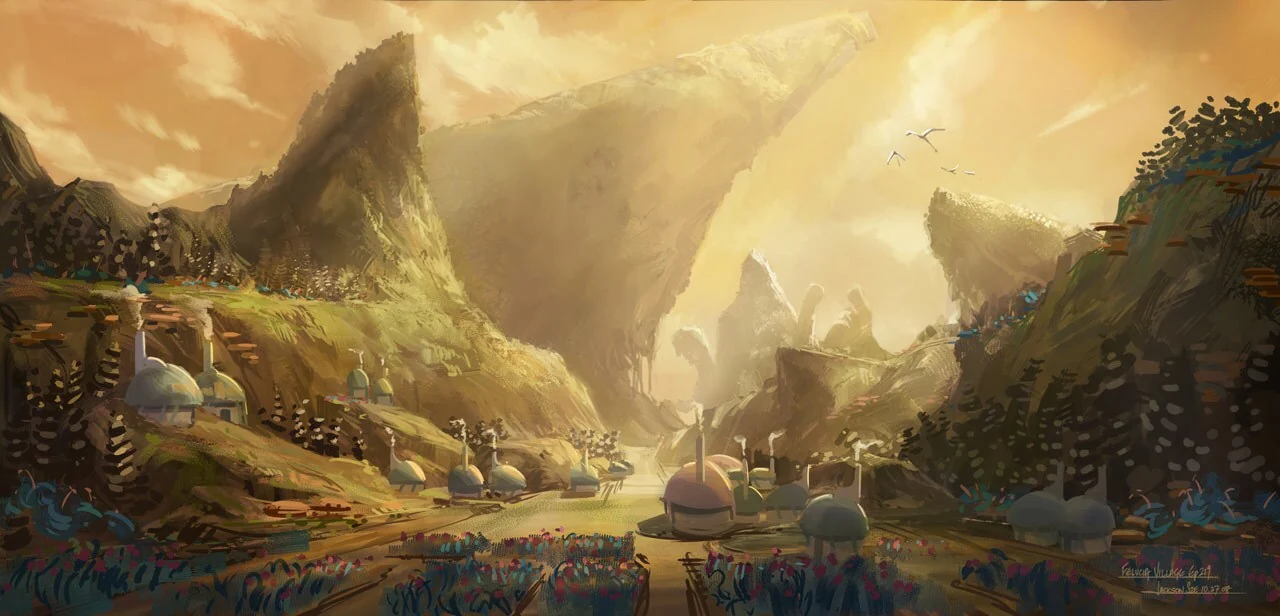
The production concept gallery includes a view of the crop environment developed for Bounty Hunters. Its colors and arrangement help explain the visual contrast between managed growing areas and Felucia’s huge surrounding vegetation. The image belongs to the production record, so it should be compared with finished episode stills. A design drawing can show an idea clearly without proving that every visible feature appears unchanged on screen. The explorer identifies that distinction in the image credit. Its contextual labels invite closer examination of work, habitation and production design without pretending to measure the location of a particular farmer’s plot.
Bringing in and protecting the harvest
The official story gallery describes villagers harvesting nysillin and putting bushels into the barn while Anakin instructs residents in the use of improvised pole-arms. The two activities happen as parts of the same preparation. The crop must be gathered, and the people responsible for it must learn to resist the attack. This connection makes the barn relevant as a storage function within the village account. It does not justify a separate invented warehouse district or a technical specification of its construction. The official stills, the village investigation and the documented preparation together show why ordinary work continues as danger approaches.
Protection as an agreement
The village hires four bounty hunters under Sugi’s leadership. The arrangement joins a farming community with specialists who can confront armed raiders. Hondo tries to persuade the hunters to stand aside, but Sugi keeps the original commitment. That choice has a direct consequence for the harvest because the defenders remain available when the pirates attack. The Jedi then join the local alliance rather than replacing every other participant. This is a specific relationship in a specific episode. It should not be generalized into a claim that all hunters follow the same code, that the farmers belong to an invented guild, or that the Jedi administer the village’s economy.
What residents contribute
The farmers practice using weapons and cooperate in defending the settlement. Ahsoka’s slingshot lesson makes part of that learning visible. The official rewatch emphasizes training and collaboration, which supports reading the residents as participants rather than passive recipients of rescue. Their contribution also differs from the specialized fighting abilities of the Jedi and hunters. The story does not require every farmer to acquire the same equipment or perform the same task. The interactive investigation therefore follows the documented stages of cultivation, gathering and resistance. It does not assign invented crop yields, calculate an unsupported battle score or turn a source-based account into an agricultural simulation.
The limits of a local victory
The combined defense forces Hondo’s pirates to withdraw. The immediate threat to the harvest is repelled, and Sugi’s hunters help the Jedi leave Felucia. The world’s later history includes further Clone Wars fighting and Aayla Secura’s death during Order 66. Those events do not establish that this same crop field becomes Aayla’s patrol route or that the village suffers an otherwise undocumented destruction. The separate battlefield file follows the film sequence using its own evidence. Keeping the accounts distinct allows visitors to understand the local victory without mistaking it for the end of the war or a complete biography of every place on Felucia.