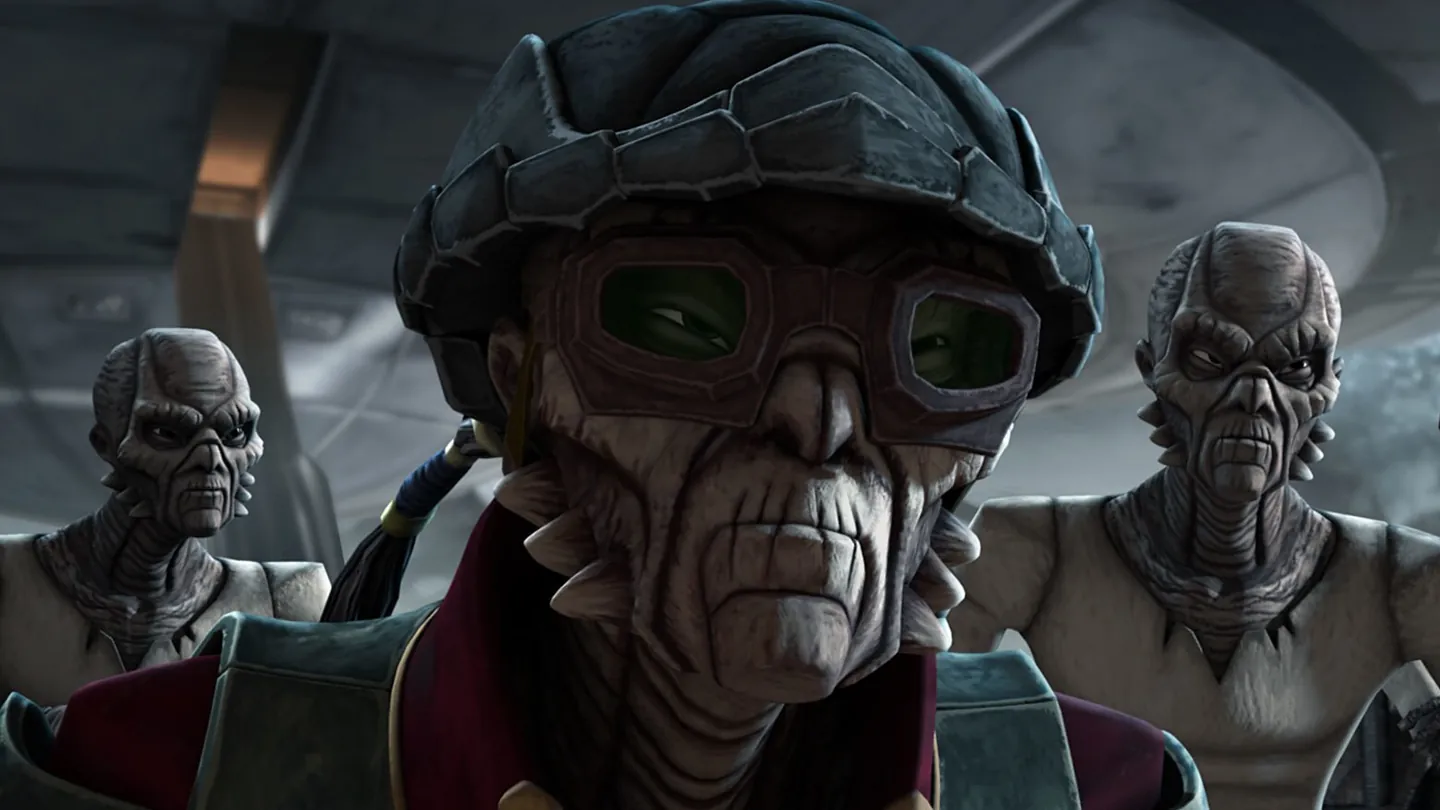
The economics of a remote stronghold
Florrum was an arid, sulfurous Outer Rim world sufficiently remote from major hyperspace routes to be useful to Hondo Ohnaka and his Weequay gang. The official Databank describes the pirate operation as a source of income through salvage, raids and ransom. A remote base let its residents keep provisions and stolen goods while making unwanted interference less likely. It did not make the operation a recognized government of the world or an institution with ordinary legal authority over travelers.
The pirate compound was a documented destination, but the series does not provide a surveyed plan of every hut, passage, hangar or cell. This scene therefore uses interactive subjects directly on the picture rather than manufactured point coordinates. The landscape, criminal enterprise and later military attacks are kept distinct.
Hondo and the Weequay pirates
Hondo Ohnaka led a band of Weequay pirates whose collective survival depended on finding profitable targets while avoiding total domination by either side of the Clone Wars. The Weequay are a recognized species with varied lives across the galaxy; Hondo's gang was a particular criminal group rather than a government representing all Weequay. The pirates had food, supplies and social gatherings at their stronghold, yet theft and hostage-taking were central to its business.
The Databank notes that Hondo could appear cooperative when a bargain suited him, then betray a guest or companion when the reward changed. His pragmatism created unpredictable relationships with Jedi, bounty hunters and Separatists. The archive describes that behavior through named encounters instead of romanticizing the base as a harmless tavern or assigning undocumented roles to its members.
Dooku becomes an expensive prisoner
After Count Dooku escaped an attack near Vanqor, he met a group of Weequay pirates who took him to Florrum. Hondo recognized that the captive Separatist leader might bring a vast ransom. The count's lightsabers were stolen by Pilf Mukmuk, a Kowakian monkey-lizard attached to the gang, leaving him with fewer immediate options. Hondo offered the Republic the chance to recover its powerful enemy for payment, believing the war would make the offer valuable.
Anakin Skywalker and Obi-Wan Kenobi arrived to verify the extraordinary claim. Hondo then drugged the Jedi and attempted to sell their freedom as well. What began as a negotiation for one prisoner became an effort to profit from three opposing leaders. The account does not establish that every pirate approved of each step, but it clearly names their chief as the organizer.
Prisoner status and shifting bargaining power
Hondo's imprisonment of Dooku and the Jedi exposed the unstable character of his bargains. The pirates used force, confinement and painful shackles to secure leverage. Dooku, Obi-Wan and Anakin were compelled to cooperate despite their different positions in the larger war. A planned exchange broke down, and the captives eventually escaped. Hondo remained on Florrum without receiving the complete reward he had expected.
Obi-Wan's decision not to take revenge on the pirate chief illustrates one response to a failed criminal bargain, not a declaration that the earlier kidnappings had been legitimate. The official biography records both the coercion and the unusual restraint shown afterward. The scene links to those documents rather than inventing a separate courtroom or legal settlement that never occurred.
Ahsoka and a rescue disguised as entertainment
Later, Hondo's pirates captured Ahsoka Tano while attacking the Jedi training vessel Crucible. On Florrum he hoped to sell her to another underworld buyer after it became clear that an ordinary Republic ransom was unlikely. The younglings aboard the damaged vessel defied instructions to remain safe and pursued a rescue. They entered the pirate compound as performers with a traveling circus and used their abilities to distract its residents.
The episode records a specific plot rather than a permanent circus district on Florrum. The younglings' deception allowed them to approach the captive Ahsoka and retrieve her equipment. Their presence became even more consequential when General Grievous attacked the same stronghold. The related siege page traces the wider conflict without treating a single party scene as a complete map of the camp.
Source limits and the compound's history
The Florrum world record, Weequay Pirates Databank and Hondo's extended biography support the base's purpose, group membership, supplies and ransom schemes. The episode galleries support Ahsoka's captivity and the younglings' improvised rescue. They do not supply all individual rooms, a complete account of stolen property or names for every person present. The image controls are therefore contextual and specific rather than pretending to identify unsupported locations.
The planet's later history includes military attacks that altered the compound and forced the pirate group to adapt. Visitors can switch between its economic organization, high-value captives and Jedi rescue. A separate shipyard-and-sieges investigation covers the departures, Grievous and Maul, with each scene and gallery subject selected to avoid immediately repeating the large first image.