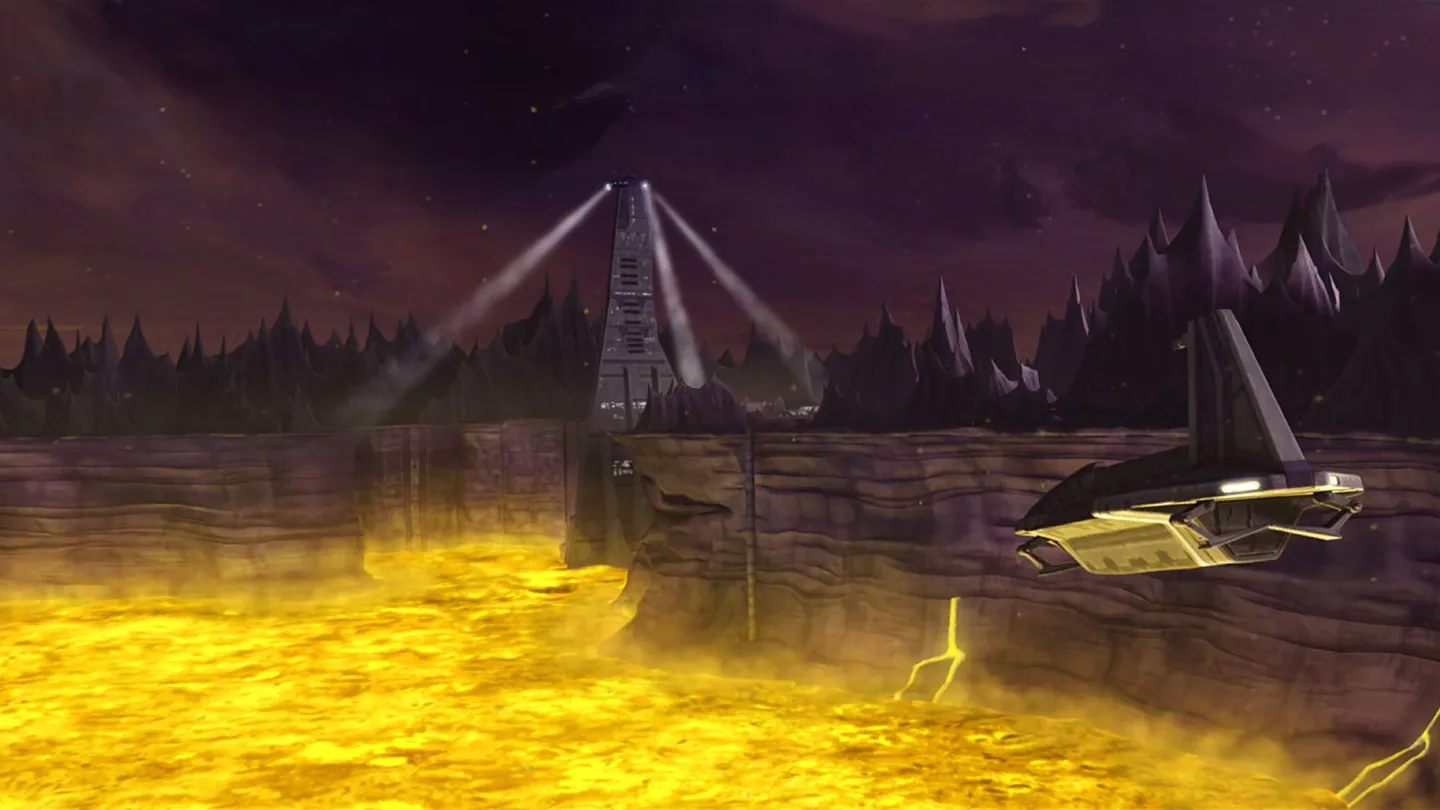
A prison built against an unlikely threat
The Citadel was constructed approximately five centuries before the Clone Wars as a safeguard against the possibility that a Jedi might turn against the Republic. Its original function was not to hold ordinary thieves or create a permanent Separatist garrison. The government built a heavily armed structure on a prominent butte above Lola Sayu's volcanic landscape. Its defenses reflected a fear that a prisoner with Force abilities could be difficult to confine.
This original purpose became an important historical irony. The Citadel later passed into Separatist hands when the Confederacy conquered Lola Sayu early in the Clone Wars. The building remained highly capable of imprisoning Jedi, but its operators and political objectives had changed. The page distinguishes those historical states rather than treating the installation as a timeless Republic or Separatist monument.
Osi Sobeck and Separatist control
The Separatists used the Citadel to hold Republic officers and entrusted its administration to Osi Sobeck. Sobeck was a harsh warden who reported to the Separatist leadership and sought to satisfy Count Dooku. Battle droids, security procedures and engineered hazards gave him material means to enforce captivity. These features also made an open assault extremely risky for the Republic.
The sources establish a heavily defended prison but not a complete room-by-room floor plan. A photograph of Sobeck or a droid is therefore treated as evidence for the institution's operations rather than as proof of the location of every guard station, lift and interrogation room. The clickable subjects open documentation or related investigations, not invented architectural coordinates.
Why Piell and Tarkin mattered
The prisoners included Jedi Master Even Piell and Captain Wilhuff Tarkin, who held strategically sensitive information about the Nexus Routes. Each possessed part of the intelligence. That division meant that rescuing only one of them would leave the Republic with an incomplete account. The intelligence was sufficiently important to justify an unusually dangerous mission by experienced Jedi and clones.
Tarkin was already a military professional with strong views about the methods needed to win the war. His disagreement with Jedi ethics during the escape foreshadowed positions he later adopted in the Imperial period. That later career should not be projected backward so far that he appears to command the prison or to know its complete future. During the Citadel mission, he was a rescued Republic captain.
A covert entry instead of a siege
Anakin Skywalker and Obi-Wan Kenobi led the effort to penetrate the Citadel. Ahsoka Tano joined the mission despite instructions not to do so, and a small detachment of clone troopers took part. R2-D2 accompanied reprogrammed droids to help the infiltration. The team used specialized concealment and tactical improvisation to get past defenses designed to stop direct military access.
The official episode guide describes the release of Piell and Tarkin but also makes clear that freeing the prisoners from their cells did not complete the assignment. The challenge of leaving the fortress under enemy pressure quickly became a separate problem. The archive gives the exterior fortress and escape terrain their own views instead of conflating the cell rescue with the eventual extraction.
A costly operation for the clones
Clone soldiers, including Cody, Fives and Echo, took part in the Citadel mission. Their involvement was not merely decorative beside the Jedi. The task required teamwork, firearms and improvised action in confined spaces. Echo appeared to die during the escape, an event with major consequences for Fives as the surviving member of Domino Squad. Later Star Wars stories revealed that Echo survived and was held captive, so his apparent death should not be presented as the last fact about him.
Those developments belong to separate points in the timeline. The Citadel-era characters believed that Echo had been lost, and Fives experienced that loss in the immediate context of a failed escape attempt. The image navigator links the participants to their existing dossiers without asserting that later stories happened inside the prison.
The walls were only the beginning
The Republic mission entered and moved through the prison, freed its targets and then faced an escape across Lola Sayu. Osi Sobeck's forces pursued them, and the landscape outside the fortress brought different threats. The mission's outcome depended on whether the survivors could reach a Republic task force despite the Separatist presence.
The strongest references are the Citadel Databank, the Lola Sayu world profile and the three official episode guides. They support the prison's original role, its capture, the named wardens and prisoners and the general escape sequence. They do not support a complete blueprint of the prison interior or precise coordinates for all security traps. On-image topics are contextual where physical placement cannot be verified.