A world defined by shadow
Umbara is known as the Shadow World because the rays of its sun never fully reach its surface. The official Databank describes a landscape of persistent darkness in which organisms and inhabitants have adapted to limited light. The environment created difficult conditions for outside troops accustomed to more visible battlefields. Movement through thick ground cover and uncertainty about what lay ahead became important features of the Republic's invasion.
The world is not represented by a precise expedition route in the official record. A dark forest vista establishes environmental context but does not locate an individual platoon or named camp. Accordingly, this page uses contextual image-area topics rather than artificial dots suggesting exact positions. It also distinguishes scenes of the world itself from images of vehicles, animals and people photographed elsewhere in the campaign.
The inhabitants and the decision to secede
The Umbarans were an advanced, technologically capable species whose leaders eventually aligned with the Confederacy of Independent Systems. They had previously belonged to the Republic and been represented in its Senate. Their political shift was therefore not simply the appearance of an invading Separatist army on an uninhabited planet. The Republic's subsequent operation threatened an inhabited world with its own society, equipment and sovereignty claims.
The Databank notes that Umbaran technology posed unusual problems for clone troops. This military capacity belongs to the society that developed and fielded the weapons, even though larger powers were competing over the planet. The interactive page allows readers to investigate local material culture without treating the population as faceless terrain obstacles or implying that every resident shared the same political opinion.
A hazardous living landscape
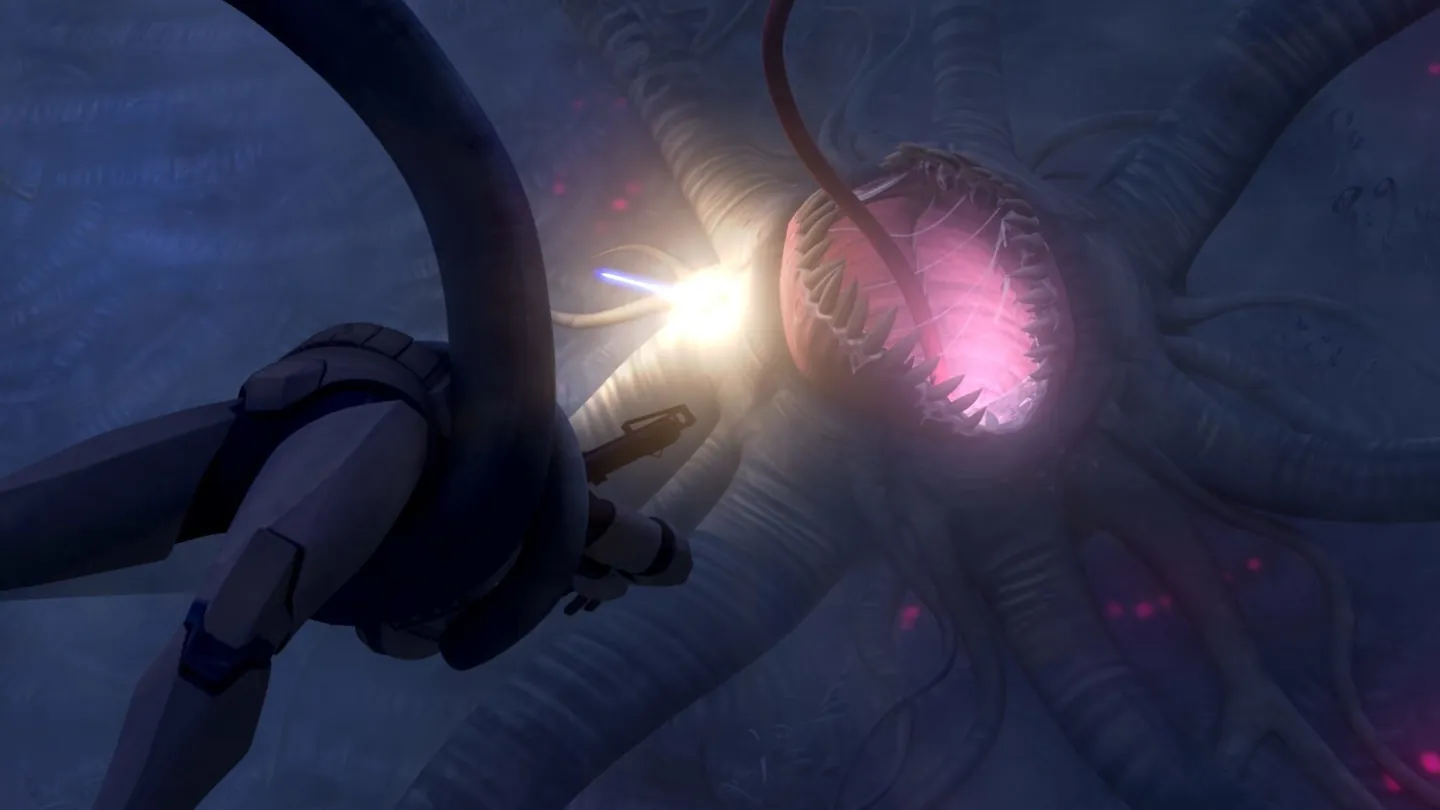
The planet's fauna included the vixus, a predatory organism armed with tentacles that could grasp unsuspecting animals or soldiers. In the series, the clones had to remain alert not only for sentient opponents but for the dangers of the environment itself. A vixus could become a hazard when it was mistaken for harmless vegetation. Its presence demonstrates that the forest's risks extended beyond droid fire and hidden military units.
This creature is not a generic decoration on the planet page. The scene gives it a distinct subject, a source and an explanation of its behavior. The exact distribution of individual vixus plants is not known from the episode, so a clicked topic opens the documented species instead of claiming to mark a permanent colony in one specific patch of forest.
A different approach to heavy armor
Umbaran forces deployed mobile heavy cannons, large machines standing on six legs with a heavily armored upper body. An articulated weapon arm carried a destructive electromagnetic plasma cannon. The MHC's construction made it difficult for ordinary anti-armor rockets to defeat. This helped the defenders exploit their home terrain and forced the Republic to respond to machinery unlike the familiar Separatist battle droid columns.
Hover tanks and crawler vehicles added to the technological variety. These weapons were part of the native Umbaran military effort, not arbitrary models borrowed from a separate theater of the war. The gallery provides different official visual subjects for the cannon, hover tank, crawler and fighter, preserving their distinction instead of repeating a generic clone trooper portrait for each system.
Fighters and the Republic's countermeasure
Umbaran starfighters were distinctive aircraft whose flexible frames and touch-sensitive holographic cockpit controls allowed agile maneuvering. Their plasma weaponry made them dangerous in the local airspace. These vehicles later became central to a dispute between clone troopers and their commander after the Republic captured a strategic airbase. Several soldiers realized the fighters could be used for a mission that Krell had not authorized.
The fighter record supports the technology's general functions. It does not map where every aircraft took off or give precise flight tracks over the forest. The related airbase page addresses that operation, while this location investigates the material capabilities that made the plan possible. This keeps a vehicle's design distinct from the event in which another group used it.
Sources and the limits of reconstruction
The Umbara, Umbaran, vixus and military equipment Databank entries describe the planet's environmental conditions, inhabitants, wildlife and engineering. The official campaign episodes show how the equipment and terrain influenced a particular battle. They do not document every neighborhood, biological specimen or hidden village, and cannot justify made-up geographical markers on an illustrated forest.
The interactive picture changes between landscape ecology, six-legged artillery and hover vehicles. Each topic has a distinct source or connects to the airbase investigation. Captions and gallery credits distinguish official reference art from geographic certainty. The page provides a way to understand the world as an inhabited environment without reducing it to the battle that made it famous.