Illustration: original IDS symbolic reconstruction. Read the author's notes on this story.
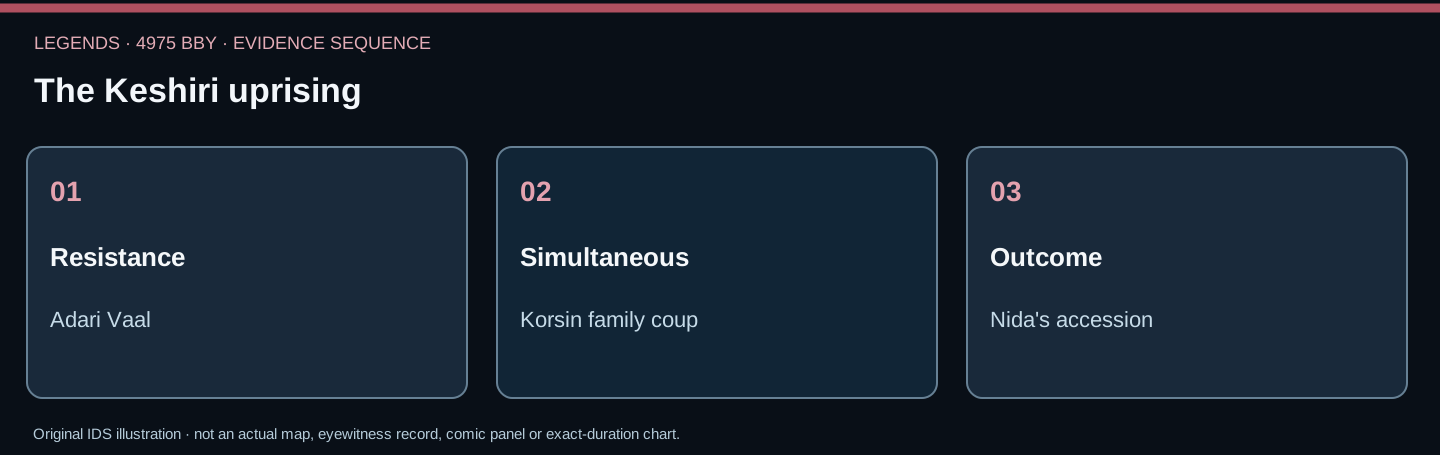
In 4975 BBY, Adari Vaal and a Keshiri resistance movement attempted to break the Lost Tribe's rule over Keshtah Minor. At the same time, Seelah Korsin and her son Jariad tried to overthrow Grand Lord Yaru Korsin. Nida Korsin defeated both threats, and the year ended with Yaru dead and Nida emerging as the new Grand Lord.
Adari Vaal turns against the Sith
Adari had helped the stranded Sith make first contact with the Keshiri. Fifteen years of exploitation and mass poisoning transformed her into an organizer of resistance.
The attempted uprising
Keshiri rebels planned to steal uvak and undermine Sith mobility and control. The plot was compromised, forcing survivors to flee.
Exile across the Endless Sea
Adari and hundreds of followers eventually reached Alanciar, where they warned a second Keshiri civilization about the Sith and helped shape a militarized society prepared for future contact.
Nida Korsin takes power
Nida defeated the coup against her father and then inherited leadership after Yaru's death. She commanded the Skyborn Rangers, an uvak-riding organization founded by her father Yaru, which also served as a reserve security force.
Anthropological assessment
The 4975 BBY crisis shows how colonial domination produces resistance while ruling elites simultaneously fight among themselves. Keshiri opposition and Sith dynastic conflict were distinct, but they intersected because both challenged the same political center.
Hidden Sith & Lost Tribe / Legends research
Two rebellions threaten the Lost Tribe's rule
Adari Vaal's resistance arose from the unequal power established by the stranded Sith over the Keshiri. The outsiders had exploited religious ideas of the Skyborn and controlled uvak flight, which made mobility and authority closely related. Over years of rule, mass poisoning, exploitation and the death of Adari's son undermined any remaining legitimacy the Sith might have claimed. By 4975 BBY Adari organized an uprising intended to seize the animals the rulers relied on and challenge the political order. The plan was compromised when Tona Vaal passed information to Nida Korsin.
The Keshiri uprising occurred during a simultaneous succession crisis among the Sith themselves. Seelah and Jariad Korsin sought to overthrow Yaru, while Nida and her Skyborn Rangers intervened on the ruler's side. The Skyborn Rangers had been established by Yaru with Nida as their leader; they were not a militia independently founded by her in the middle of the conflict. Adari's surviving followers eventually crossed the Endless Sea to Alanciar, carrying warnings that helped shape an entirely different Keshiri response to the Sith threat.
Transport technology becomes political authority
Control of uvak-riding meant influence over communication, movement and access to distant places. The resistance targeted those animals because removing the rulers' mobility could weaken a key material basis of their dominance.
The ruling household is not a single political actor
Seelah's coup and Adari's resistance had different motivations and objectives. Their timing overlapped, but combining them into one rebellion would erase the distinction between internal elite struggles and opposition from those under colonial rule.
Did Adari's uprising and Seelah's coup have the same leadership?
No. Adari organized Keshiri resistance against Sith dominance; Seelah and Jariad fought for power within the Sith ruling family.
Source record: John Jackson Miller, Lost Tribe of the Sith: Savior (2010); original book's Keshiri uprising and Korsin household plots. This is Legends continuity. The political comparisons are IDS interpretations, with actor responsibilities and date uncertainty distinguished from direct scenes.
Legends · Research field note
Historical perspective: The Keshiri uprising
Resistance by a subordinated population challenges the political legitimacy of the Lost Tribe's rule.
Reading the evidence: This interpretation draws out the social implications of the recorded event without supplying undocumented conversations, numbers or motivations.
Research question: what would stronger evidence require?
Compare the source cited below with nearby chronology entries. Distinguish what is explicitly recorded from broader conclusions about political institutions, lived experience and historical consequences.
4975 BBY · Legends · Author source and narrative
Resistance, palace conspiracy, and the succession of Nida Korsin
- Adari Vaal organizes resistance from within
Adari's decision to help the stranded Sith in 5000 BBY enabled their access to Keshiri communities and institutions. Fifteen years later, she had become disillusioned with their rule. The author identifies Keshiri use of uvak as a practical factor in the Sith's ability to govern, and Adari's resistance plan responds to that same transportation network.
- The ruling house has its own conflict
The uprising occurs during a separate succession struggle between Yaru, Seelah and Jariad Korsin. These are related crises, but the Keshiri are not merely allies in a Sith family feud. Their goal concerns their own political autonomy, while different Sith factions compete for the ruling office.
- Nida consolidates authority; resistance survives in memory
Nida Korsin emerges as the new Grand Lord after her father's death and the failure of the uprising. Adari's departure and the continued existence of other Keshiri communities complicate any claim that the Sith received unanimous support on Kesh. The story is one phase in a much longer history of occupation and adaptation.
Was the Keshiri uprising identical to Seelah's attempt to seize Sith leadership?
No. Savior brings both storylines together, but the native Keshiri's opposition to Sith rule had different political goals from the Korsin family succession plot.
Original story: John Jackson Miller, Lost Tribe of the Sith: Savior. John Jackson Miller's original story notes →. The author distinguishes narrative intention from the direct sequence of events; later political interpretations are IDS commentary.
Legends · Source study · 5000–4896 BBY
Indigenous resistance and the politics of the Korsin family
Adari Vaal's resistance should not be merged with Seelah and Jariad Korsin's attempt to seize command of the Lost Tribe. One challenged the authority that Sith outsiders exercised over Keshiri communities; the other was a struggle within the colonizers' political family. The simultaneous crises made Grand Lord Yaru Korsin's position more precarious, but their leaders did not have the same aims or claim the same kind of legitimacy. This distinction gives agency to the Keshiri rather than reducing them to participants in a Sith succession drama.
Adari's later departure across the Endless Sea connects this uprising to long-term histories of isolation, memory and resistance elsewhere on Kesh. Miller's collected-story notes describe how a warning to distant Keshiri people shaped later encounters with Sith settlers. The event in 4975 BBY ended with the defeat of the immediate rebellions, Yaru's death and Nida's succession. It did not prove that the entire indigenous population permanently accepted Sith rule or that Adari's influence ended.
Connected histories and boundaries
Source trail: Author / book source. These establish a licensed fictional narrative; historical interpretation of migration, governance, colonization or destruction is IDS analysis. No unrecorded casualty figures or spoken orders are claimed.
Why this article stays separate from nearby events
The Omen castaways founded an isolated political order on Kesh, not Vitiate's Empire at Dromund Kaas. Even events in the same year, such as the indigenous uprising and the Korsin family struggle, had different people, stakes and outcomes.
Historical judgment · Legends
Test your historical judgment
Answer both questions and receive scored corrections explaining what the source material actually supports.
4975 BBY · Legends · Source and society
Two different rebellions within a single colonial crisis
Adari Vaal and Keshiri dissidents challenged the authority of the Lost Tribe over the world they inhabited. Their resistance concerned outsiders who had imposed a new hierarchy. At approximately the same time, Seelah and Jariad Korsin sought to reshape authority within the ruling Sith-descended population. These movements overlapped chronologically, but their political constituencies and aims should not be conflated.
The change in the Tribe's leadership to Nida Korsin was an outcome of the combined crisis. That does not mean the Keshiri resistance succeeded in removing Sith rule, nor that every member of the ruling family opposed the same individuals for the same reasons. A historical interpretation can compare struggles over power without treating indigenous opposition as equivalent to a dynastic challenge.
John Jackson Miller's Savior and related creator notes are the appropriate sources for the sequence. The original IDS image below presents the three distinct elements as source claims. It does not depict the real appearance of Adari Vaal or a documented route across Kesh's Endless Sea.
Check the historical interpretation: Were Adari Vaal's followers and Seelah Korsin's conspirators one unified political movement?
Explanation: No. They challenged the existing system from different social positions and for different objectives.
Compare a related history → · Explore the complete timeline →
Reference: John Jackson Miller, Lost Tribe of the Sith: Savior. A summary or creator commentary is distinguished from an independently checked printed issue/page; no invented dialogue, visual details or casualty totals.
Sources and further reading
- John Jackson Miller, Lost Tribe of the Sith: Savior.
- Keshiri uprising in Keshtah, Wookieepedia