
In 4975 BBY, years of hidden family conflict inside the Lost Tribe erupted into open violence. Seelah Korsin and her son Jariad attempted to remove Grand Lord Yaru Korsin. Yaru was mortally wounded, but Nida Korsin and the Skyborn Rangers defeated the uprising. Before dying, Yaru named Nida the future of the Sith on Kesh, and she became the Tribe's new Grand Lord.
A family feud becomes a state crisis
Seelah's conspiracy grew from the death of her first husband Devore at Yaru's hands.
Private revenge therefore became a succession war for the entire Lost Tribe.
The Skyborn Rangers
Nida's uvak-riding organization functioned as a military reserve.
It gave her an independent force capable of responding to the coup.
A seventy-nine-year reign begins
Nida's rule later became remembered as a golden age on Kesh.
Her reign lasted until 4896 BBY.
Anthropological assessment
Nida's succession shows how kinship and state power overlap in dynastic systems.
Her Skyborn Rangers also demonstrate how social organizations can become political forces during a succession crisis.
Hidden Sith & Lost Tribe / Legends research
The next Grand Lord is made in a battle over succession
Nida Korsin inherited the title of Grand Lord after the violent 4975 BBY crisis on Kesh. Her father Yaru had founded the Skyborn Rangers and placed her in command of the uvak-riding group. What appeared at first to be an organization for recreation and aerial skill also provided a reserve with political and security value. When Seelah and Jariad attempted to overthrow Yaru, Nida's supporters intervened, ending the coup even though the aging ruler did not survive his wounds.
Nida's new position must be understood alongside the separate Keshiri resistance movement, whose plans she had learned through Tona Vaal. The victory over rival members of the ruling family did not mean all inhabitants consented to Sith rule. Adari and her followers continued into exile and brought their warning about the Sith to people on another continent. Nida would govern for decades, during which the stranded crew's emergency command structure evolved into something that felt like an ordinary local dynasty.
A social association becomes a source of coercive power
A group of riders organized around skill and prestige can become a decisive military reserve if its members trust one another and can move quickly. Nida's command made her more than a nominal heir during the succession struggle.
Dynastic authority is not the same as public consent
Nida's position followed the defeat of a household coup and the wishes of her dying father. Those facts explain who could claim the title, not the opinions of every Keshiri inhabitant subject to the Tribe.
Did Nida single-handedly found the Skyborn Rangers in 4975 BBY?
No. Yaru founded the organization and put Nida in charge. Her leadership of the riders became crucial during the coup.
Source record: John Jackson Miller, Lost Tribe of the Sith: Savior; The Essential Reader's Companion. This is Legends continuity. The political comparisons are IDS interpretations, with actor responsibilities and date uncertainty distinguished from direct scenes.
Legends · Source study · 5000–4896 BBY
Why Nida's succession is not a second Keshiri uprising
Nida Korsin's rise was the institutional consequence of the 4975 BBY crisis rather than a separate Keshiri rebellion. Her father Yaru was mortally wounded in conflict involving the family faction led by Seelah and Jariad. Nida, supported by the Skyborn Rangers, helped defeat the immediate threat and became Grand Lord. The Keshiri uprising formed another front in the crisis, but had a different purpose and leadership. Keeping those strands separate improves the chronological record while allowing readers to understand why the same year appears in more than one dossier.
The transfer of power mattered because the Lost Tribe needed a rule of succession that would survive its original shipwreck generation. Nida's later seventy-nine-year tenure helped make the isolated organization more stable. Her eventual death is recorded in 4896 BBY and should not be folded into the first battle for succession. The narrative evidence comes from Miller's Savior, whereas some later developments are described only in his subsequent stories and retrospective notes.
Connected histories and boundaries
Source trail: Author / book source. These establish a licensed fictional narrative; historical interpretation of migration, governance, colonization or destruction is IDS analysis. No unrecorded casualty figures or spoken orders are claimed.
Why this article stays separate from nearby events
The Omen castaways founded an isolated political order on Kesh, not Vitiate's Empire at Dromund Kaas. Even events in the same year, such as the indigenous uprising and the Korsin family struggle, had different people, stakes and outcomes.
Historical judgment · Legends
Test your historical judgment
Answer both questions and receive scored corrections explaining what the source material actually supports.
4975 BBY · Legends · assessed sources
Nida Korsin: succession alongside Keshiri resistance
Evidence
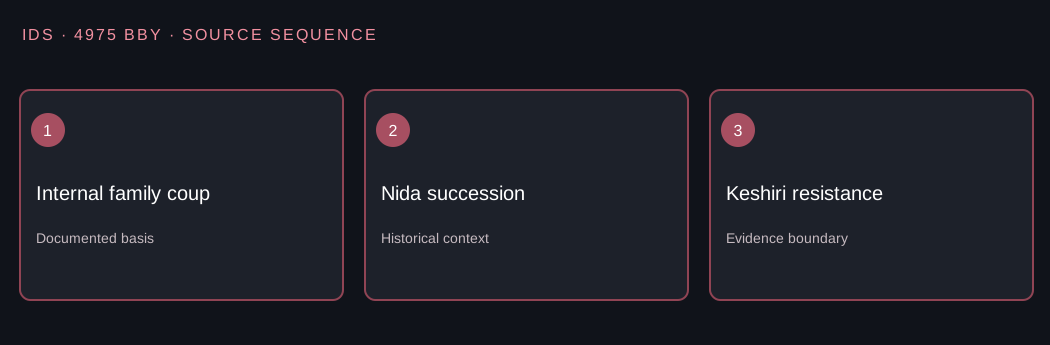
In Lost Tribe of the Sith: Savior, Nida and her Skyborn Rangers frustrate Seelah and Jariad's coup. After Yaru dies, Nida succeeds him. At the same time, Adari Vaal's Keshiri resistance pursues its own escape.
Anthropological interpretation
The Sith family crisis was not the only political struggle on Kesh. The Keshiri were not passive subjects, and a ruling household's claim to succession is not proof of indigenous consent.
What remains uncertain
The story does not establish that every Keshiri supported Nida or that Adari's surviving followers ceased to exist.
Historical judgment: Did Nida's victory end all Keshiri resistance?
Explanation: No. Adari and followers continued their separate efforts beyond the coup.
Source: Lost Tribe of the Sith: Savior (2010). Consult source record →.
Sources and further reading
- John Jackson Miller, Lost Tribe of the Sith: Savior.
- Nida Korsin, Wookieepedia