Original IDS symbolic artwork; not an official depiction of Vaiken’s prototype vessel. Read the original Galactic History.
Around 4904 BBY, Grand Moff Odile Vaiken led a Sith Imperial campaign against an unidentified alien society in deep space. Vaiken had already helped tame Dromund Kaas, reorganize the military, and lay the foundations of the Imperial Armada. He died in battle on the bridge of a prototype Star Destroyer.
Architect of the Imperial military
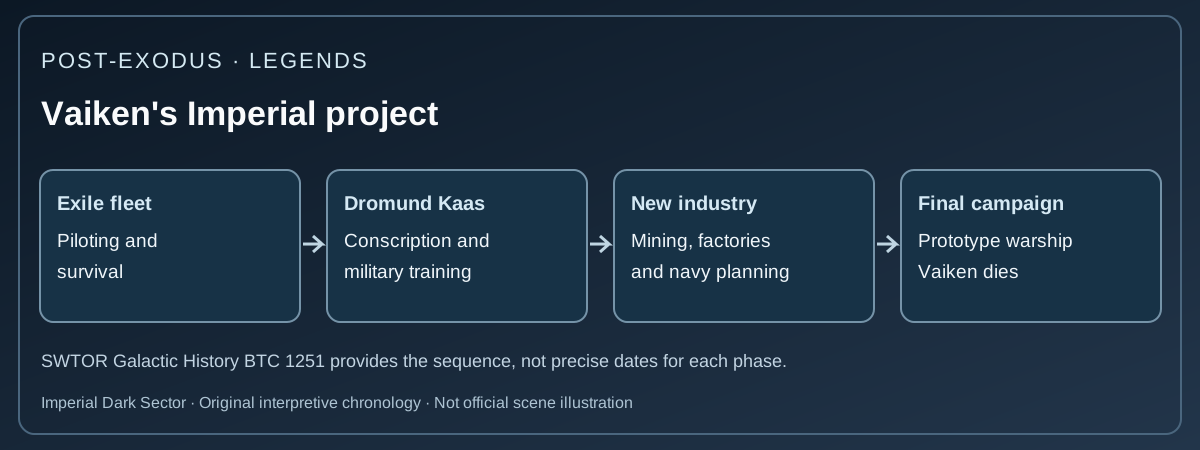
According to the official SWTOR Galactic History, Odile Vaiken was among the few hundred Sith Empire refugees who fled Korriban as children after the Great Hyperspace War. His career began with the exile of a defeated population, not with the command of a fully developed interstellar navy. Once the surviving fleet settled on Dromund Kaas, he organized military recruitment and training in preparation for creating a new political center.
The official account associates his early military command with a campaign to secure space for the new city and Imperial Citadel in Dromund Kaas’s jungle. The same retrospective reports that Vaiken killed a dangerous terentatek at the future site of the citadel. Because the story appears inside a later historian’s reconstruction of Imperial records, it should not be confused with a contemporary field report recording the creature’s dimensions or exact manner of death.
Vaiken later redirected people and resources toward mining, manufacturing, engineering and vessel construction. He expected the planned Imperial armada to take centuries. Military strength in this account is produced by training institutions and labor systems, rather than by the Emperor’s powers alone.
The first Grand Moff
Vaiken’s army and naval construction plan gained the support of the Dark Council. The official Galactic History describes his appointment as the first Grand Moff recognized in the new Sith Imperial military. The title formalized a role for a powerful non-Force-sensitive officer inside a system otherwise ruled by Sith practitioners.
The appointment did not make Vaiken sovereign, and the existence of a senior military title cannot be taken as evidence that civilian or enlisted Imperials possessed equal political authority. Gnost-Dural’s later reflection specifically asks why Vaiken and other Imperial citizens showed such deep loyalty despite remaining subordinate to their Sith rulers. That is the historian’s question about a political relationship, not proof that every person in the Empire consented freely to its hierarchy.
The campaign against an unidentified system
The Emperor’s government remained largely hidden from the Republic while it developed the capacity to project military force into nearby deep-space systems. Vaiken took part in one of these early campaigns against an alien civilization whose identity was not preserved in the official summary. The description indicates that Imperial expansionism affected populations beyond the original refugee community, even while the Empire’s planned future campaign against the Republic was generations away.
Vaiken was killed on the bridge of a prototype Star Destroyer during the fighting. The record does not name the enemy’s species, its world, the number of vessels, the purpose of any local resistance or the outcome of the battle. A ship’s design and operational condition also cannot be inferred from the later Imperial Star Destroyers familiar in Galactic Civil War-era films. The comparison is one of terminology and military tradition, not visual continuity across thousands of years.
Anthropological assessment
Vaiken’s career provides a way to study military institutions across generations. The survivors of Korriban were a displaced population, yet the organization built on Dromund Kaas gradually mobilized recruitment, skilled work, training and construction for a future war. Imperial identity rested not only on Sith religious authority but on the ordinary routines of military labor that permitted a long-term political project to continue after its first planners died.
The Grand Moff’s recognition also illuminates the contradiction at the center of Imperial citizenship. Vaiken could receive extraordinary rank and prestige without challenging the formal priority accorded to Sith rulers. Gnost-Dural uses this tension to explain the loyalty of non-Force-users. A different inquiry would ask what options these citizens actually had, how conscription shaped their experience, and whose accounts of exile or conquest remain absent from the surviving historical record.
Hidden Sith & Lost Tribe / Legends research
The engineer of an empire dies before its planned revenge
Grand Moff Odile Vaiken helped organize the military forces of the concealed Sith Empire during the centuries after Vitiate's refugees reached Dromund Kaas. His work connected mining, technology, shipbuilding and centralized command into the long-term project of constructing an Armada. The Empire expected to challenge the Republic in the future, but Vaiken knew that building the necessary capabilities would occupy generations. His last reported campaign occurred around 4904 BBY, during an expedition against an unidentified society in deep space.
Vaiken died aboard a prototype Star Destroyer during the operation. The original historical record does not establish the name of the enemy civilization, a full order of battle or a decisive outcome for that campaign. Inventing those details would make a thin but meaningful record less reliable. The event matters because one of the architects of Imperial expansion died while exercising the military power he had helped build. The organizations, titles and technical projects associated with him continued beyond his lifetime.
Strategic planning across generations
Military programs intended for long-term conflict require people to invest labor and resources in objectives they will not personally see achieved. Vaiken's career illustrates how a political demand for revenge can become a permanent institutional commitment.
Titles can outlive their first officeholder
The Grand Moff rank became part of the Empire's command hierarchy. Its later reuse in other Star Wars eras does not mean the same government continued unchanged through every millennium.
Did Vaiken's final campaign conclusively conquer a named alien capital?
The source does not identify the enemy society or establish that result. It does place Vaiken's death during a deep-space operation.
Research sources: Star Wars: The Old Republic, Galactic Timeline 11: Rebirth of the Sith Empire. Source-sparse events remain bounded by the available evidence. Political interpretation is not invented eyewitness history.
c. 4904 BBY · Legends · Evidence review
What the official history actually records
- Survival and resettlement
Vaiken fled Korriban as a child and reached Dromund Kaas with Vitiate’s refugees. The subsequent military project started during the long reconstruction of a displaced population.
- Creation of military institutions
Gnost-Dural credits Vaiken with training, recruitment, a Dromund Kaas campaign, the labor network for ship construction, and recognition as the first Grand Moff.
- An unrecorded enemy
Vaiken died on the bridge of a prototype Star Destroyer while fighting an unidentified alien society. The record gives no reliable illustration of the encounter and no definite outcome.
Can a later Star Destroyer model be used to illustrate Vaiken’s prototype?
Not as a confirmed depiction. The SWTOR text identifies the type generically, but does not provide a verified production illustration of this specific prototype. The IDS image above is explicitly a symbolic reconstruction.
Primary source: Star Wars: The Old Republic, Galactic History, BTC 1251: Rebirth of the Sith Empire. Date placement and the title are editorial classifications based on Legends reference timelines.
Legends · Historical source review
Vaiken's final campaign and the military that outlived him
SWTOR's Galactic History credits Odile Vaiken with training the reconstituted Empire's soldiers, conscripting non-Force users and organizing mining, manufacturing and engineering to build a navy. His grand strategy was industrial rather than solely military: even a victorious campaign could not substitute for the long-term capacity to produce warships, sustain crews and enforce obedience. The first Grand Moff died on the bridge of a prototype Star Destroyer while campaigning to conquer an unnamed alien system. That source does not reveal the defenders' identity or who held the system afterward. This distinction is important when viewing later Imperial fleet designs; none can be claimed as a confirmed portrait of Vaiken's specific prototype.
Evidence boundary and primary-source trail
SWTOR Galactic History BTC 1251; named ship and imperial institutions. View source or reference information →. Source-supported fiction history is distinguished from IDS interpretation of political institutions and material culture. No undocumented eyewitness testimony, precise casualty figures or invented rituals are claimed.
History quiz · Legends
Test your historical judgment
Get a score and a correction explaining the source for each question.