
Illustration: original IDS reconstruction, not a film still or comic panel. Consult the source.
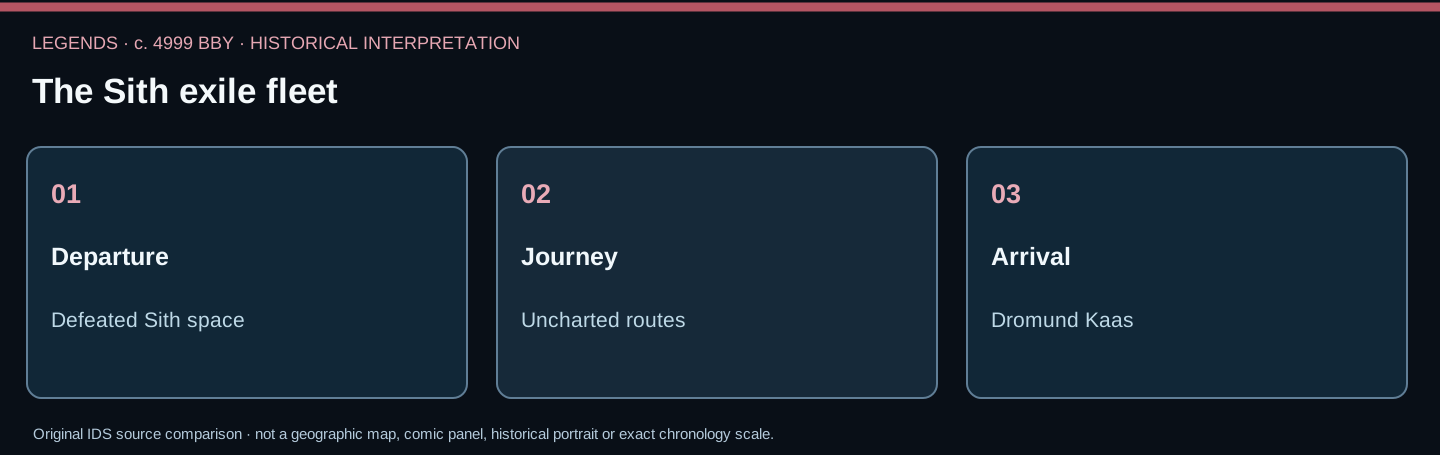
After the Ritual of Nathema in 4999 BBY, Vitiate gathered survivors of the shattered Sith Empire and offered himself as their savior. He blamed the destruction of Nathema on the Jedi and Republic, concealed his own responsibility, and led the refugees away from known Sith space. The fleet then wandered for almost twenty years before reaching Dromund Kaas.
A refugee population under authoritarian leadership
Many followers had lost worlds, institutions, and family during the war and counterinvasion.
Vitiate offered protection and a future under his sole authority.
The Republic becomes the official enemy
Vitiate blamed the Jedi for Nathema and the destruction of Sith civilization.
This narrative became foundational to the reconstituted Empire's political identity.
Nearly twenty years in transit
The fleet wandered rather than taking a direct announced route.
The journey strengthened Vitiate's role as the only leader who appeared to know where survival was possible.
Anthropological assessment
The Sith exodus shows how displacement can create conditions for authoritarian consolidation.
A leader who controls navigation, information, and the promise of safety can turn refugee dependence into political legitimacy.
Great Hyperspace War / Legends chronology
An exodus shaped by unequal access to truth
The Sith exodus began after Vitiate destroyed Nathema and presented himself as a leader who could protect the survivors of the old Sith Empire. Refugees faced loss of territory, institutions, status and family networks as the Republic counterinvasion continued. Their decision to depart was shaped by genuine insecurity, but also by the ruler's deliberate falsehoods about who was responsible for the catastrophe on Nathema. People following him lacked critical information about the leader in whom they placed their trust.
The journey into the Unknown Regions lasted for many years before the group settled on Dromund Kaas. Vitiate's knowledge of navigation and the supposed destination gave him extraordinary power over the migrants. The exodus did not encompass every Sith survivor. Different groups escaped to other worlds, while remnants endured in isolation. The founding of the concealed Sith Empire on Dromund Kaas therefore belongs to a longer process rather than a state appearing fully formed the day refugees abandoned their homes.
Movement depends on control of routes
Ships, supplies and access to reliable navigational information are political resources for displaced groups. A leader monopolizing them can make ordinary survival contingent on continuing personal obedience.
A community can inherit a false memory
The story Vitiate told about Nathema reinterpreted a crime he committed as an attack by the group's enemies. That narrative shaped later Imperial politics long after the voyage itself ended.
Did the Sith refugees reach Dromund Kaas immediately in 4999 BBY?
No. The hidden Empire's capital developed after a long journey, and other Sith communities pursued separate routes of survival.
Source tradition: The Old Republic: Revan; Star Wars: The Old Republic Encyclopedia. The original Legends historical sequence is not treated as automatically confirmed current Canon.
4999 BBY · Legends · Source and interpretation
Flight, navigation, and the creation of a new imperial project
- Who left Korriban?
Gnost-Dural's official SWTOR history describes a small surviving fleet led by the Sith Emperor, including children who had lived through the Empire's destruction. The survivors were one branch of Sith history, not proof that all remaining Sith people boarded the same ships or that no other communities persisted.
- Years without a secure capital
The refugees made dangerous hyperspace journeys through unfamiliar regions while avoiding the Republic. Navigation was a survival skill, not simply a means to military conquest. Odile Vaiken's later role in building the rebuilt Empire began with experience accumulated during this wandering period.
- The end of a journey is not the beginning of a mature state
Official HoloNet accounts place their arrival on Dromund Kaas at about 4980 BBY, roughly two decades after the war. Their later city, military, and fleet developed across generations. The account of a secure and powerful Empire therefore cannot be projected back to the first moment of departure in 4999 BBY.
Did the exiles reach a fully built Kaas City in 4999 BBY?
No. They spent nearly two decades searching before reaching Dromund Kaas. The city and imperial military developed after settlement, as the official SWTOR history describes.
Original source: SWTOR Galactic History, BTC 1251: Rebirth of the Sith Empire. SWTOR HoloNet: Dromund Kaas; Drew Karpyshyn, Revan (2011). The interpretations here do not assert an exact date or eyewitness account beyond the source.
Legends · Source study · 5000–4896 BBY
The refugees' flight and the making of an imperial origin story
The journey that began after the Ritual of Nathema took surviving Sith out of their former territory, but it was not a spontaneous or politically neutral migration. Vitiate positioned himself as the person who understood the danger and could keep the refugees alive. He directed ships away from known hyperspace routes, and the long search created a new community through shared deprivation, disciplined travel, and obedience to his authority. This does not mean all exiles were Sith Lords or that every refugee had equal access to information about Nathema.
Official SWTOR background places the fleet's eventual rediscovery of Dromund Kaas after roughly twenty years of wandering. The source distinguishes arrival on the jungle planet from the later transformation of its atmosphere by the Emperor's esoteric practices. It also gives the refugee society a longer institutional story: the exiles needed pilots, supply organization, settlement construction, labor and military command. The Emperor's promises of vengeance became a political account of what the society was for. The separate Omen crash on Kesh in 5000 BBY must not be described as part of Vitiate's fleet. The two displaced Sith populations developed different political orders.
Connected histories and boundaries
Source trail: Licensed or official source · Related source. These establish a licensed fictional narrative; historical interpretation of migration, governance, colonization or destruction is IDS analysis. No unrecorded casualty figures or spoken orders are claimed.
Why this article stays separate from nearby events
The collapse of Naga Sadow's Sith Empire, the Republic's counterinvasion, Vitiate's ritual, the exile fleet's long voyage and the Dromund Kaas founding belong to a connected sequence, not one undifferentiated battle. Keep separate dates and documented causes.
Historical judgment · Legends
Test your historical judgment
Answer both questions and receive scored corrections explaining what the source material actually supports.
Legends · Comparative evidence review
An exile route is also a system of dependency
The SWTOR planetary history supplies a concrete limit on reconstruction: after the defeat of the old Empire, the refugee fleet abandoned known hyperspace routes, undertook dangerous blind scouting and wandered for twenty years before rediscovering Dromund Kaas. This establishes prolonged flight and eventual settlement, but not a dated stopover log for each ship. Neither invented star coordinates nor a complete series of unseen battles should be inserted to fill that interval.
For the people aboard the fleet, navigation was both a technical problem and a matter of political authority. Someone had to decide which uncertain jump to attempt, which supplies to ration and which navigators to trust. An institution controlling route information can acquire authority even without governing a settled territory. This is a social interpretation of the documented long wandering, not evidence that surviving logs contain specific food allocations or punishments that the sources never record.
The exile's community also differs from two other contemporary groups. Sadow had retreated to Yavin 4, and the Omen independently crashed on Kesh during the earlier war. Calling all three a single refugee fleet would combine incompatible accounts. The official Dromund Kaas entry traces the development of its own imperial state after arrival, while the earlier flight itself ends at that settlement rather than instantly producing Kaas City's full infrastructure.
Historical question: Does the twenty-year journey establish that the exiles already possessed a fixed, mapped route to Dromund Kaas?
Correction: No. The official account specifically describes abandoned known routes and blind scouting before the lost Dromund system was rediscovered.
Compare the three aftermath trajectories →
Source: Official SWTOR Dromund Kaas HoloNet. Some precise dates or individual quotations depend on original novel/game chapters not yet checked directly. Interpretation is labeled separately from reported events.
c. 4999 BBY · Legends · Historical evidence
Twenty years of flight did not create a ready-made imperial capital
After Vitiate gained control of surviving Sith factions, his followers abandoned familiar routes and sought a world where a hidden state could survive. The official SWTOR account describes nearly two decades of navigation before the fleet reached Dromund Kaas. That interval establishes a difficult journey, not a complete list of verified stopovers and not an exact day-by-day naval log.
The newcomers' political identity rested partly on Vitiate's account of Nathema and the Republic threat. A population experiencing displacement could be asked to accept an authoritarian explanation of the past and an uncertain future. The official Dromund Kaas history later describes a lengthy effort to construct Kaas City and rebuild institutions; these developments should not be depicted as completed at the time of first arrival.
The fleet should also be distinguished from Naga Sadow's separate refuge on Yavin 4 and the Omen crew's independent crash on Kesh. Treating all three as one displaced population would combine different stories into a false migration map.
Historical judgment: Did Vitiate's followers arrive on Dromund Kaas with the entire later capital already built?
Explanation: No. The new imperial city and political infrastructure developed after settlement.
Read a related historical dossier → · Complete timeline →
Primary story or reference family: Official Star Wars: The Old Republic Dromund Kaas HoloNet. Explanations distinguish source-reported facts from editorial inference; original editions require page-level proofing where only summaries are available.
Sources and further reading
- The Old Republic: Revan.
- Star Wars: The Old Republic Encyclopedia.