Naga Sadow is most important not simply because he was powerful, but because he understood that fear could be organized into political authority. When Marka Ragnos died, the ancient Sith faced a succession struggle. Sadow's rival Ludo Kressh represented a more defensive vision of Sith power. Sadow wanted expansion. The arrival of Republic hyperspace explorers gave him the opportunity to turn an internal contest over leadership into a story about an external enemy.

A succession crisis becomes a foreign threat
The death of Marka Ragnos left the Sith Empire without an uncontested ruler. Naga Sadow and Ludo Kressh embodied competing responses to that uncertainty. Kressh favored protecting Sith territory. Sadow argued for aggressive expansion and treated contact with the Republic as an opportunity rather than a warning.
The arrival of the hyperspace explorers Jori and Gav Daragon changed the balance. Sadow did not merely react to them. In the Legends account, he manipulated their presence, staged evidence of a Republic attack, and used the resulting panic to strengthen his claim to leadership. The important point is not only that the deception worked. It worked because the Sith political community already faced unresolved questions about succession, security, and the future of the Empire.
Sadow therefore makes propaganda part of state formation. His political project depends on producing a shared interpretation of unfamiliar outsiders. Once the Republic can be presented as an approaching threat, war becomes a test of loyalty and Sadow becomes the leader who claims to know how to answer it.
Jori and Gav Daragon: mobility becomes intelligence
The Daragons enter Sith space as explorers, but their knowledge of hyperspace routes makes them strategically valuable. Their mobility links two political worlds that had been separated long enough to develop myths about one another. Sadow recognizes immediately that navigation itself is power.
He uses Jori's return to Republic space to gain access to information and routes while drawing Gav into his own orbit. Gav's position becomes especially unstable. He is at once outsider, student, military asset, and political symbol. Sadow's treatment of him demonstrates how empires often recruit people at boundaries precisely because they can move between systems that do not yet understand one another.
The relationship ultimately exposes a weakness in Sadow's command. A subordinate who has access to both sides can become an intermediary, but can also become a defector. When Gav turns against him, the information network Sadow built to expand his power becomes one of the mechanisms through which that power breaks apart.
The Great Hyperspace War
Sadow's invasion of the Republic becomes the Great Hyperspace War, an early collision between the Sith Empire and the Republic. Official Old Republic material describes the Republic as initially unprepared for the scale of the assault and identifies Sadow as the Dark Lord who drove the campaign. Sith forces struck on several fronts, including Coruscant, before the Republic and Jedi recovered and reversed the invasion.
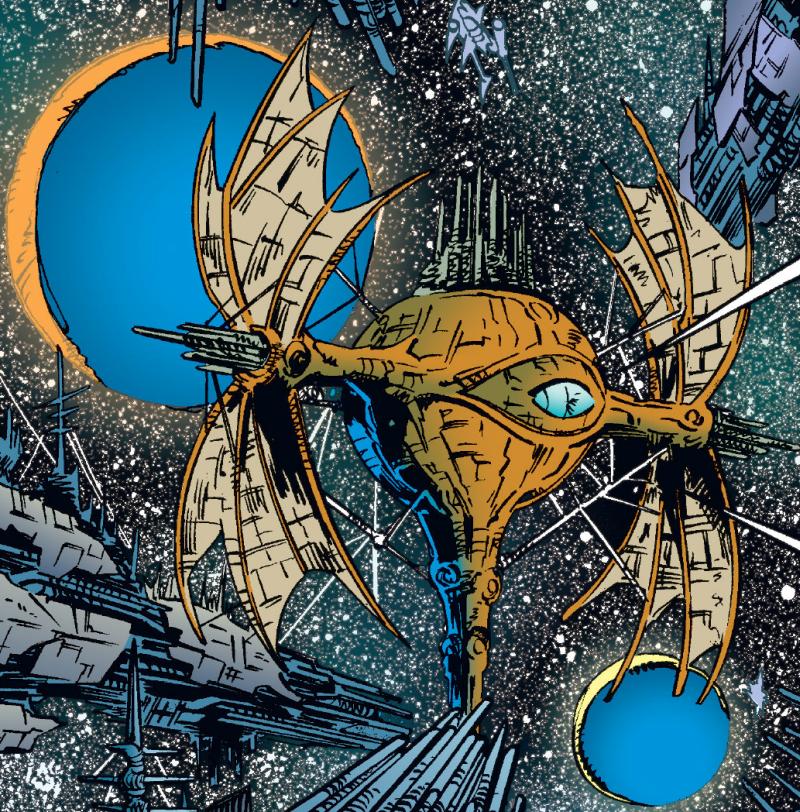
Sadow did not command only through ordinary fleet movements. Legends stories associate him with a meditation sphere and forms of battle meditation and illusion that made his forces appear more overwhelming than they were. This is an unusually literal version of political spectacle: perception becomes part of military capacity.
The strategy is powerful but fragile. If an army's apparent scale depends on one leader maintaining concentration, then command becomes dangerously centralized. Gav's betrayal disrupts Sadow's control at a critical moment. Once the illusion and coordination break, the gap between projected strength and material strength becomes visible.
Ritual, technology, and the performance of command
Naga Sadow is useful for the IDS archive because his power does not fit neatly into a modern division between religion, technology, and government. Sith sorcery, military hardware, alchemical experimentation, temples, meditation chambers, fleets, and inherited titles all belong to the same political world.
The meditation sphere is a good example. It is a machine, a ritual environment, and a command center at the same time. Its value comes from the way material technology supports a Force practice that in turn changes the behavior of armies. Sadow's authority is therefore not located only in his body. It is distributed through objects, architecture, subordinates, and systems of belief.
This also explains why ancient Sith sites remain politically meaningful long after their original rulers are gone. A tomb is not merely a grave. A fortress is not merely a ruined building. These places preserve dangerous knowledge, claims to succession, ritual memory, and material evidence that later Sith can use to construct their own legitimacy.
Defeat, Korriban, and the end of an old order
After the invasion failed, Sadow returned to a Sith Empire already damaged by internal conflict. His rivalry with Kressh and the losses of the war left the Sith vulnerable at the same moment the Republic was able to carry the conflict back toward Sith territory.
The result was more than Sadow's personal defeat. The old Sith political order fractured. Later Old Republic accounts treat the aftermath of the Great Hyperspace War as a turning point that scattered survivors and helped create the historical conditions for later Sith empires built far from the Republic's view.
This makes Sadow a paradoxical founder. His expansionist project failed, but the failure reorganized Sith history. The destruction and displacement that followed became part of the political memory later Sith used to justify return, revenge, secrecy, and restoration.
Yavin 4, the Massassi, and rule in exile
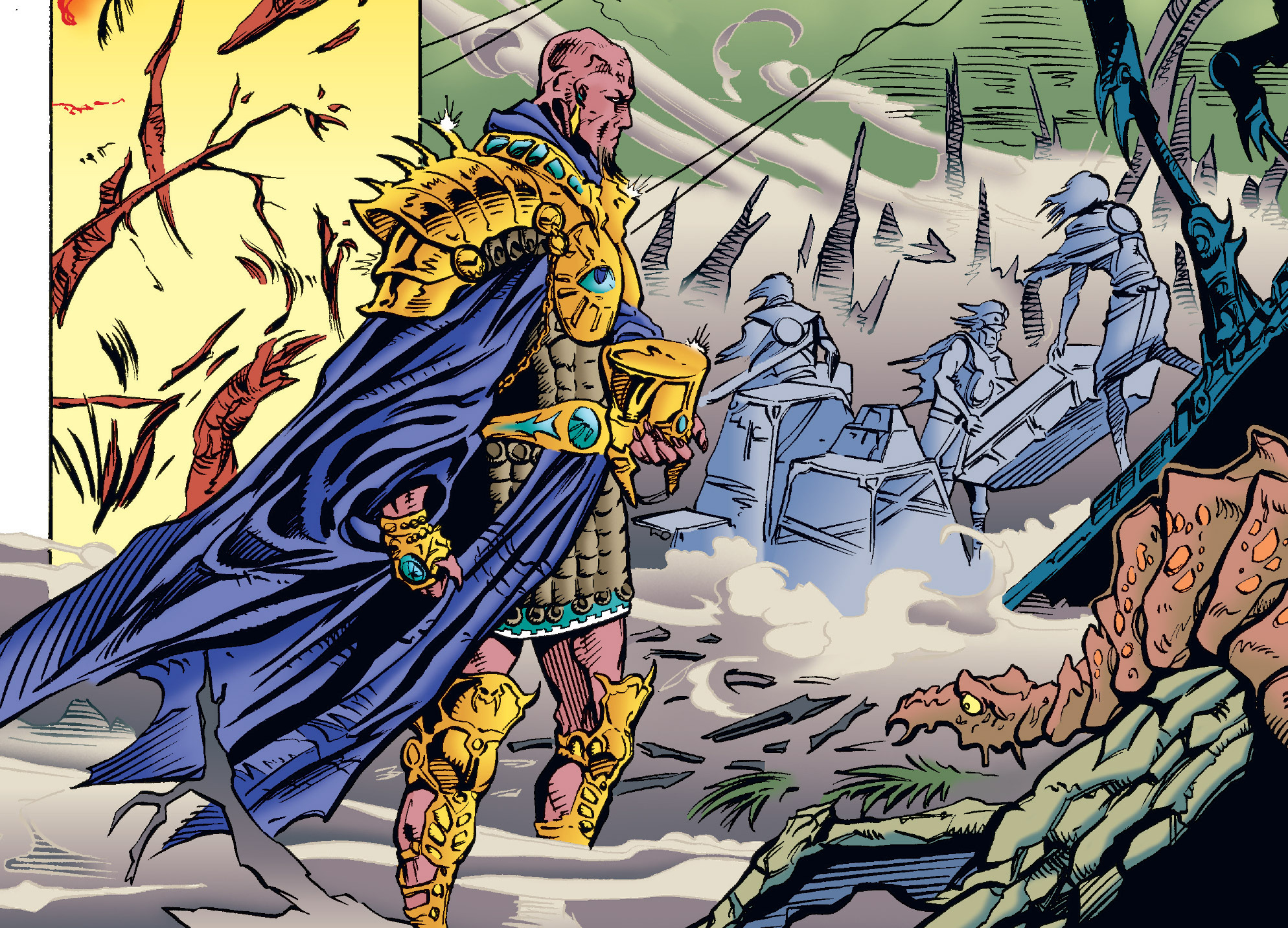
Legends places Sadow's final refuge on Yavin 4. There, his relationship with the Massassi reveals another side of Sith power: domination over a subject population through hierarchy, ritual, and bodily transformation. Old Republic lore describes Massassi warriors who survived around Sadow's temples and attributes horrific experimentation to his rule.
Yavin 4 therefore becomes more than a hiding place. It is a colonial landscape in which architecture, altered bodies, military service, and religious authority remain after the ruler himself is gone. Later visitors encounter Sadow through ruins and descendants rather than through a living state.
The persistence of those traces matters. Political systems often survive as landscapes. A temple can outlast an army. A tomb can outlast an ideology's official defeat. Sadow's Yavin legacy demonstrates how material remains keep older forms of power available for reinterpretation by people who were never part of the original regime.
Afterlife: tombs, spirits, artifacts, and later Sith
Sadow's historical influence continues because later Sith do not treat the ancient past as finished. Tombs, fortresses, ritual sites, weapons, alchemical writings, and stories become resources. Star Wars: The Old Republic repeatedly returns to his name and sites connected to him, including his tomb on Korriban and ancient holdings whose meaning survives into later conflicts.
The Old Republic's galactic-history records describe a later confrontation involving Sadow's lingering dark presence and his tomb on Yavin 4. Even when later Sith want to eliminate the danger posed by ancient rivals, they still operate inside a political culture that grants those ancestors authority.
That is why Naga Sadow belongs beside figures such as Darth Bane, Revan, and Vitiate in the archive. They do not simply represent different levels of power. They represent different answers to the same institutional problem: how can Sith authority survive defeat, succession, and the death of individual rulers?
Canon and Legends
The detailed story in this file is primarily Legends, especially the Tales of the Jedi tradition and the historical material developed around Star Wars: The Old Republic. Modern canon has preserved Naga Sadow as an ancient Sith name and has reused pieces of that deep history without restoring the entire Legends biography unchanged.
For IDS, that distinction is important. A canon reference confirms that the name and ancient Sith memory exist in the current continuity. It does not automatically canonize every event from the older comics or games. The Great Hyperspace War, the exact succession conflict with Ludo Kressh, Sadow's manipulation of the Daragons, and the full Yavin 4 narrative should still be labeled as Legends unless a current canon source establishes them independently.
External enemies as tools of succession
Sadow recognizes that an outside threat can reorganize internal politics. Republic explorers become evidence he can use to argue that expansion and aggressive leadership are necessary.
The strategy converts uncertainty about succession into fear of an external enemy, making personal ambition look like collective defense.
War through deception and spectacle
His campaigns rely on more than military force. Illusion, misinformation, and Force-enhanced command allow Sadow to magnify the appearance of Sith power.
That makes perception part of warfare. Political authority grows when enemies and followers believe the ruler commands more resources than can actually be seen or counted.
Collector note: Naga Sadow is primarily a deep-lore and Legends collecting subject. The strongest visual identifiers are his ornate ancient Sith armor, gold-and-black or red-and-green ceremonial designs, his meditation sphere, Korriban imagery, Yavin 4, and Great Hyperspace War references.
Sources and further reading
- The Great Hyperspace War, Star Wars: The Old Republic
- Galactic History, Star Wars: The Old Republic
- The Sith Empire, Star Wars: The Old Republic HoloNet
- Game Update 7.9: Legacy Reborn, Star Wars: The Old Republic
- Naga Sadow, Wookieepedia — current canon reference
- Naga Sadow, Wookieepedia — Legends reference
Connected archive