
Hero artwork: original IDS editorial reconstruction for this Legends episode. View the comic issue at Marvel for the original source.
In 5000 BBY, Naga Sadow launched the Sith Empire into the Great Hyperspace War. Using the route opened by Gav and Jori Daragon, Sith forces struck major Republic targets including Coruscant, Koros Major, and Kirrek. Sadow used illusions to magnify the apparent scale of his armies, while real Sith and Massassi forces attacked across multiple fronts.
A sudden invasion across hyperspace
The Republic had little recent knowledge of the Sith Empire.
The Daragon Trail allowed Sadow to bypass centuries of isolation and strike deep into Republic territory.
The Battle of Coruscant
Sith forces attacked the Republic capital while Jedi and planetary defenders organized resistance.
The battle ended in a Republic victory as Sadow's illusion-supported offensive began to collapse.
Empress Teta becomes a principal Republic commander
Teta's newly unified system became one of the war's main targets.
Her forces and Jedi allies played a central role in counterattacking the Sith.
The war destroys the old Sith political order
Sadow's campaign ultimately failed and the Republic counterinvaded Sith space.
The defeat shattered the old empire and forced surviving Sith factions into exile or hiding.
Anthropological assessment
The Great Hyperspace War demonstrates how transportation technology compresses political distance. Two civilizations could remain isolated for millennia and then become military neighbors as soon as one viable route linked them.
It also shows how exploration, propaganda, and state ambition interacted to create a war neither population had anticipated before the Daragons' accidental contact.
Great Hyperspace War / Legends chronology
A new hyperspace corridor becomes an invasion route
Naga Sadow's decision to invade the Republic transformed the outcome of the Daragons' journey. The discovery of a route to a civilization that the Sith had long regarded as distant or legendary became the material basis for moving fleets and ground forces toward Republican worlds. Sadow organized attacks against Coruscant, Koros Major and Kirrek. The invasion was not a single battle occurring in the same place. It was a multi-front operation whose simultaneous threats strained the defenders' ability to interpret information, coordinate resources and decide where reinforcements were most needed.
Sadow used a meditation sphere and dark-side illusions to increase the apparent scale of his attacks. The illusion did not create actual ships or trained soldiers, but it shaped how observers experienced the attack. When his concentration broke, the imbalance between perceived and real Sith strength became critical to the Republic response. Empress Teta and the Jedi were part of a coalition that responded to the invasion. Their own political and military institutions had been built over years; war tested whether those systems could coordinate under sudden strategic pressure.
A route is a political technology
A hyperspace corridor is not merely a path through physical space. It reorganizes trade, travel time, intelligence and the possibilities of conquest. The Daragon Trail converted a long-isolated border into a channel for large-scale military movement.
Fear can be engineered
Battlefield illusion made perceived troop strength different from actual troop strength. The attack demonstrates that commanders respond to what they believe can harm them, not only to forces physically present. Information and trust are therefore military resources.
Did the Great Hyperspace War begin when the Republic attacked Korriban first?
No. The Legends narrative describes Naga Sadow's initial Sith invasion through the route revealed by the Daragons; Republic counterattacks followed.
Original story and evidence: Tales of the Jedi: The Golden Age of the Sith; The Fall of the Sith Empire #1–5; Sith Lords Chronicles. This episode is in Legends. Later Canon retains some ancient names and motifs, but it does not automatically confirm every detail of the 1990s comic sequence.
Legends · 5000 BBY · Source reading
A hyperspace discovery becomes an invasion
Gav and Jori Daragon reveal a route into isolated Sith space, creating contact where the Republic had no reliable direct access.
Naga Sadow decides to use that route for military expansion; the strike against Coruscant and Koros is a strategic choice, not an automatic result of exploration.
Illusory troop strength and dependence on Gav complicate Sadow's campaign. His vulnerabilities become apparent across several simultaneous fronts.
Did discovering the Daragon Trail itself begin the war?
No. Charting a route and choosing to invade are separate developments within the comic. The political decision belongs to Sith leadership.
Source: Kevin J. Anderson, Tales of the Jedi: The Fall of the Sith Empire #1 (Dark Horse Comics, 1997). Publisher's comic listing and cover →. The documented story is Legends; social interpretation is editorial analysis.

5000 BBY · Legends · Historical source lab
War from a hyperspace route: the Daragon Trail becomes military infrastructure
Gav and Jori Daragon discovered an unexpected connection between the Republic and the long-isolated Sith Empire. Their navigation data gave rival rulers an opportunity that neither side's previous policy had fully anticipated. Naga Sadow used this route for an attack across multiple targets, rather than a single sequential invasion. Jori's attempt to warn the Republic shows the same map could produce different consequences depending on who controlled it. For a historical analysis, the navigation route is infrastructure: information about movement could shift a society from relative isolation to sudden military danger. The comic's dark-side illusions made defenders overestimate some forces, so an artwork showing a crowded battlefield cannot be counted as a literal troop census.
Evidence boundary: historical fact versus interpretive analysis
This is a Legends fictional-history dossier. Characters, encounters and broad outcomes follow Tales of the Jedi and licensed secondary chronology. Assessments of power, institutions, consent and political legitimacy are IDS interpretations. Page-specific casualty counts, direct speeches and scientifically exact mechanisms should not be inferred from a general reference summary or comic cover.
Historical judgment · 5000 BBY
Test your historical judgment
Answer both questions to receive a score and corrections explaining the evidence.
Primary story series: Kevin J. Anderson and Dario Carrasco Jr., Tales of the Jedi: The Golden Age of the Sith #0–5 and The Fall of the Sith Empire #1–5. Marvel's Fall of the Sith Empire #1 describes Jori Daragon's warning and Naga Sadow's invasion. Marvel's Golden Age #2 describes the succession crisis. Not every page-specific incident can be independently established from publisher marketing summaries alone.
Original IDS study · Legends source reconstruction
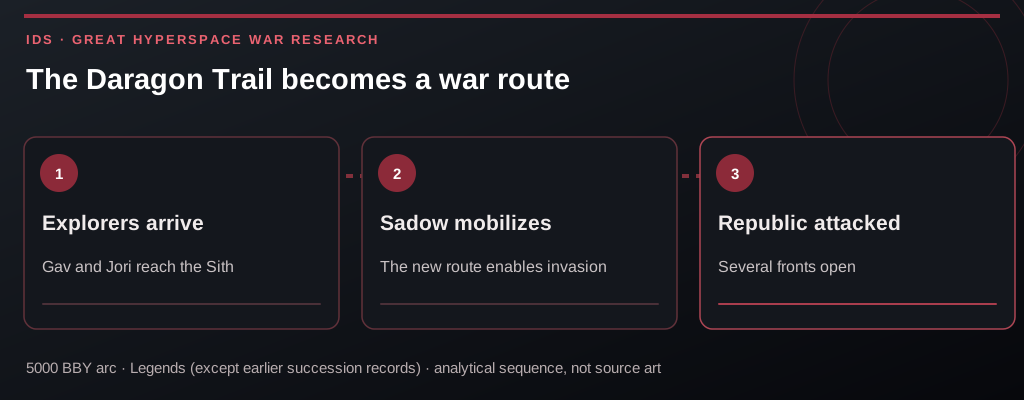
Evidence sequence: The Daragon Trail becomes a war route
What the original history supports
The invasion should not be presented as an inevitable result of a new navigational route. Sadow made political and military choices within an existing succession conflict. Jori's return to the Republic and Gav's coerced involvement are different paths through the same crisis.
Interpretation and evidence limit
This supplementary diagram describes causal order, not a map of a navigable hyperspace trail. No invented distances or star coordinates are asserted.
Sources and further reading
- Tales of the Jedi – The Golden Age of the Sith.
- Tales of the Jedi – The Fall of the Sith Empire.
- Great Hyperspace War/Legends, Wookieepedia