
Hero artwork: original IDS editorial reconstruction for this Legends episode. View the comic issue at Marvel for the original source.
In 5000 BBY, Sith Lord Shar Dakhan led an attack on Coruscant as one of the simultaneous opening battles of Naga Sadow's invasion. Sadow remained far away in a meditation sphere, using the dark side to create illusions that made the Sith armies appear vastly larger than they really were. Republic troops and Jedi led by Memit Nadill fought the attackers near the Senate Hall until Gav Daragon's rebellion against Sadow broke the Dark Lord's concentration.
An attack on the political center
Sadow did not begin with a frontier target. Coruscant itself was attacked.
Capturing the Senate would have given the invasion enormous political and symbolic value.
Illusion as military force multiplication
Sadow's sorcery created the appearance of overwhelming numbers.
When the illusions vanished, Republic defenders realized that much of the apparent Sith strength had never been physically present.
Jedi defend the Senate
Memit Nadill and other Jedi coordinated with Republic soldiers at the capital.
The defense tied Jedi religious authority directly to preservation of Republic government.
Anthropological assessment
The battle demonstrates that military power includes perception. Sadow's illusions changed how defenders interpreted the battlefield even when the imagined soldiers could not physically occupy territory.
It also shows why symbolic geography matters: attacking a capital can threaten political confidence far beyond the immediate battlefield.
Great Hyperspace War / Legends chronology
The Sith try to seize the Republic's political center
During the Great Hyperspace War, Sith troops attacked Coruscant while Naga Sadow directed the wider invasion from a distant meditation sphere. Shar Dakhan commanded the attacking force on the ground. Jedi defenders, including Memit Nadill, supported Republic military personnel near the institutions of the capital. The assault threatened more than a large city: it placed the governing center of the Republic under direct attack at a time when information about the Sith Empire was still new and incomplete.
Sadow's illusions caused the Sith forces to appear more numerous than their true strength. The apparent scale of the assault was therefore partly an effect of dark-side manipulation rather than physical troop deployment alone. Gav Daragon's break with Sadow disrupted the latter's concentration and contributed to the collapse of the offensive. An accurate chronology must keep the fighting on Coruscant connected to the larger battle command occurring elsewhere, without imagining that every defender on the planet knew about the meditation sphere at the time.
Institutional symbols as wartime targets
Attacking a capital threatens the legitimacy and everyday operation of a government even without destroying every administrative building. The political significance of Coruscant magnified the danger of the Sith offensive.
The relationship between sight and certainty
Defenders had to act on what they could perceive while the enemy distorted that perception. Sadow's use of illusion raises questions about intelligence and the cost of misplaced confidence under wartime uncertainty.
Were all the overwhelming Sith troops seen on Coruscant physically present?
No. The Legends story identifies Sadow's Force illusions as a major source of the apparent numerical advantage.
Original story and evidence: Tales of the Jedi: The Fall of the Sith Empire; The Essential Atlas; Coruscant battle in the Legends Great Hyperspace War. This episode is in Legends. Later Canon retains some ancient names and motifs, but it does not automatically confirm every detail of the 1990s comic sequence.
Ancient Republic · Legends · Historical field note
Interpreting Coruscant in the Great Hyperspace War
A strike at the Republic's political center can carry symbolic consequences beyond immediate battlefield results.
Research distinction: The documented event anchors this article. Its political and cultural implications are analytical observations, not invented scenes or claims about undocumented participants.
Open the historian's evidence question
What is directly established by the cited account, and what is an interpretation of its significance? Avoid treating an approximate date or a short reference entry as evidence for exact dialogue, motives or casualty totals.
Legends · 5000 BBY · Source reading
The Republic capital and an army of illusions
Shar Dakhan's Sith assault reaches the Republic's political center while Jedi and Republic defenders protect the Senate.
From a distant meditation sphere, Sadow creates the impression of a much greater attacking force. Actual Sith soldiers and Force projections must be distinguished.
Gav Daragon's action at Primus Goluud breaks Sadow's concentration and removes much of the illusory force from the Coruscant battle.
Does this mean the entire Sith invasion was imaginary?
No. The comic depicts both material attackers and Force illusions. The failure of the latter does not erase the former.
Source: Kevin J. Anderson, Tales of the Jedi: The Fall of the Sith Empire #4 (Dark Horse Comics, 1997). Publisher's comic listing and cover →. The documented story is Legends; social interpretation is editorial analysis.
5000 BBY · Legends · Historical source lab
Coruscant: defending the Republic's political center
Coruscant was not simply one more fortified planet in Naga Sadow's offensive. It was the political seat where Republic institutions organized authority, communicated with member systems and claimed legitimacy. Shar Dakhan's attack therefore had a symbolic aim as well as a military one. The Sith used illusions that expanded the apparent scale of their forces. Understanding the distinction between illusion and material units avoids treating every image or story impression as an accurate headcount. The Jedi and Republic defenders confronted an army whose psychological effect was designed to exceed its physical strength. This is a study of fear, communication and coordinated defense, not a basis for inventing exact fleet totals.
Evidence boundary: historical fact versus interpretive analysis
This is a Legends fictional-history dossier. Characters, encounters and broad outcomes follow Tales of the Jedi and licensed secondary chronology. Assessments of power, institutions, consent and political legitimacy are IDS interpretations. Page-specific casualty counts, direct speeches and scientifically exact mechanisms should not be inferred from a general reference summary or comic cover.
Historical judgment · 5000 BBY
Test your historical judgment
Answer both questions to receive a score and corrections explaining the evidence.
Primary story series: Kevin J. Anderson and Dario Carrasco Jr., Tales of the Jedi: The Golden Age of the Sith #0–5 and The Fall of the Sith Empire #1–5. Marvel's Fall of the Sith Empire #1 describes Jori Daragon's warning and Naga Sadow's invasion. Marvel's Golden Age #2 describes the succession crisis. Not every page-specific incident can be independently established from publisher marketing summaries alone.
Original IDS study · Legends source reconstruction
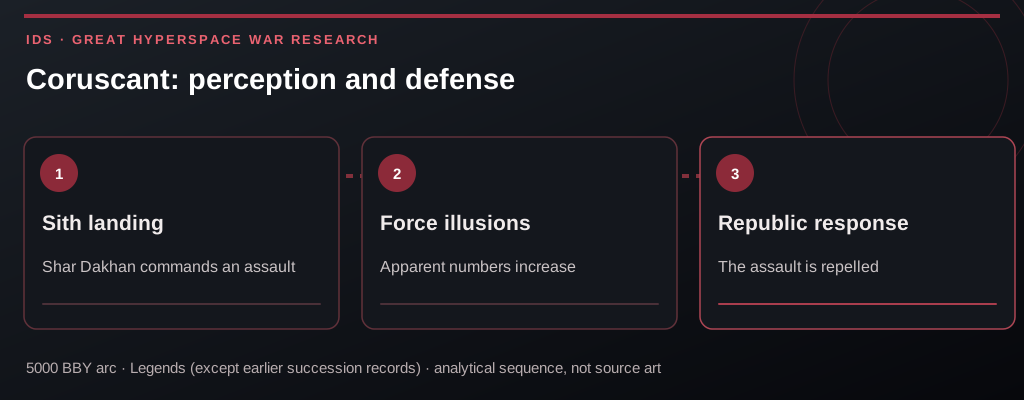
Evidence sequence: Coruscant: perception and defense
What the original history supports
The graphic isolates the difference between a real invasion and the inflated army that Sadow's illusion appears to create. Memit Nadill and the Republic defenders confront an attack on a political center, not an ordinary frontier raid. The exact appearance of units must be established from comic panels rather than inferred from later technical artwork.
Interpretation and evidence limit
The illusion's collapse illustrates the fragility of a command strategy dependent on a Force user's sustained attention. It does not establish a numeric order of battle.
5000 BBY · Legends · Independent source reading
What the concurrent invasion reveals
The Coruscant assault cannot be read as an independent surprise raid followed by a later Kirrek or Koros Major attack. The original comic divides attention among battles on several worlds. The Republic capital was a prominent target because its Senate and political leadership embodied the government Sadow meant to defeat. The broader campaign also attacked Teta's recently unified system, so the political targets were different even while the offensives were connected.
At Coruscant, Memit Nadill and the Jedi acted alongside military defenders. Later accounts name Anavus Svag among the leaders of the defense. Sadow's meditation amplified the apparent numbers of the invading army while he acted from far away. The critical change came when Gav Daragon attacked the meditation sphere at Primus Goluud. Disrupted concentration changed what defenders perceived on Coruscant; it did not teleport the real invading troops away or retroactively erase the physical damage.
Reading the sequence as evidence about institutions clarifies the point. Senate security, military organization and Jedi authority had to function together when a central symbol of government came under direct attack. The comic does not establish a reliable civilian casualty count, a minute-by-minute attack schedule or precise numbers of illusions. A research page should not invent those measurements.
Historical judgment: Does the collapse of Sadow's illusions prove that no physical Sith forces reached Coruscant?
Correction and evidence: No. The illusion made the attack appear much larger. The defenders still fought real soldiers. This distinction matters when assessing why the defense succeeded.
Great Hyperspace War campaign sequence → · Compare related front → · Continue to Primus Goluud →
Primary storyline: Tales of the Jedi: The Fall of the Sith Empire Issues 3–4 (1997), written by Kevin J. Anderson, art by Dario Carrasco Jr. Publisher's issue catalog →. Editorial interpretation is separate from the depicted events. Verify original printed panels before assigning page numbers, exact force totals or precise clock times.
Sources and further reading
- Tales of the Jedi – The Fall of the Sith Empire.
- Daniel Wallace and Jason Fry, The Essential Atlas, 2009.
- Battle of Coruscant, Wookieepedia