
Hero artwork: original IDS editorial reconstruction for this Legends episode. View the comic issue at Marvel for the original source.
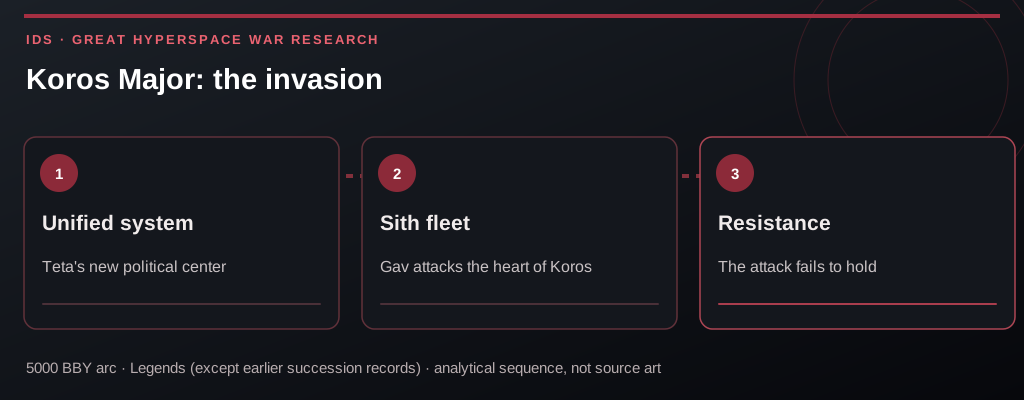
At Koros Major in 5000 BBY, Sith forces under Gav Daragon attacked the political heart of Empress Teta's newly unified system. The invasion brought Gav face-to-face with the destruction caused by the war he had helped enable. Confrontation with his sister Jori and the death of Aarrba the Hutt pushed him toward breaking with Naga Sadow.
A new state faces immediate invasion
The Koros system had only just emerged from its own Unification Wars.
Sith attack tested whether Teta's recently consolidated political order could survive an external war.
Gav Daragon's loyalty breaks
Gav had been manipulated and trained by Sadow after arriving in Sith space.
Seeing friends and his home region attacked made the personal cost of Sadow's strategy impossible to ignore.
Koros forces repel the attack
Empress Teta's military resisted the Sith assault.
The battle helped shift momentum away from Sadow across the wider war.
Anthropological assessment
Koros Major shows how political identities can change rapidly when individuals are caught between personal relationships and ideological allegiance.
Gav's defection was not simply strategic. It emerged from seeing how an abstract imperial project affected people he knew.
Legends · 5000 BBY · Source reading
The attack that breaks Gav's allegiance
The newly united Koros capital faces attack before the political settlement from the Unification Wars is firmly established.
Gav commands Sith forces near people he knows. Jori's pursuit and the confrontation at Aarrba's repair business make the war personally consequential.
Gav breaks from Sadow and heads toward the meditation sphere, creating the possibility of changing the larger invasion's outcome.
Was the outcome determined solely by a family dispute?
No. The sibling encounter informs Gav's choices, but the battle is also a struggle over a newly unified planetary government.
Source: Kevin J. Anderson, Tales of the Jedi: The Fall of the Sith Empire #4 (Dark Horse Comics, 1997). Publisher's comic listing and cover →. The documented story is Legends; social interpretation is editorial analysis.
5000 BBY · Legends · Historical source lab
Koros Major: invasion confronts the cost of divided family loyalty
The battle on Koros Major places Gav Daragon in conflict with the Republic-side community he had belonged to before encountering the Sith. He is an unwillingly compromised intermediary, trained and manipulated by Naga Sadow, rather than a faceless invading commander. His reunion with Jori and the destruction around their old relationships changed his judgment of the conflict. This does not mean that Gav's earlier service caused every Republic loss or that his return immediately ended the invasion. The sequence dramatizes why political loyalty is not fixed by birthplace alone: institutions can recruit, isolate, and redirect people under coercive conditions. Here, the agency of one explorer matters without erasing the organized defense of Teta's world.
Evidence boundary: historical fact versus interpretive analysis
This is a Legends fictional-history dossier. Characters, encounters and broad outcomes follow Tales of the Jedi and licensed secondary chronology. Assessments of power, institutions, consent and political legitimacy are IDS interpretations. Page-specific casualty counts, direct speeches and scientifically exact mechanisms should not be inferred from a general reference summary or comic cover.
Historical judgment · 5000 BBY
Test your historical judgment
Answer both questions to receive a score and corrections explaining the evidence.
Primary story series: Kevin J. Anderson and Dario Carrasco Jr., Tales of the Jedi: The Golden Age of the Sith #0–5 and The Fall of the Sith Empire #1–5. Marvel's Fall of the Sith Empire #1 describes Jori Daragon's warning and Naga Sadow's invasion. Marvel's Golden Age #2 describes the succession crisis. Not every page-specific incident can be independently established from publisher marketing summaries alone.
Original IDS study · Legends source reconstruction
Evidence sequence: Koros Major: the invasion
What the original history supports
A recently consolidated system provided both a prestigious target and a fragile coalition of former rivals. Gav Daragon's participation in the attack is distinct from Jori's decision to warn the Republic. Their respective choices should not be treated as a single shared response to Naga Sadow.
Interpretation and evidence limit
The attack's failure does not prove every system member shared the same loyalty before the war; that is an institutional inference, not a depicted opinion survey.
5000 BBY · Legends · Independent source reading
Kinship and the limits of command loyalty
Koros Major was not merely another strategic point on a list of Sith targets. It was Gav and Jori Daragon's home region, the center of Teta's new political settlement, and the place where their personal ties conflicted with Sith military command. Sadow delegated the attack to Gav while directing the larger war. The relationship between personal recruitment and military obedience became unstable as soon as Gav was forced to confront what the invading troops were doing to people he knew.
The death of Aarrba the Hutt is especially important for reconstructing responsibility. Gav's Massassi escorts attacked Aarrba when they interpreted him as a threat. Jori encountered the aftermath and initially held Gav responsible. An accurate retelling should distinguish the guards' actions from a documented personal order to murder Aarrba. The confrontation helped drive Gav away from Sadow, but it did not itself finish the wider war.
The city's repair business also shows that civilian and commercial sites matter during invasion. Aarrba was not simply a military commander; the death took place in a setting where trade, employment and friendship connected people beyond the war's two formal governments. The comic's family drama therefore intersects with the vulnerability of civilian infrastructure, without supplying evidence for invented damage or casualty figures.
Historical judgment: Did Gav personally kill Aarrba the Hutt in the story's established sequence?
Correction and evidence: The Massassi escorts killed Aarrba. Jori initially blamed Gav on seeing the scene. Attributing the killing directly to Gav as a confirmed personal act overstates the evidence.
Great Hyperspace War campaign sequence → · Compare related front → · Continue to Primus Goluud →
Primary storyline: Tales of the Jedi: The Fall of the Sith Empire Issues 3–4 (1997), written by Kevin J. Anderson, art by Dario Carrasco Jr. Publisher's issue catalog →. Editorial interpretation is separate from the depicted events. Verify original printed panels before assigning page numbers, exact force totals or precise clock times.
Sources and further reading
- Tales of the Jedi: The Golden Age of the Sith and The Fall of the Sith Empire.
- Battle of Koros Major, Wookieepedia