
In 5000 BBY, hyperspace explorers Gav and Jori Daragon made a blind jump aboard the Starbreaker 12 and emerged near Korriban. Their arrival reconnected the Galactic Republic with a Sith Empire that had developed in isolation since the Dark Jedi Exiles arrived almost nineteen centuries earlier.
Exploration driven by economic desperation
The Daragons were not official Republic diplomats.
They were independent navigators searching for profitable new hyperspace routes.
First contact becomes imprisonment
Sith forces captured the siblings shortly after arrival.
Their appearance became evidence in the internal political struggle between Sadow and Kressh.
The Daragon Trail reconnects two political worlds
The route the siblings opened allowed Sith forces to reach Republic space.
One exploratory jump therefore changed the strategic geography of the galaxy.
Anthropological assessment
The Daragons show how private economic activity can trigger state-level consequences.
A route discovered for personal survival became the corridor for a galactic war.
Great Hyperspace War / Legends chronology
A private route discovery connects two rival civilizations
Gav and Jori Daragon sought a profitable new hyperspace route after their family suffered hardship in the Koros system. Their vessel, Starbreaker 12, entered unexplored space and arrived unexpectedly at Korriban. They were not ambassadors sent by Empress Teta or a Republic military reconnaissance unit. Nevertheless, the voyage connected the Republic to a Sith Empire that had developed largely outside ordinary Republic awareness for centuries. The siblings encountered the Sith at a moment of succession tension following the death of Marka Ragnos, and the rulers treated their arrival as politically significant.
Gav and Jori's experiences subsequently diverged. Sith leaders imprisoned and manipulated the visitors, while the route they had opened became the basis for movement between two empires. The term Daragon Trail thus names more than a successful navigation experiment. It marks the sudden creation of a strategic corridor capable of supporting commerce, escape, intelligence activity and military invasion. The Republic's lack of detailed knowledge about Sith society made the unexpected connection particularly dangerous when Naga Sadow turned toward war.
Travel can have unforeseen political effects
Route discovery changes the practical distance between communities. Star systems isolated from one another can suddenly exchange people, objects and military threats. The explorer's intention does not determine every later use of the path.
The category of 'spy' serves a political purpose
The siblings arrived seeking a commercial solution to their own problems. Sith leaders could still classify them as spies because that interpretation reinforced political fears useful to factional rivals. Historians must distinguish the visitors' actual purpose from accusations made about them.
Was Starbreaker 12 a Republic warship carrying an invasion fleet?
No. It was the Daragon siblings' exploration vessel. The military invasion followed when Sith leaders exploited knowledge of the route.
Original story and evidence: Tales of the Jedi: The Golden Age of the Sith #1–5; game chronicle 'A Golden Age'. This episode is in Legends. Later Canon retains some ancient names and motifs, but it does not automatically confirm every detail of the 1990s comic sequence.

Ancient Republic · Legends · Historical field note
Interpreting The Daragons' discovery
Exploration can unintentionally connect rival political systems and create consequences beyond explorers' intentions.
Research distinction: The documented event anchors this article. Its political and cultural implications are analytical observations, not invented scenes or claims about undocumented participants.
Open the historian's evidence question
What is directly established by the cited account, and what is an interpretation of its significance? Avoid treating an approximate date or a short reference entry as evidence for exact dialogue, motives or casualty totals.
Historical interpretation · 5000 BBY · Legends
What the surviving story establishes
Gav and Jori Daragon's hyperspace prospecting is shaped by the economic pressures surrounding independent navigation. The Starbreaker 12's arrival near Korriban is not an official diplomatic encounter between governments.
The encounter gives two isolated political worlds knowledge of each other. Navigation charts become potentially valuable to merchants and militaries alike, but the siblings do not control how the Sith rulers interpret their discovery.
After capture, Jori works to escape and warn the Republic while Gav is drawn into Sadow's orbit. The same first-contact episode creates different risks for two travelers who began the journey together.
Should the Daragons be described as official Republic envoys?
No. They are private hyperspace explorers. Their discovery carries state-level consequences, but their original mission was not a Republic government delegation.
Original story or reference: Tales of the Jedi: The Golden Age of the Sith #1–4. View the cited source listing →
Original IDS study · Legends source reconstruction
Evidence sequence: The Daragons: explorers and contact
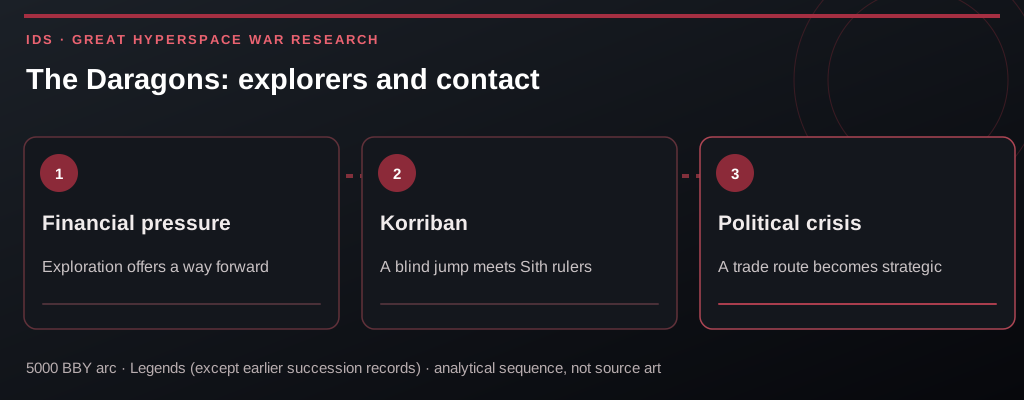
What the original history supports
Gav and Jori were independent navigators, not Republic diplomats. The Sith leadership interpreted their arrival through factional interests: an opportunity for expansion and a perceived security threat. Their original goal of profitable passage became politically irrelevant to those holding them prisoner.
Interpretation and evidence limit
The figure highlights a difference between an explorer's intention and the state consequences of a route. It does not imply that the Daragons chose the subsequent invasion.
Sources and further reading
- Tales of the Jedi – The Golden Age of the Sith.
- 5000 BBY/Legends, Wookieepedia