
In 5000 BBY, Marka Ragnos died after a century-long reign over the Sith Empire. His death immediately created a succession crisis between Naga Sadow, who favored expansion, and Ludo Kressh, who favored continued isolation. The rivals fought over Ragnos's tomb while the spirit of the dead Dark Lord appeared and warned that the future of the Sith was uncertain.
The end of the Sith Golden Age
Ragnos had kept rivals divided and the Empire relatively stable.
His death removed the political center holding competing factions together.
Expansion versus isolation
Sadow saw the Republic as a target and opportunity.
Kressh believed contact with the larger galaxy threatened Sith survival.
A succession struggle before outside contact
The political divide already existed before Gav and Jori Daragon arrived.
Their appearance intensified a crisis rather than creating it from nothing.
Anthropological assessment
Ragnos's death shows how personalized stability can conceal institutional weakness.
The succession crisis emerged immediately because the empire lacked a broadly accepted mechanism for transferring power.
Great Hyperspace War / Legends chronology
An imperial succession crisis invites an outside war
Marka Ragnos had ruled the Sith Empire for a century before his death in 5000 BBY. The long reign created a reputation for stability, but that stability rested partly on one ruler's ability to restrain ambitious rivals. Naga Sadow wanted a more expansionist future; Ludo Kressh regarded contact with the wider Republic as a threat to Sith survival. Their disagreement was not simply a contest of personalities. It concerned what the Empire was for, how far its control should extend, and whether long isolation remained a source of safety.
The rivals confronted each other around Ragnos's tomb as the dead ruler's spirit warned of dangers to the Sith. The arrival of Gav and Jori Daragon supplied both sides with evidence that an unfamiliar external civilization existed beyond their accustomed boundaries. Sadow then used the outsiders' presence within a political scheme to gain support for invasion. The timing does not mean the Daragons created the succession dispute. The dispute already existed, and their arrival altered the calculations of those competing for power.
A strong ruler can conceal weak procedures
Ragnos's reign offered a single widely recognized authority. His death exposed the problem of transferring power among elite rivals who did not accept the same strategic aims. Succession becomes a crisis when an office lacks an uncontested method for selecting the next holder.
Foreign contact becomes a domestic argument
The Daragons had arrived while pursuing their own trading ambitions. Sith elites reinterpreted their presence as either an invasion warning or a possible opportunity. The meaning assigned to the visitors depended upon an internal political struggle they had not intended to enter.
Did the Daragon siblings kill Marka Ragnos and trigger succession?
No. Ragnos died before their arrival. Their unexpected landing intensified the struggle between Naga Sadow and Ludo Kressh.
Original story and evidence: Tales of the Jedi: The Golden Age of the Sith #2, Funeral for a Dark Lord; Sith Empire reference chronology. This episode is in Legends. Later Canon retains some ancient names and motifs, but it does not automatically confirm every detail of the 1990s comic sequence.
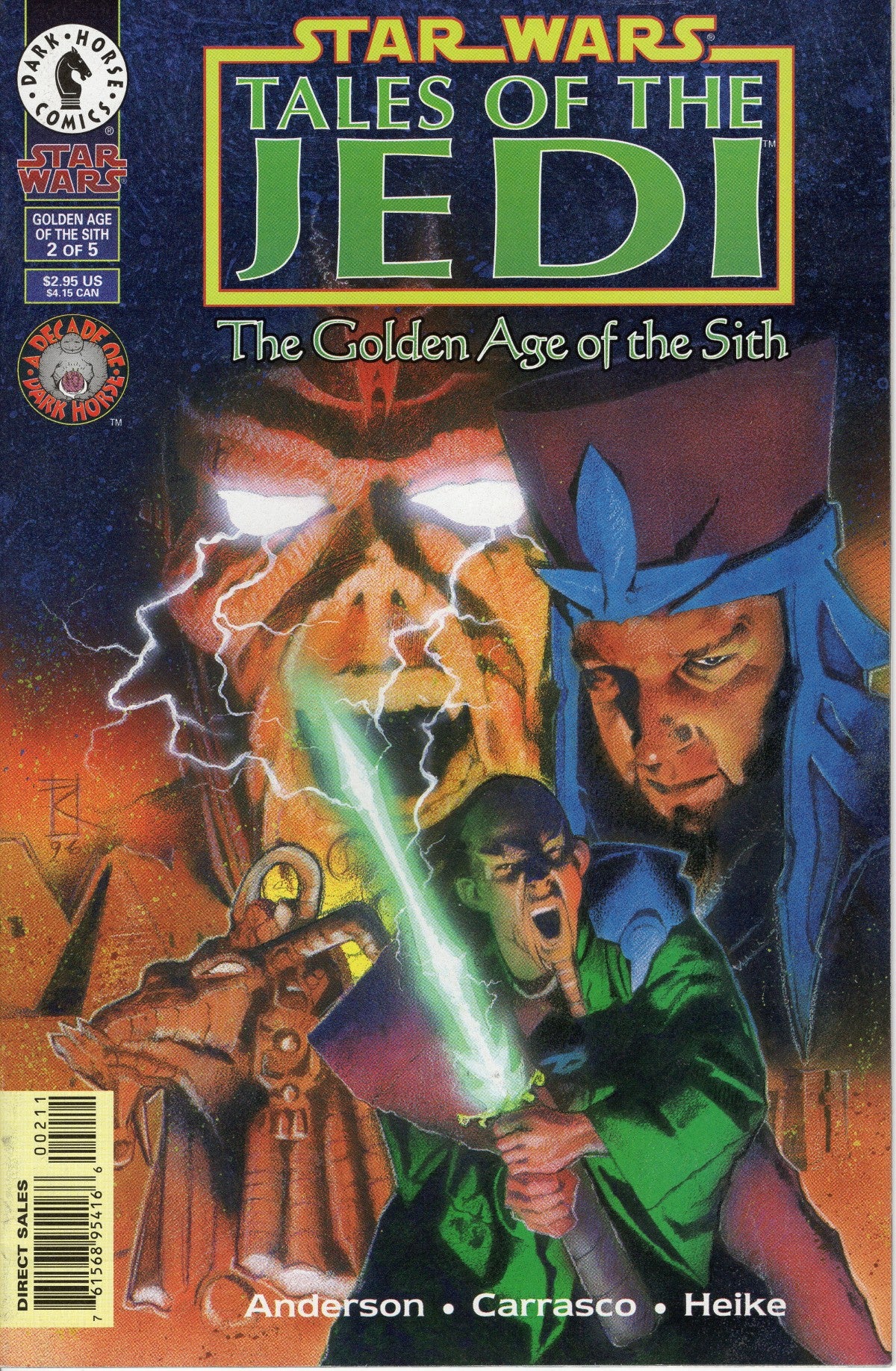
Historical interpretation · 5000 BBY · Legends
What the surviving story establishes
Marka Ragnos's death removes a ruler whose long reign had contained competition among powerful Sith Lords. Succession is immediately contested rather than treated as an automatic transfer of authority.
Naga Sadow favors outward expansion, while Ludo Kressh argues for maintaining the old Empire's boundaries. Their disagreement concerns the future of the state, not only the personal status of its next ruler.
The arrival of Gav and Jori Daragon at this political moment supplies a reason for the leaders to disagree over contact with the wider galaxy. Their independent exploration becomes entangled with a succession crisis.
Did Ragnos himself launch the Great Hyperspace War?
No. The invasion followed his death and the political struggle between Sadow and Kressh. The comic depicts a transition in leadership before an expansionist campaign was authorized.
Original story or reference: Tales of the Jedi: The Golden Age of the Sith #2. View the cited source listing →
5000 BBY · Legends · Historical source lab
Marka Ragnos and the danger of a contested imperial succession
Marka Ragnos's death created an opening in a political order built around the prestige and power of a single Dark Lord. The rival claims of Naga Sadow and Ludo Kressh were not merely personal hostility. Sadow advocated an expansionist future, while Kressh defended established Sith isolation. When Gav and Jori Daragon arrived with evidence of an accessible Republic, the succession conflict intersected with a new strategic possibility. Reading the funeral scene with this context shows how a ritual can express legitimate authority and, at the same time, reveal that authority is being contested. The two later battles over Korriban belong to the military consequences of this division, not to the funeral itself.
Evidence boundary: historical fact versus interpretive analysis
This is a Legends fictional-history dossier. Characters, encounters and broad outcomes follow Tales of the Jedi and licensed secondary chronology. Assessments of power, institutions, consent and political legitimacy are IDS interpretations. Page-specific casualty counts, direct speeches and scientifically exact mechanisms should not be inferred from a general reference summary or comic cover.
Historical judgment · 5000 BBY
Test your historical judgment
Answer both questions to receive a score and corrections explaining the evidence.
Marvel's official issue #2 summary →
Primary story series: Kevin J. Anderson and Dario Carrasco Jr., Tales of the Jedi: The Golden Age of the Sith #0–5 and The Fall of the Sith Empire #1–5. Marvel's Fall of the Sith Empire #1 describes Jori Daragon's warning and Naga Sadow's invasion. Marvel's Golden Age #2 describes the succession crisis. Not every page-specific incident can be independently established from publisher marketing summaries alone.
Original IDS study · Legends source reconstruction
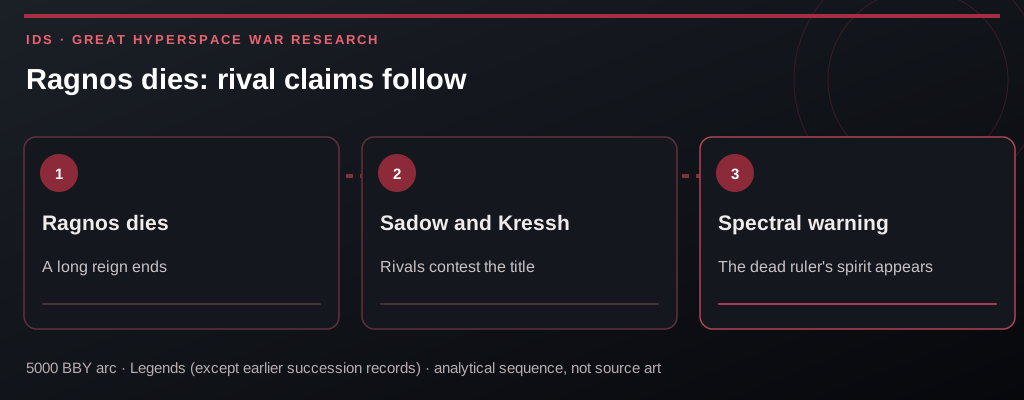
Evidence sequence: Ragnos dies: rival claims follow
What the original history supports
The funeral and leadership contest are depicted in the 1996 series' second issue. The earlier Ragnos–Simus duel belongs to retrospective history and must not be confused with the Sadow–Kressh fight by Ragnos's tomb.
Interpretation and evidence limit
The scene presents succession as an unstable relationship between personal prestige and collective acceptance. This source-bound figure is an editorial diagram, not the original comic cover.
Sources and further reading
- Tales of the Jedi – The Golden Age of the Sith.
- Marka Ragnos, Wookieepedia