
In 5000 BBY, Teta completed the unification of the Koros system. Jedi Odan-Urr joined Teta's Jedi advisor Memit Nadill and used battle meditation during the final campaign on Kirrek, helping end resistance with fewer casualties than a conventional assault might have caused. The seven worlds were now united under Teta's authority.
The final resistance on Kirrek
Kirrek remained the principal holdout after other system worlds were subdued.
Its defeat ended the decade-long unification campaign.
Odan-Urr and battle meditation
The Jedi used battle meditation to coordinate and strengthen allied forces.
Force practice became directly involved in state consolidation.
Anthropological assessment
The end of the Unification Wars shows the Jedi participating in the creation of a centralized regional state.
It also raises questions about the line between peacekeeping and military support for political conquest.
Great Hyperspace War / Legends chronology
The Republic gains a newly unified ally
In 5000 BBY, Teta completed the unification of seven worlds within the Koros system after years of political and military campaigning. Kirrek was the last major center of resistance, and the conflict there had consequences for the young Jedi scholar Odan-Urr and the families of space traders who supplied the fighting. The intervention of Jedi such as Memit Nadill was part of the political process by which a regional monarchy became a more centralized state. A source describing the campaign's completion therefore provides an account of government formation as well as battlefield victory.
The newly unified Koros system would soon become a major target of Naga Sadow's Sith invasion. Its government and military infrastructure were still connected to the experiences of their recent internal war. That sequence is important: the Great Hyperspace War was not a war against an unprepared blank political landscape. Empress Teta had built networks of command and loyalty through the Unification Wars, and those institutions helped shape the resistance when Sith forces reached the system. The Daragon family's loss also preceded the siblings' later search for hyperspace routes.
A peace won through force
Military unification can create stronger institutions, but communities defeated during the process may not understand the outcome in the same way as their new sovereign. Odan-Urr's use of battle meditation belongs in the story without erasing the actual human costs of the campaign.
Personal losses precede the Sith encounter
Gav and Jori Daragon did not begin their famous journey as an official exploration corps. Their family's economic situation and losses were shaped by the same regional history that made Empress Teta's forces capable of responding to a later invasion.
Did the Sith invade before Teta had finished the Unification Wars?
No. Legends places the Koros unification immediately before the Great Hyperspace War, making the newly consolidated system one of the invasion's major Republic targets.
Original story and evidence: Tales of the Jedi: The Golden Age of the Sith #0–1; original Koros Unification account. This episode is in Legends. Later Canon retains some ancient names and motifs, but it does not automatically confirm every detail of the 1990s comic sequence.
Legends · Research field note
Historical perspective: The Koros Unification Wars
Political unification can consolidate institutions while leaving questions about who benefits and who loses autonomy.
Reading the evidence: This interpretation draws out the social implications of the recorded event without supplying undocumented conversations, numbers or motivations.
Research question: what would stronger evidence require?
Compare the source cited below with nearby chronology entries. Distinguish what is explicitly recorded from broader conclusions about political institutions, lived experience and historical consequences.
Historical interpretation · 5000 BBY · Legends
What the surviving story establishes
Empress Teta completes the Koros Unification Wars after resistance on Kirrek. The result is a single political authority across the seven worlds, but their previous rivalries remain essential background for the next crisis.
Odan-Urr and Memit Nadill's Jedi participation shows how a religious order becomes involved in the consolidation of a state. Military victory and the later recognition of legitimate government are different historical questions.
The unification provides an existing command structure when Naga Sadow's forces soon attack the system. The later Battle of Kirrek offers a rare case in which people who fought against Teta subsequently defend the same region from an outside invader.
Does the unification date mean all seven planets shared a single cultural identity?
No. It records a political result. The continued importance of Kirrek's former rebels shows why political rule and cultural identity should not be treated as identical.
Original story or reference: Tales of the Jedi: The Golden Age of the Sith #0–1; The Fall of the Sith Empire. View the cited source listing →
Original IDS study · Legends source reconstruction
Evidence sequence: Koros: unification before invasion
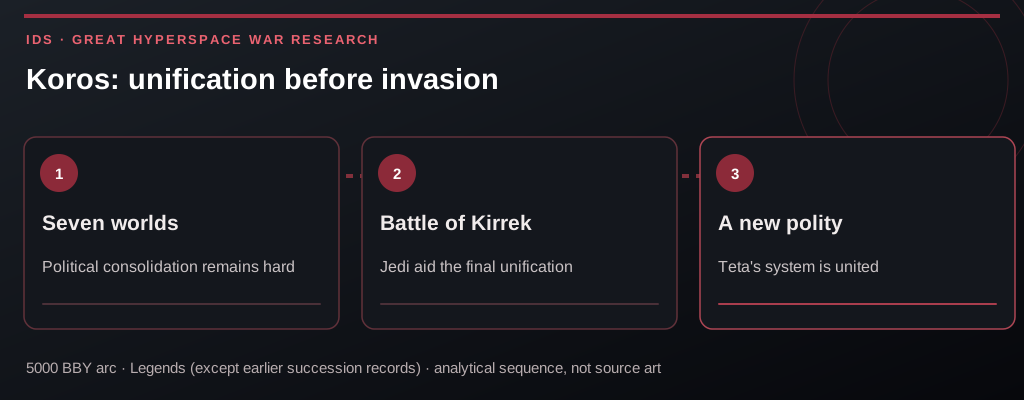
What the original history supports
This unification conflict precedes Naga Sadow's invasion. The Battle of Kirrek during Teta's consolidation must not be merged with the later Sith invasion of Kirrek, even when the same Jedi and local communities appear in the historical accounts.
Interpretation and evidence limit
The diagram describes the political change, not the exact troop movements. The comic prelude is a source for Odan-Urr and the final unification phase, not a comprehensive chronology of all seven worlds.
Sources and further reading
- Tales of the Jedi – The Golden Age of the Sith.
- Empress Teta/Legends, Wookieepedia