
In 5010 BBY, Teta ascended to the throne of Koros Major and began the Unification Wars. The seven worlds of the Koros system were politically fragmented despite their shared economic importance. Teta sought to impose a single trade and defense alliance, using military force against worlds and settlements that rejected her authority.
Carbonite wealth and political disorder
The Koros system contained valuable carbonite resources.
Smuggling, weak governance, and uneven control created the conditions Teta used to justify unification.
Unification through coercion
Teta presented centralized rule as law, prosperity, and security.
Opponents experienced the same policy as military conquest.
Anthropological assessment
The Unification Wars demonstrate how state-building can be represented simultaneously as reform and conquest.
Teta's later heroic reputation should not erase the violence required to create the political unit that eventually carried her name.
Manderon Era · Legends research
Seven worlds, one contested political union
Teta took power on Koros Major around 5010 BBY and pursued the political unification of the seven worlds of the Koros system. The region's carbonite resources and trade connections gave its political structure consequences for merchants, settlers and officials far beyond the throne room. The Unification Wars were presented by Teta and her supporters as the return of stable government to a disorderly system. Several resisting communities instead experienced the program as forceful extension of a single ruler's control. The distinction between law and conquest lies at the center of the event.
Over the following decade, Teta's campaigns brought most of the system under her authority, while Kirrek remained a difficult holdout. Near the war's conclusion in 5000 BBY, Jedi involvement through Memit Nadill and Odan-Urr became important to the final fighting. The original Tales of the Jedi comic and its later Dark Horse collected editions depict a throne room transformed into a command center as the monarch planned operations. That visual detail is historically meaningful: royal ceremony and wartime administration occupied the same space, reflecting the fusion of inherited status and command authority.
Economic integration is also territorial control
Teta proposed a shared system for trade and defense, but commercial consolidation did not guarantee voluntary membership. Carbonite mining, access to routes and state revenue were sources of power worth fighting over. Separating promised benefits from the method of enforcement allows both sides of the conflict to become visible.
The origin of a later system name
The region was known as Koros during the campaigns and came to bear Empress Teta's name later. Using the later designation as though it were timeless would conceal how a ruler's legacy became part of the geography and public identity of her political order.
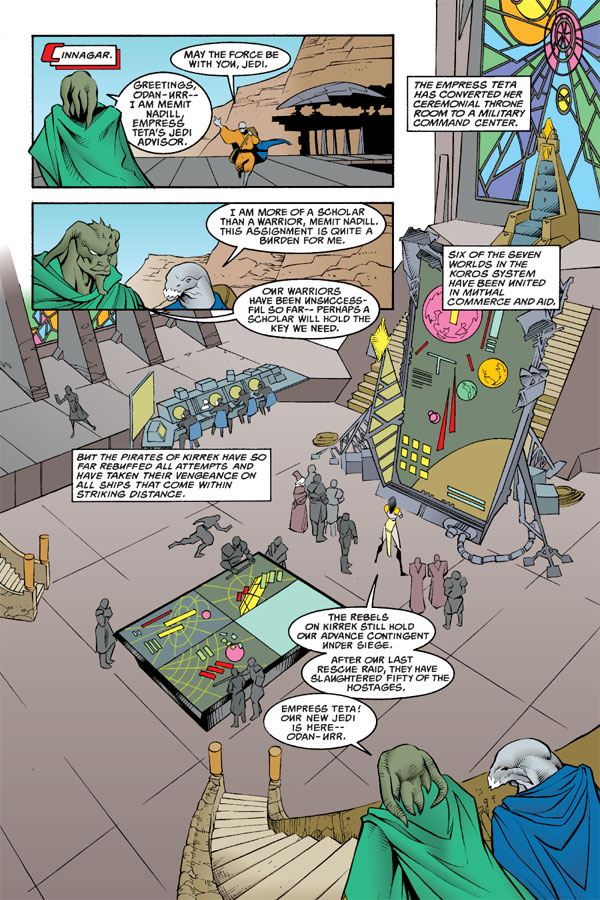
Did the Unification Wars finish in the year Teta took the throne?
No. The chronology places the start around or after 5010 BBY and the final unification in 5000 BBY, after continued resistance including the fighting on Kirrek.
Evidence and continuity: Tales of the Jedi: The Golden Age of the Sith #0; Dark Horse Omnibus: Tales of the Jedi Volume 1; The Essential Atlas. Legends-only retrospective history. Source-established actions are separated from social and political interpretation; dating and the limits of testimony remain explicit.
Sources and further reading
- The Essential Atlas.
- Koros Unification Wars, Wookieepedia