
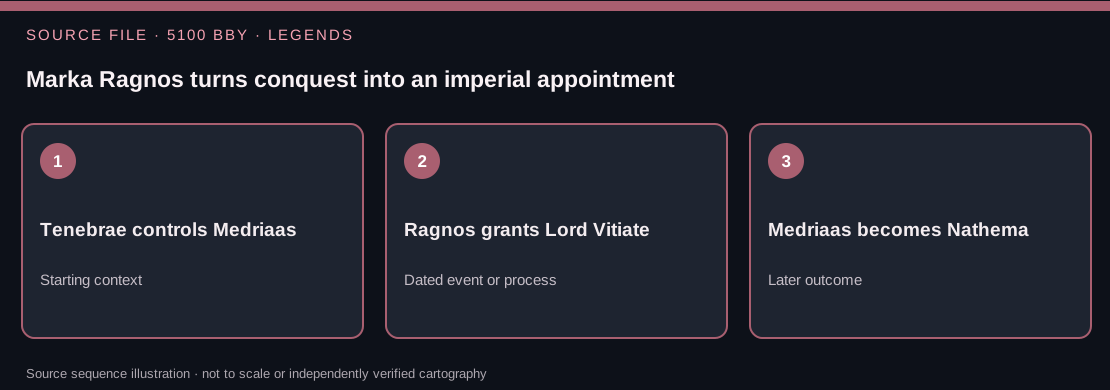
In 5100 BBY, thirteen-year-old Tenebrae presented himself before Marka Ragnos on Ziost. Impressed by the child's conquest of Medriaas and extraordinary power, Ragnos formally granted him rule of the world and the title Lord Vitiate. Vitiate returned home, renamed Medriaas as Nathema, and began a century of isolation and dark-side study.
Conquest receives imperial legitimacy
Tenebrae had already taken practical control before meeting Ragnos.
The Dark Lord's recognition transformed de facto rule into a position acknowledged by the wider Sith Empire.
Renaming the world
Medriaas became Nathema under Vitiate.
Renaming asserted the ruler's power to redefine the political identity of the place itself.
A century outside Sith factional politics
Vitiate largely withdrew Nathema from ordinary Sith infighting.
That isolation later spared the planet from the Great Hyperspace War.
Anthropological assessment
Recognition by Ragnos demonstrates the difference between local coercive power and wider political legitimacy.
Vitiate's renaming of Nathema also shows how rulers use place names to mark a break with earlier authority.
Manderon Era · Legends research
From local coercion to a recognized Sith lordship
By 5100 BBY, Tenebrae had secured control over his native Medriaas and sought recognition from Marka Ragnos. Ragnos, ruler of the Old Sith Empire, was sufficiently impressed by the youth's power to grant him the name Lord Vitiate and acknowledge his control of the planet. The grant did not create Tenebrae's earlier conquest. It formalized that control within a wider political hierarchy whose leading figures could confer titles and acknowledge local Sith Lords. Later accounts locate the meeting on Ziost, then a center of imperial Sith authority.
Vitiate subsequently renamed Medriaas Nathema and spent roughly the next century developing power and remaining aloof from much of the ordinary political rivalry of the Old Sith Empire. The later devastation of Nathema after the Great Hyperspace War must not be projected into this earlier event: at the moment of recognition, the world still had its population and its institutions. The eventual ritual that consumed the planet occurred after the Sith defeat centuries later in story sequence. The distinction matters because a ruler's renaming of a world is not the same action as his later destruction of it.
Imperial recognition and local sovereignty
An official title made Vitiate's rule legible to other Sith elites, but it did not make the planet's residents free participants in that decision. The recognition system of the empire focused on powerful rulers. Those governed by them were largely absent from the process.
Renaming marks an attempted break with the past
Medriaas carried a history that preceded the new lord. Renaming it Nathema asserted that one person's authority could redefine the planet's public identity. Earlier inhabitants and family relationships did not cease to exist merely because the political label changed.
Was Nathema already a dead Force-void world when Ragnos made Tenebrae Lord Vitiate?
No. The consuming ritual occurred after the Great Hyperspace War around 5000 BBY, long after recognition in 5100 BBY.
Evidence and continuity: Drew Karpyshyn, The Old Republic: Revan; SWTOR Emperor historical accounts. Legends-only retrospective history. Source-established actions are separated from social and political interpretation; dating and the limits of testimony remain explicit.
5100 BBY · Formal Sith authority · Legends
Marka Ragnos turns conquest into an imperial appointment
Published evidence
In 5100 BBY, thirteen-year-old Tenebrae traveled to Ziost to request recognition from the reigning Dark Lord, Marka Ragnos. Ragnos did not take Tenebrae as an apprentice, but gave him the rank of Sith Lord, the name Vitiate and authority over Medriaas. Vitiate subsequently renamed his homeworld Nathema and withdrew for lengthy study of the dark side.
Culture and power
Recognition by a superior ruler converted control achieved locally through force into a position acknowledged throughout an imperial hierarchy. Renaming the planet and creating a new palace also allowed Vitiate to redefine the public memory of his place of origin. These are material and symbolic acts of state formation, not evidence that Nathema became uninhabited immediately.
Dating and continuity limits
The ritual that later stripped Nathema of life followed the Great Hyperspace War of 5000 BBY, roughly a century after this appointment. The title Lord Vitiate should not automatically be rewritten as Darth Vitiate in accounts of his early reign, since the later Darth styling is retrospective.
Historical judgment: Did Vitiate consume all life on Nathema during Ragnos's 5100 BBY ceremony?
Correction and explanation: No. Nathema's devastating ritual occurred after the Great Hyperspace War, around a century later.
Reference: Drew Karpyshyn, The Old Republic: Revan, Nyriss's recollection; Star Wars: The Old Republic histories. Review reference history →. Specific printed page numbers and historical claims need independent source verification.
Sources and further reading
- The Old Republic: Revan.
- Nathema, Wookieepedia