
In 5103 BBY, Tenebrae confronted and apparently killed his father, Lord Dramath. Later Legends storytelling establishes that Dramath's spirit survived imprisoned within a holocron under Tenebrae's control. He then spent the next three years eliminating rivals across Medriaas. His half-brother Dramath the Second eventually fled rather than face him, leaving Tenebrae in effective control of the planet.
Patricide becomes a political transfer
Tenebrae did not inherit Dramath's position through recognized succession.
He defeated and dispossessed the ruling lord, then forced local society to accept his authority. The later revelation of spiritual imprisonment complicates the early report of an ordinary death.
Three years of consolidation
Rivals continued resisting after Dramath's death.
Tenebrae systematically removed them until no significant challenger remained.
Anthropological assessment
The conquest of Medriaas turns family conflict into state formation.
It shows how personal violence can become political legitimacy when institutions lack mechanisms capable of restraining an exceptionally powerful claimant.
Manderon Era · Legends research
Patricide does not finish a planetary conquest
In 5103 BBY, Tenebrae confronted his father Dramath and killed him, removing the established Sith Lord who had claimed the right to rule Medriaas. The event was a striking reversal of the expected parent-child hierarchy, but not the immediate disappearance of every opponent. Tenebrae still needed to overcome other claimants, followers and forces that could resist his control. Legends accounts describe the following three years as a period of violent consolidation, ending before his formal recognition by Marka Ragnos.
His half-brother Dramath the Second became an important survivor of the family conflict. The later Revan story and related SWTOR material connect him to the tomb on Rekkiad where Revan and Malak later found a clue pointing toward Nathema. This makes the 5103 BBY episode relevant to more than a local succession: its effects left a material trail that resurfaced during the investigation of the hidden Empire in 3960 BBY. The entry should clearly distinguish the father's killing, the second Dramath's later flight and the official grant of the world to Lord Vitiate in 5100 BBY.
Dynastic violence and institutional control
Removing a ruler does not automatically eliminate his supporters or create a recognized succession. Tenebrae depended on sustained repression to turn the death of Dramath into effective control over the planet. The time required shows why personal violence is not identical with durable government.
Material traces connect distant periods
Rekkiad's tomb later carried information that helped other generations reconstruct the Emperor's early history. A private family rivalry on Medriaas thus entered the military history of the Republic many centuries later through objects, records and decisions to conceal knowledge.
Was Dramath's death the same event as Ragnos bestowing the Vitiate title?
No. Dramath died in 5103 BBY, with further consolidation before Ragnos recognized Tenebrae as Lord Vitiate around 5100 BBY.
Evidence and continuity: Drew Karpyshyn, The Old Republic: Revan; SWTOR Knights of the Eternal Throne Dramath background. Legends-only retrospective history. Source-established actions are separated from social and political interpretation; dating and the limits of testimony remain explicit.
5103 BBY · Dynasty, violence and a later retcon · Legends
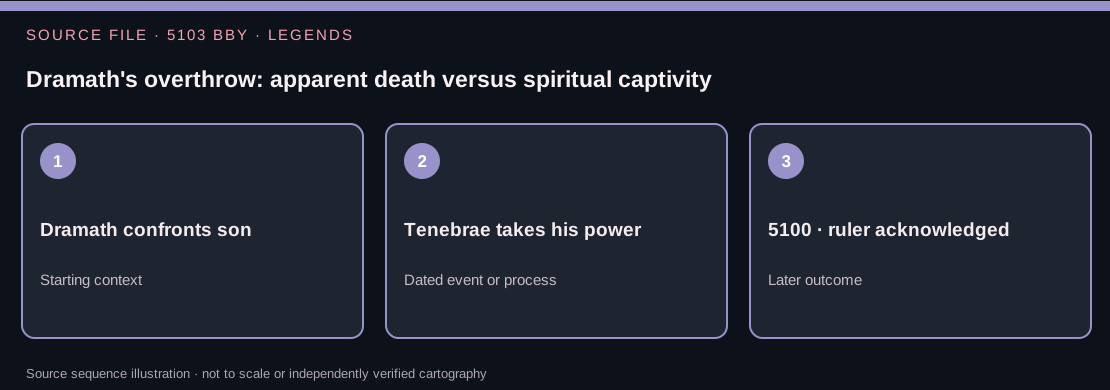
Dramath's overthrow: apparent death versus spiritual captivity
Published evidence
Tenebrae confronted Lord Dramath when the boy was about ten, conventionally 5103 BBY. Early retrospective accounts described Dramath's defeat as death, followed by several years in which Tenebrae eliminated rivals and secured his hold over Medriaas. Later Knights of the Eternal Throne material reveals that Tenebrae confined Dramath's spirit inside a powerful holocron and subjected him to a prolonged imprisonment.
Culture and power
Dynastic rule was not simply passed to a recognized heir. The challenger first used supernatural coercion against his own father, then imposed himself over rival local elites. The later story about spiritual captivity changes how the apparent execution is understood, but does not alter the fact that Dramath lost the capacity to govern.
Dating and continuity limits
This article retains its traditional event title for archive continuity. The phrase 'killed Dramath' reflects earlier reports and apparent physical death; the later revelation qualifies any statement that his spirit ceased to exist. The 5103 BBY date is derived from Tenebrae's reported age of ten.
Historical judgment: Did all later Legends sources treat Dramath's death as the complete destruction of his spirit?
Correction and explanation: No. SWTOR later reveals that his spirit was imprisoned inside a holocron rather than annihilated.
Reference: The Old Republic: Revan (2011); SWTOR Knights of the Eternal Throne (2016), Nathema material. Review reference history →. Specific printed page numbers and historical claims need independent source verification.
Sources and further reading
- The Old Republic: Revan.
- 5103 BBY, Wookieepedia