
In 5113 BBY, Tenebrae was born on Medriaas, a Sith agricultural world later renamed Nathema. He was the illegitimate son of Sith Lord Dramath and a local farm woman. The child displayed extraordinary Force power early in life and eventually became one of the longest-lived and most destructive rulers in Legends history.
An illegitimate child of a Sith ruler
Dramath ruled Medriaas but did not raise Tenebrae as his heir.
The child's marginal family position shaped the violent path by which he later claimed power.
A life that will span more than a millennium
Tenebrae later became Lord Vitiate, Sith Emperor, and Valkorion.
His career would outlast the political order into which he was born.
Anthropological assessment
Tenebrae's origin shows how dynastic exclusion can produce political violence when a powerful child has no recognized place inside the existing succession system.
His later identity changes also demonstrate how rulers can reconstruct political legitimacy under new names and institutions.
Manderon Era · Legends research
A child outside a ruler's recognized household
Tenebrae was born on Medriaas in 5113 BBY, within the Old Sith Empire ruled at the time by Marka Ragnos. Drew Karpyshyn's novel The Old Republic: Revan describes him retrospectively through accounts of the Sith Emperor's past. His father was Dramath, a local Sith Lord, while his mother occupied a far less privileged position. The child did not enter public history as a formally designated heir to his father's rule. That difference between biological descent and acknowledged succession shaped the setting in which later violence occurred.
The narrative attributes extraordinary Force potential and an unusual lack of ordinary emotional responses to Tenebrae very early in his life. These traits are elements of a retrospective Legends biography, not the findings of a contemporaneous medical or scientific record. They help establish how later Sith observers explained the emergence of a ruler whose identity changed repeatedly: the child Tenebrae became Lord Vitiate and then the Emperor of a rebuilt Sith Empire, later taking on another imperial identity as Valkorion. Each name belongs to a different political relationship rather than indicating that all those states existed when he was born.
Birth and social hierarchy
Dramath's formal status and the child's position outside recognized succession were separate facts. An illegitimate birth did not make Tenebrae politically powerless forever, but it excluded him from the usual avenue of inherited legitimacy and complicated how others initially understood his claims.
The danger of reading destiny backward
A biography written after centuries of atrocities can turn an infant into the inevitable future Emperor. The historical entry should resist that interpretation. Later actions require later opportunities, institutions and choices, not just unusual qualities attributed to a newborn.
Was Tenebrae already known as the Sith Emperor at birth?
No. Tenebrae was his childhood name. He received the title Lord Vitiate in 5100 BBY and developed the later imperial identities afterward.
Evidence and continuity: Drew Karpyshyn, The Old Republic: Revan (2011); SWTOR Legends historical chronology. Legends-only retrospective history. Source-established actions are separated from social and political interpretation; dating and the limits of testimony remain explicit.
5113 BBY · Kinship and legitimacy · Legends
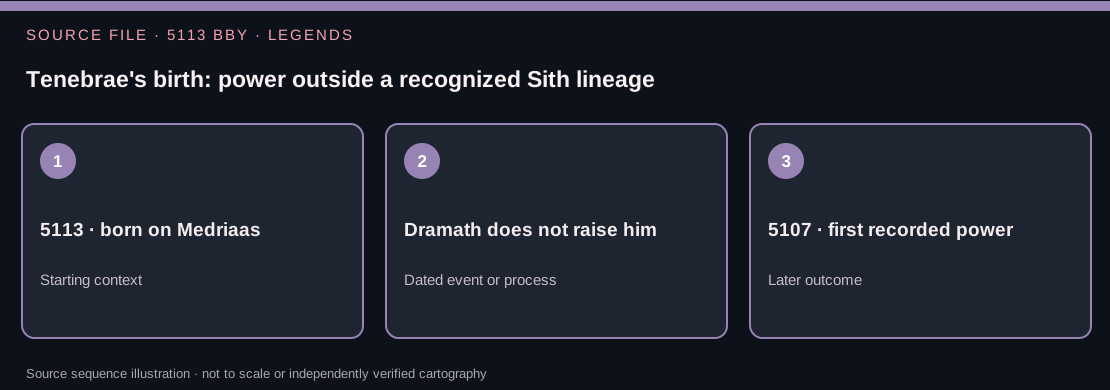
Tenebrae's birth: power outside a recognized Sith lineage
Published evidence
Tenebrae was born to a poor farmer and Sith Lord Dramath on the agricultural Sith world Medriaas in 5113 BBY. His mother raised him outside his biological father's ruling household. The later novel introduces this childhood through Darth Nyriss's retrospective account to Lord Scourge, a story told in the context of Sith political secrets rather than an independently surviving village birth register.
Culture and power
The contrast between a Sith aristocrat's recognized household and an unacknowledged son matters because hereditary authority and personal Force ability did not automatically coincide. Tenebrae would later use violence to escape the position assigned by his father's refusal to recognize him. These future acts must not be projected backward as evidence that his infancy already established a political constituency.
Dating and continuity limits
His later identities—Lord Vitiate, Sith Emperor and Valkorion—belong to subsequent historical eras. Sources do not supply an official birth certificate or establish the exact day within 5113 BBY. Sith narratives about his unusual infancy are retrospective character testimony.
Historical judgment: Was Tenebrae already called Lord Vitiate at birth?
Correction and explanation: No. Marka Ragnos bestowed the title Lord Vitiate in 5100 BBY, when Tenebrae was thirteen.
Reference: Drew Karpyshyn, The Old Republic: Revan (2011), Nyriss account of Tenebrae's childhood. Review reference history →. Specific printed page numbers and historical claims need independent source verification.
Sources and further reading
- Drew Karpyshyn, The Old Republic: Revan.
- 5113 BBY, Wookieepedia